Can Global Trade Still Guarantee Food Security?
India's fourteen-month rice export ban showed how quickly global trade can stop functioning as a food security guarantee
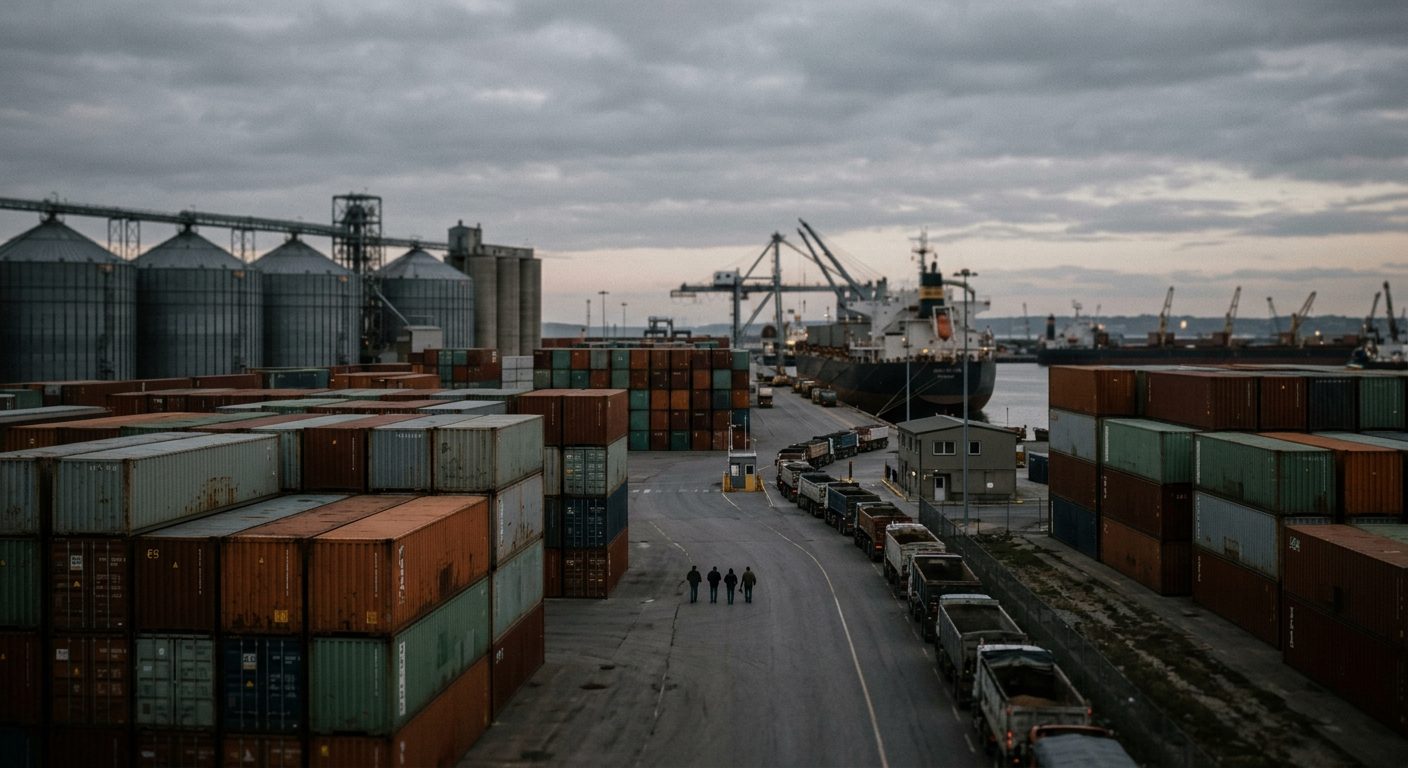
In September 2024, India quietly lifted a ban that had shaped world food prices for fourteen months. The restriction, imposed in July 2023 on non-basmati white rice, had taken roughly two-fifths of global rice trade partly off the market from the country that supplies it, according to the U.S. Department of Agriculture's Foreign Agricultural Service, which tracked export prices climbing to their highest level in more than a decade. Importers from Nigeria to the Philippines scrambled for alternatives that mostly did not exist, because rice, unlike wheat or corn, is thinly traded relative to how much of it the world eats.
That episode, still working through global markets months after India relaxed the policy, is one data point in a pattern that trade economists and food-security researchers have been documenting since Russia's invasion of Ukraine in February 2022. The assumption baked into the postwar trading system, that an open global market would always let a country in shortfall buy its way out because someone else's surplus was for sale, is being tested harder than at any point since the 2007-08 and 2010-11 food price crises. The test is not merely about prices. It is about whether the institutional architecture built to keep trade open during exactly these moments still functions, and increasingly, it does not.
The Loophole Built Into Free Trade's Promise
The World Trade Organization's rulebook was never built to discipline export restrictions the way it disciplines tariffs on imports. Article XI of the GATT bans quantitative restrictions in general but carves out an explicit exception for measures "temporarily applied to prevent or relieve critical shortages of foodstuffs." That clause, drafted in the 1940s with domestic shortages in mind, has become the legal doorway through which most modern food export bans pass without consequence. Unlike bound tariffs, which members negotiate down and cannot easily raise again, export restrictions carry no comparable commitment. A government can impose one overnight and offer no notice, no timeline, and no compensation to trading partners who lose supply. Chad Bown, writing for the IMF's Finance & Development magazine, has described this asymmetry as one of the clearest gaps in the trading system: the rules that protect access to foreign markets have no real counterpart protecting access to foreign supply. WTO members have discussed tightening notification and transparency requirements around export restrictions for more than a decade, including at the 2022 and 2024 ministerial conferences, but the closest they came to binding action was a 2022 declaration exempting World Food Programme humanitarian purchases from export bans, a narrow carve-out that does nothing for commercial importers.
What India's Rice Ban Actually Revealed
India's restriction mattered because of who India is in this market. As the source of roughly 40 percent of global rice trade, its decisions do not ripple through the market so much as define it. When Delhi banned non-basmati white rice exports to protect domestic consumers ahead of state elections and amid uneven monsoon rains, countries with little capacity to grow substitute staples absorbed the shock directly. The International Food Policy Research Institute, which has tracked the restriction's effects since 2023, noted that the ban functioned as a transfer of scarcity: India insulated its own consumers from price spikes by exporting the shortage to everyone else. When the government finally withdrew the ban in September 2024, it replaced outright prohibition with a minimum export price, a softer instrument but still a discretionary lever Delhi can pull again whenever domestic politics demand it. That durability is the real lesson. Export restrictions are not necessarily emergency measures with a natural expiry. They are policy tools a government keeps in reserve indefinitely.
The Black Sea Deal's Collapse Exposed a Deeper Fragility
If India showed how one country's domestic politics can distort global supply, the Black Sea Grain Initiative showed how fragile any negotiated fix to that problem really is. Brokered by the United Nations and Turkey in July 2022, the deal allowed Ukrainian grain shipments to resume from three Black Sea ports despite the ongoing war, moving tens of millions of tonnes of wheat, corn, and sunflower products to markets that badly needed them. IFPRI's analysis of the initiative credited it with helping stabilize world grain prices that had spiked to record highs in the war's opening months. Russia terminated its participation in July 2023, citing unmet demands over its own agricultural export and financial access, and the arrangement collapsed. Ukraine subsequently built its own unilateral shipping corridor along its coastline, protected by its navy rather than by any multilateral agreement, and volumes partially recovered. But the episode demonstrated something the trade-based model does not like to admit: a functioning food corridor for two of the world's largest grain exporters depended, in the end, not on WTO rules or market mechanisms but on the goodwill of a wartime combatant, revocable at will.
Food Nationalism Has Become the Default Response
These are not isolated incidents. Trackers maintained by IFPRI and the OECD's Inventory of Export Restrictions on Staple Crops show that the number of active food and fertilizer export restrictions worldwide has stayed elevated since the surge that followed Russia's invasion, rather than receding as the initial shock faded. Reporting on the OECD's data has noted that roughly one in six food items traded globally remains subject to some form of export restriction. The WTO's own December 2024 review of global trade developments found trade restrictions climbing against a backdrop of what it termed unilateral policies, a diplomatic phrase for governments increasingly choosing to act alone rather than coordinate. Russia has kept a floating export duty on wheat in place since 2021, adjusting it every few weeks depending on domestic price signals and, at times, setting price floors to steer exporters toward selling at rates Moscow prefers. None of this fits the crisis-response model the GATT exception was written for. It is closer to routine industrial policy, deployed by major exporters as a permanent instrument for managing domestic inflation and rewarding domestic consumers at trading partners' expense.
When Breadbaskets Fail Together, Not One at a Time
The trade-based model always assumed shocks would be geographically scattered: a drought in one region offset by a good harvest somewhere else. Climate research increasingly says that assumption is aging poorly. Studies on what scientists call multiple breadbasket failure, including work published in Nature Climate Change and more recent analysis highlighted by The Conversation, find that warming is raising the odds that major grain-producing regions face poor harvests simultaneously rather than independently, because the same jet-stream patterns and heat domes that stress crops in one breadbasket increasingly stress others at the same time. If Midwestern corn, Black Sea wheat, and South Asian rice all take a hit in the same season, the entire premise of relying on someone else's surplus starts to fail structurally, not just politically. A trading system designed around offsetting regional variation has no good answer for correlated global shortfall.
Strategic Reserves and Regional Blocs Are Making a Comeback
Faced with that combination, a growing number of governments and institutions are hedging against trade rather than relying on it outright. The World Bank has published renewed analysis on strategic grain reserves as a food-security tool, arguing that physical stockpiles, if managed transparently and released countercyclically rather than hoarded, can dampen price spikes without the beggar-thy-neighbor effects of export bans. Regional blocs are moving in a similar direction. ASEAN's long-standing Food Security Reserve agreement has drawn fresh attention as Southeast Asian governments discuss deepening intra-bloc trade specifically so members are not solely dependent on world markets during shocks, a shift documented in 2025 analysis from the ISEAS-Yusof Ishak Institute and the East Asia Forum. The logic is straightforward: if the multilateral system cannot discipline exporters, importers will build their own buffers, whether through reserves, regional trade preferences, or bilateral supply agreements that function like insurance policies against exactly the kind of unilateral restriction India and Russia have both demonstrated.
So Does the Trade Model Still Hold?
The honest answer is that it holds in aggregate and fails at the margin, and the margin is where people go hungry. Global food production remains, on paper, more than sufficient to feed everyone, and most trade continues to flow normally most of the time. But the postwar bet was never just that enough food would exist somewhere. It was that markets would reliably move it to wherever the shortage was, and that bet is now conditional on the political choices of a small number of dominant exporters who have shown, repeatedly since 2022, that they will restrict supply whenever domestic politics reward it. The WTO has neither the legal tools nor the member consensus to change that calculus. What is emerging instead is a hybrid system, still built on trade but layered with reserves, regional pacts, and bilateral hedges that assume the worst about global markets rather than the best. That is not a repudiation of open trade. It is an acknowledgment that open trade alone was never going to be enough, and the countries still betting everything on it are the ones most exposed when the next major exporter decides its own consumers come first.
Sources: USDA Foreign Agricultural Service, "Rice Export Prices Highest in More Than a Decade as India Restricts Trade"; USDA Economic Research Service, "India's recent export restrictions expected to reduce global rice trade in 2023 and 2024"; IFPRI, "India's export restrictions on rice continue to disrupt global markets, supplies, and prices"; IFPRI, "India lifts export restrictions on rice"; IFPRI, "Russia terminates the Black Sea Grain Initiative: What's next for Ukraine and the world?"; WTO, "WTO report shows increase in trade restrictions against backdrop of unilateral policies" (December 2024); OECD, "Key trends in the use of export restrictions up to 2025: OECD Inventory of Export Restrictions on Staple Crops"; FoodIngredientsFirst, "Food nationalism continues to dent global trade as 1 in 6 food items remain restricted"; IMF Finance & Development, Chad Bown, "The Challenge of Export Controls"; World Bank, "Leveraging strategic grain reserves to enhance food security"; ISEAS-Yusof Ishak Institute, "Outlook for Agriculture and ASEAN's Role in Southeast Asia's Food Security"; Nature Climate Change, "Changing risks of simultaneous global breadbasket failure"
The Food Observatory Brief
Weekly briefing on food systems, climate, agriculture and policy — straight to your inbox.
More on Markets
Olive Oil, Orange Juice and the New Climate Price Shock
Crops concentrated in one or two climate-exposed regions now follow a boom and bust pattern, with heat, drought and disease compounding the swings. This piece looks at olive oil, orange juice and vanilla, explains why prices fall back but not to old levels, and asks who carries the risk when hedging is thin.
Fertilizer Prices Are the Hidden Driver of Food Inflation
Fertilizer is made from natural gas and from potash and phosphate controlled by a handful of exporters, so its price follows energy and trade policy more than crop demand. This piece argues that fertilizer affordability, not only grain prices, sets farmers' planting decisions and next season's food prices, and looks at what India, Africa and efficiency measures change.

GLP-1 Drugs Are Starting to Change What the Food Industry Sells
Semaglutide and tirzepatide are changing grocery baskets, restaurant portions and product launches in the United States. This piece argues that the food industry is facing its first pharmacological shift in appetite, traces the consequences for protein, fibre, portion size and the commodities behind them, and sets out why it will not become a universal change.