Coffee Has Become a Climate Story
Record arabica prices are not a two-year story, they are the sound of coffee's growing regions running out of road
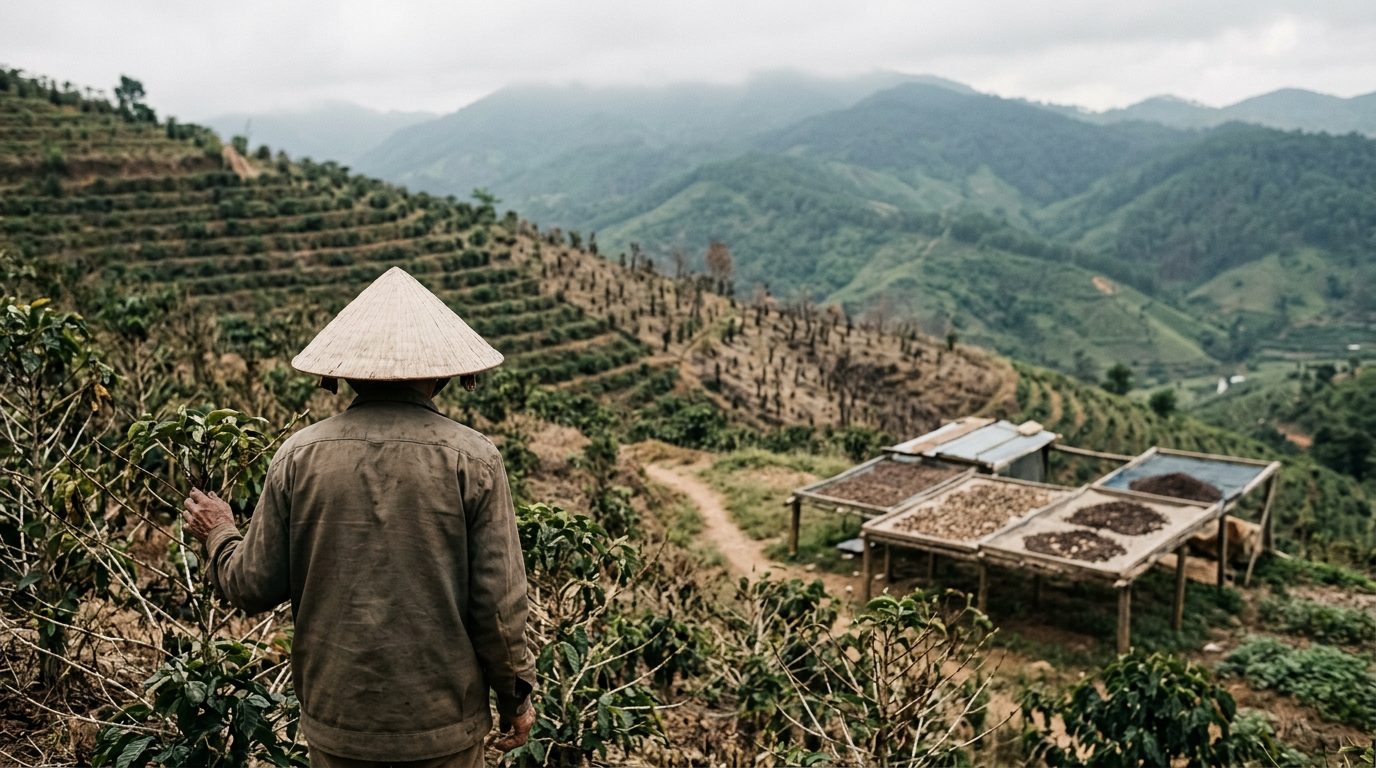
Arabica futures traded above $4.30 a pound in February 2025, a level never recorded in the contract's history and more than double what roasters paid two years earlier. The proximate cause was straightforward: back-to-back harvest disappointments in Brazil and Vietnam, the two countries that together grow roughly half the world's coffee. But the deeper cause is not a two-year story. It is a slow reorganization of where coffee can physically grow, and it is happening faster than the plant, or the millions of farmers who depend on it, can adapt.
No other major agricultural commodity maps as cleanly onto the climate crisis as coffee does. Cocoa has had its own catastrophic seasons in West Africa, but coffee's vulnerability is structural rather than episodic: arabica, which accounts for roughly 60 percent of world production, evolved in the cool highland forests of southwestern Ethiopia and tolerates only a narrow temperature band, roughly 18 to 22 degrees Celsius, before yields and cup quality degrade. That narrowness is precisely why coffee has become the case study climate scientists reach for and the crop that makes the abstraction of "agricultural climate risk" legible in a cup people drink every morning.
Brazil's bad years are no longer just bad luck
Brazil produces about 40 percent of the world's coffee, and its 2025/26 crop, forecast by the government agency Conab at 51.81 million 60-kilogram bags, represents a 4.4 percent decline from the prior year and the lowest output since 2022/23. The arabica component fell even harder, down 12.4 percent to 34.7 million bags, driven by drought and abnormally high temperatures that cut national productivity to 28 bags per hectare. Conab's analysis pointed to a specific mechanism: heavy defoliation during the dry spell reduced the trees' capacity for photosynthesis, so that even when rain returned in September and October 2024, the plants lacked the energy reserves to properly support flowering and cherry development the following season. Minas Gerais, the country's largest arabica-growing state, saw production drop 11.6 percent.
This followed an even more brutal stretch in 2024, when the trading house Volcafe slashed its Brazil arabica outlook after what it called one of the most severe droughts in the country's coffee-growing history, compounded by an unusually hot spell during flowering that caused cherries to abort before they could develop. Brazilian agronomists increasingly describe a pattern rather than a single bad year: irregular rainfall onset, longer dry spells between wet-season showers, and heat spikes timed to coincide with flowering, the single most weather-sensitive stage of the coffee plant's annual cycle. A tree that flowers into a heat wave simply does not set the cherries it would have in a normal year, and there is no irrigation fix for that at the scale of Brazil's coffee belt.
Vietnam's robusta cushion is fraying too
For years, the industry treated robusta, the hardier, more heat-tolerant species grown mostly in Vietnam and used in instant coffee and blends, as the load-bearing wall that would absorb arabica's climate losses. That assumption is now being tested. Vietnam's 2023/24 crop fell roughly 20 percent amid prolonged dry weather linked to an intense El Niño cycle, and Bloomberg reported that the 2024/25 harvest came in at 26.5 million bags, below even the reduced estimate the Vietnam Coffee and Cocoa Association had given in December, according to the group's chairman, Nguyen Nam Hai. Robusta futures in London have hit repeated record highs as buyers who once treated the bean as a cheap filler now compete for scarce supply.
Robusta tolerates heat better than arabica, but it is not drought-proof, and Vietnam's Central Highlands depend on predictable monsoon timing and groundwater for irrigation during the dry months. Farmers there report wells running dry earlier each year and rainy seasons that arrive late and end abruptly, a pattern consistent with the broader disruption of monsoon regularity that climate scientists have documented across mainland Southeast Asia. The bean bred to survive climate stress is running into the same water constraints as the one it was supposed to replace.
The map of where coffee can grow is shrinking
The single most consequential body of research on coffee and climate concerns not this year's harvest but the next several decades of land suitability. A foundational 2015 study by Peter Läderach and colleagues, published in Climatic Change, modeled where arabica and robusta could still be grown viably as the planet warms and found that large swaths of current growing regions in Central America, Colombia, and East Africa would become climatically marginal by mid-century. Subsequent research has refined rather than overturned that finding: a Rabobank analysis published in 2026 by researchers Camila Bonilla-Cedrez, Lilian Lin, and Guilherme Morya projects that the share of global arabica-growing land considered climatically unsuitable will rise from about 8 percent today to roughly 20 percent by 2050. The country breakdowns are stark. Brazil's suitable arabica area is projected to fall from 81 to 62 percent of current growing zones. Honduras, where coffee is the largest agricultural export and supports hundreds of thousands of smallholder households, could see suitable land collapse from 53 percent to just 12 percent.
The FAO has separately modeled that a broader basket of staple and cash crops, including coffee, wheat, beans, and cassava, could lose roughly half of their best-suited growing land by 2100 under continued warming, a sign that coffee's exposure sits within a wider pattern of climate-driven agricultural relocation rather than as an isolated anomaly. Ethiopia stands out as a rare partial exception: because much of its arabica grows at high elevation, warming could expand the zone of highly suitable land there, from 4 to 13 percent of the country, even as it degrades conditions almost everywhere else coffee is grown. That is small comfort for an industry whose supply chains and quality reputations are built around specific origins that took generations to establish.
Breeding a plant that has almost no genetic room to maneuver
Arabica's biological weakness is partly a historical accident: the species is believed to have originated from a natural hybridization event between two wild coffee relatives many thousands of years ago, leaving it with unusually low genetic diversity compared to most cultivated crops. That narrow gene pool limits how much conventional breeding can do to build in heat and drought tolerance, which is why the industry's most ambitious response, the Innovea Global Breeding Network coordinated by World Coffee Research, pools breeding populations and field trials across eleven countries, including Costa Rica, Kenya, Rwanda, Uganda, Mexico, and Vietnam, nations that together account for more than 40 percent of world coffee supply. Innovea uses genomic selection to identify climate-resilient genetics faster than any single country's breeding program could manage alone, delivering new populations to participating nations roughly every six years for local selection and release. The initiative was named a Time Best Invention of 2025, a sign of how seriously the industry now treats plant breeding as existential infrastructure.
World Coffee Research has been blunt about the stakes in its public materials, warning that without faster variety innovation, millions of farmers could lose their livelihoods within a generation while the industry and consumers face reduced supply and higher, more volatile prices. Some breeding programs are also looking beyond arabica and robusta entirely, toward wild species such as Coffea stenophylla and Coffea liberica, which show more inherent heat tolerance and, in early cupping trials, a quality profile closer to arabica than robusta offers. None of this moves at the speed of a market already repricing coffee in real time; a new tree variety takes three to four years to bear commercial fruit even after it clears a breeding program, an eternity against a currency of annual harvests already going wrong two years out of three.
The people absorbing the losses first
The clearest human cost of this shift has already played out once, in the Central American leaf rust epidemic of the early 2010s, which offers a preview of what accelerating climate stress does to smallholder livelihoods. Warming allowed the fungus Hemileia vastatrix, known as la roya, to spread into higher elevations that had previously been too cool for it to survive, following a roughly 1-degree-Celsius regional temperature rise and a 15 percent decline in rainfall since 1980 across Mexico, Guatemala, and Honduras. The outbreak hit an estimated 70 percent of the region's arabica farms, caused about $3.2 billion in damages, and cost 1.7 million people their jobs, according to research tracking the epidemic's economic fallout. Guatemala lost roughly half its coffee crop in 2012, with some individual producers losing 85 percent of their harvest. Research published in World Development has since linked the outbreak directly to increased outmigration from smallholder coffee households, as families with no cushion against a lost harvest and no capital to replant with rust-resistant varieties left farming for cities or for the United States.
That same fragility is now visible in East Africa, where research from Ethiopia's Kafa Biosphere Reserve and from coffee-growing districts across Uganda documents smallholders coping with erratic rainfall onset, shorter growing windows, and rising pest pressure, often with only informal adaptation strategies such as shade-tree planting or shifting planting calendars by trial and error. Roughly 8.5 million people across Central America and Mexico alone depend on the coffee supply chain for their livelihoods, and the overwhelming majority of the world's approximately 12.5 million coffee farms are smallholdings of a few hectares or less, meaning the people with the least capital to invest in irrigation, shade cover, or replanting are the ones most exposed to a crop that is becoming steadily harder to grow reliably. Coffee's price spikes make headlines in wealthy consuming countries; the deeper story is that the volatility is a symptom of a production base being physically narrowed, season by season, in the places least equipped to absorb the loss.
Sources: Bloomberg, "Vietnam's Coffee Output Dips on Drought, Adding to Global Crunch"; Comunicaffe, "Conab pegs Brazil's 2025/26 coffee output at 51.81 million bags, the lowest level since 2022/23"; Daily Coffee News, "Major Ag Lender Warns of Arabica Land Losses from Climate Change" (Rabobank report); FAO, "Adverse climatic conditions drive coffee prices to highest level in years"; FAO, "New data shows that crops like wheat, coffee, beans and cassava could lose half of the best land for growing them by 2100"; Panoramas (University of Pittsburgh), "Coffee rust disease posed to destroy Latin American market"; Perfect Daily Grind, "Arabica futures are over US $4.30/lb: It's a new era for coffee"; PLOS ONE, Läderach et al., "Projected Shifts in Coffea arabica Suitability among Major Global Producing Regions Due to Climate Change"; World Coffee Research, "Innovea Global Breeding Network"; ScienceDirect/World Development, "The impact of coffee leaf rust on migration by smallholder coffee farmers in Guatemala"
The Food Observatory Brief
Weekly briefing on food systems, climate, agriculture and policy — straight to your inbox.
More on Markets
Olive Oil, Orange Juice and the New Climate Price Shock
Crops concentrated in one or two climate-exposed regions now follow a boom and bust pattern, with heat, drought and disease compounding the swings. This piece looks at olive oil, orange juice and vanilla, explains why prices fall back but not to old levels, and asks who carries the risk when hedging is thin.
Fertilizer Prices Are the Hidden Driver of Food Inflation
Fertilizer is made from natural gas and from potash and phosphate controlled by a handful of exporters, so its price follows energy and trade policy more than crop demand. This piece argues that fertilizer affordability, not only grain prices, sets farmers' planting decisions and next season's food prices, and looks at what India, Africa and efficiency measures change.

GLP-1 Drugs Are Starting to Change What the Food Industry Sells
Semaglutide and tirzepatide are changing grocery baskets, restaurant portions and product launches in the United States. This piece argues that the food industry is facing its first pharmacological shift in appetite, traces the consequences for protein, fibre, portion size and the commodities behind them, and sets out why it will not become a universal change.