Rice Paddies and the Other Greenhouse Gas Problem
Farmers in Punjab and Haryana have received their first carbon payments for drying out rice fields, seven years after enrolment
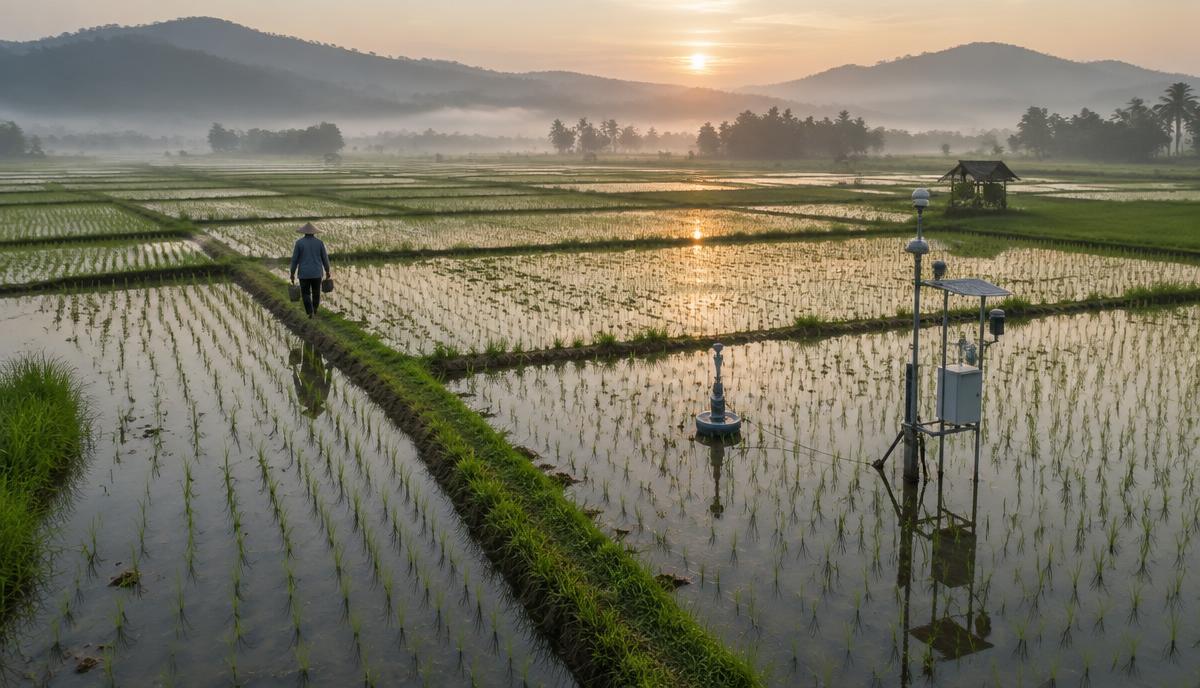
On 17 September, at Punjab Agricultural University in Ludhiana, more than 2,500 farmers from Punjab and Haryana began receiving digital payments for carbon credits earned by sowing rice directly into unpuddled fields instead of transplanting seedlings into standing water. Individual payouts ran from roughly 3,000 to 15,000 rupees. The sums are small, but the event matters for what it exposes: the practice that earned the money, drying out a rice field for part of the season, is one of the cheapest ways to cut methane available anywhere, and it took seven years from enrolment to a first payment. That gap between a known fix and a working payment system explains most of the rice methane problem.
A flooded field is a methane factory
Rice is the one major staple grown standing in water, and the water is the issue. A flooded paddy shuts oxygen out of the soil, and microbes that decompose crop residue and root exudates switch to methane-producing pathways. The gas escapes through the plant's own stem tissue. Drain the field and the microbes stop. The scale is large but often overstated. The UN Environment Programme's Global Methane Assessment puts agriculture at 40 percent of human-caused methane, with livestock accounting for roughly 32 percent and rice cultivation for about 8 percent. Some inventories put rice nearer 10 percent or a little above, because estimates range widely and rely heavily on default emission factors. What gives it importance is concentration. A 2026 review in Communications Earth and Environment found that the ten largest rice producers account for 83 percent of paddy methane, with China, India and Indonesia at the top. A handful of governments and a few hundred million farmers hold most of the lever.
Three levers, and what the evidence says
Alternate wetting and drying, known as AWD, is the best documented. The International Rice Research Institute, which developed the method with national partners across Asia, tells farmers to let the water table fall to about 15 centimetres below the soil surface, checked with a perforated tube pushed into the field, before irrigating again. IRRI reports water savings of around 30 percent and methane cuts of 30 to 70 percent without a yield penalty. A 2024 meta-analysis of 72 studies in Field Crops Research reached a more conservative figure: methane down 43 percent, yield up 1.5 percent, and a net fall of nearly 37 percent in global warming potential once nitrous oxide is counted.
Direct seeded rice, or DSR, goes further by removing the nursery and the transplanting flood altogether. A meta-analysis of 54 studies covering 876 paired measurements found methane down 70 percent compared with puddled transplanting, and down more than 80 percent where fields stayed aerobic. It also found a yield loss of 11 percent on average, which is the number that farmers care about most.
The third lever is the plant. A team led by Anna Schnürer at the Swedish University of Agricultural Sciences reported in Molecular Plant in February 2025 a conventionally bred line, low in fumarate and high in ethanol in its root exudates, that emitted 70 percent less methane than its elite parent while yielding 8.96 tonnes per hectare. Earlier work inserting a barley gene into rice, published in Nature in 2015, showed the same principle through transgenic means. A variety only counts once seed systems carry it into millions of fields.
The trade that nobody should hide
Cutting methane by drying soil raises nitrous oxide. Nitrogen fertiliser applied to a field that alternates between wet and dry conditions feeds the microbes that make N2O, a gas several hundred times more potent than carbon dioxide per tonne over a century. The AWD meta-analysis found nitrous oxide up 43 percent, and the DSR analysis found it up about 85 percent. In both cases methane savings outweighed the increase in warming terms, which is why net global warming potential still fell by roughly a third. But the margin depends on how much nitrogen is applied and when. The DSR analysis found the best results at lower pH, with zero tillage and conventional flooding after establishment, which shows how site-specific the balance is.
This matters for policy design. A programme that pays for drier fields without touching fertiliser timing leaves part of the gain on the table and, in a poorly managed system, may erode it. A headline figure of 70 percent describes methane alone, in trials, under good management.
Why farmers do not simply switch
Adoption stalls because the person who bears the risk is not the person who gets the benefit. AWD is cheap and can reduce pumping costs, which is why IRRI credits its spread in Bangladesh, the Philippines and Vietnam to the savings farmers saw in watering, fertiliser and pesticide. But where electricity for irrigation is free or heavily subsidised, as it is across much of north-west India, a farmer who saves water saves nothing on the bill. The water table benefits and the state benefits, but the farmer's only return is the chance of a smaller yield if a rain delays irrigation or a dry spell arrives at flowering.
DSR adds weed pressure, uneven germination and the 11 percent average yield loss. Punjab offered 1,500 rupees per acre for direct seeding in 2022, after 15 lakh acres were direct seeded the previous year, and Haryana now pays 4,000 rupees per acre, the highest rate in the country, with 1.8 lakh acres and 50,540 farmers reported in 2024 against a state target of more than three lakh acres. These payments were designed for groundwater, since 117 of Punjab's 150 blocks are classed as overexploited, and methane is a side benefit. That is a useful lesson: the subsidy that works is the one attached to a problem the farmer and the state both recognise.
Vietnam shows what contracts do
Vietnam's approach tackles risk directly. Decision 1490 of 2023 set a target of one million hectares of high-quality, low-emission rice in the Mekong Delta by 2030. The first phase aimed at 180,000 hectares in 2024 and 2025 and reached 354,000, according to figures reported by AgNavigator in March 2026, with another 800,000 planned. The ministry credited the overshoot to guaranteed offtake: farmers adopting the package of AWD, certified seed and reduced inputs were bought out through contracts with rice companies. Participating farmers reported incomes 13.4 percent higher, and emissions fell by an estimated 3 to 4 tonnes of carbon dioxide equivalent per hectare. The World Bank had estimated in 2022 that low-carbon practices could cut Vietnamese rice emissions by up to 30 percent and lift farm net profits by around 25 percent, with the Bank financing the transition through the Vietnam Sustainable Agriculture Transformation Project, which covered 184,000 hectares.
Vietnam did not need carbon revenue to move farmers. It needed a buyer who guaranteed to take the crop and a premium for the grade. The measurement system, piloted at 11 model sites in 2025, came after the adoption, not before it.
Carbon finance has a verification problem
Rice carbon credits were supposed to pay for the rest. The record so far is poor. Under the Clean Development Mechanism methodology AMS-III.AU, 4.5 million credits were rejected in 2024, 99.9 percent of those issued, according to RMI's technical review. Verra rejected 37 Chinese rice projects in August 2024, and research by Ecoptima and reporting by Climate Home News and Dialogue Earth found that at least 19 appeared never to have existed. Shell and PetroChina had bought credits from them. Fields in other projects had been split into small plots to avoid the stricter rules for large ones. The core defect was structural: project developers choose and pay the auditors, and the paperwork was accepted without anyone checking a field.
The weakness underneath is measurement. Most inventories still rely on the IPCC Tier 1 default factors, which cannot see how an individual farmer manages water. Closed chamber measurement is accurate but costly, and farmer logbooks are unreliable, so newer protocols lean on satellite imagery to confirm when fields were flooded. The current generation of methodologies, Verra's VM0051 and Gold Standard's updated rice methodology, estimates only 4 to 6 credits per hectare, against 12 to 15 under the old one. At that issuance rate, a farmer's share of each hectare's credits is thin next to an 11 percent yield risk. Additionality is also hard: where governments already promote dry seeding, a credit pays for something that would have happened anyway.
What would move adoption
The evidence points to a short list. First, pay for verified practice, not measured methane. A satellite check that a field was drained on schedule, with regional emission factors calibrated by a few hundred chamber sites, costs a fraction of per-farm measurement and is hard to fake. Second, attach the payment to a transaction the farmer cares about, as Vietnam did: an offtake contract, a premium for a branded low-emission grade, or crop insurance that covers the transition years. Third, price water and power so that saving them pays. Free pumping power in the north-west removes the farmer's reason to save water, and reform need not mean higher bills if the saved volume is paid for through a direct transfer. Fourth, pair water management with nitrogen advice, so the nitrous oxide penalty shrinks. Fifth, fund seed systems for lower-emission varieties now, since breeding cycles run for years.
None of this is helped by the political setting. The Global Methane Pledge, launched at COP26 in 2021, commits members to cut methane by at least 30 percent from 2020 levels by 2030, and 156 countries had joined by September 2024. India, the third-largest methane emitter, was not among the signatories at launch. The pledge's own arithmetic depends on rice: the Global Methane Assessment estimates that human-caused methane can fall by up to 45 percent this decade, and the agricultural portion cannot be reached without the paddies of South and Southeast Asia.
The final test is a plain one. A farmer in Haryana who dries her field and sows directly takes on the yield risk alone, while the groundwater, the climate and the state share the gain. The first Indian carbon payments suggest that this will change only when the payment arrives in the same season as the risk, in an amount large enough to notice, and on evidence nobody can fake.
**Sources:** UN Environment Programme and Climate and Clean Air Coalition, "Global Assessment: Urgent steps must be taken to reduce methane emissions this decade"; Global Carbon Project, "Global Methane Budget 2024 Media Highlights"; Communications Earth and Environment, "Global methane emissions from rice paddies are now increasingly quantifiable"; International Rice Research Institute, "GHG Mitigation in Rice: Alternate Wetting and Drying"; Field Crops Research, "Alternate wetting and drying maintains rice yield and reduces global warming potential: A global meta-analysis"; Meta-analysis of yield-emission trade-off in direct seeded vs. puddled transplanted rice, "Towards a cleaner and sustainable production"; Molecular Plant (via ScienceDaily), "High-yield rice breed emits up to 70% less methane"; AgNavigator, "Vietnam low emission rice: Cutting adoption risk accelerates programme expansion"; World Bank, "Transition to low-carbon rice will help Vietnam meet its emission target while maintaining competitiveness edge"; Dialogue Earth, "'Phantom' rice projects expose voluntary carbon market failings"; RMI, "Technical Explainer: Carbon Credits for Improved Rice Cultivation"; Global Methane Pledge, "Global Methane Pledge Champions Call for Accelerated Global Action on Methane Mitigation"
The Food Observatory Brief
Weekly briefing on food systems, climate, agriculture and policy — straight to your inbox.
More on Climate
Warming Oceans Are Moving the World's Protein
Fish stocks are moving poleward and into deeper water as the oceans warm, while the countries that depend most on fish protein are often the least able to follow them. This piece argues that maritime boundaries, fisheries agreements and aquaculture investment have not caught up with moving fish.