Warming Oceans Are Moving the World's Protein
Round sardinella has moved 180 kilometres north off West Africa, and catches in the Senegal-Mauritania zone have collapsed
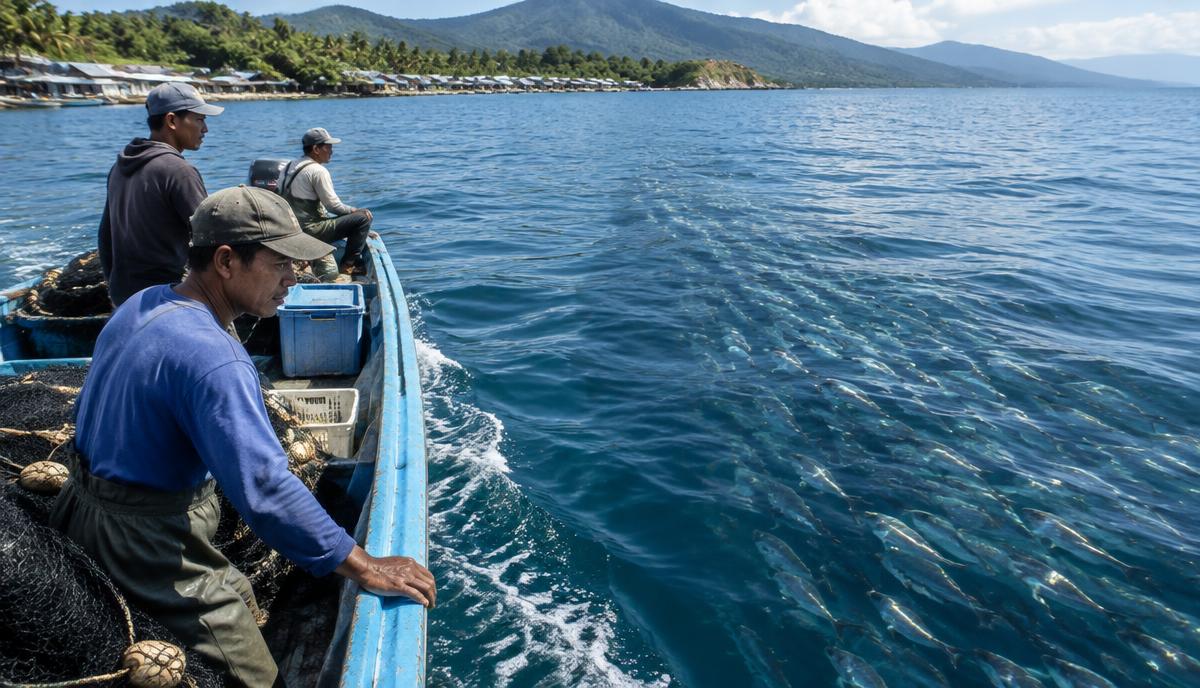
Round sardinella, the fish at the centre of Senegal's national dish thieboudienne, has shifted its range about 180 kilometres north over two decades, according to a 2024 study in Scientific Reports led by researchers at Dakar's CRODT-ISRA and France's IRD. Catches in the Senegal-Mauritania zone have fallen by 70 to 80 per cent, and a species that once fed coastal families cheaply has become scarce in local markets. The fish did not vanish. It moved, and the people who depended on it were left standing on a beach that no longer holds it.
That small drama is a preview of a much larger reallocation. As oceans warm, fish stocks follow temperature bands towards the poles and into deeper water, while the rules that decide who may catch them stay fixed to lines drawn decades ago. The result is a mismatch between where protein swims and where governance reaches, and it falls hardest on the countries with the least capacity to adapt.
Why protein from the sea is a developing-world question
Fish is a marginal item in the diets of rich countries and a staple in poorer ones. FAO's State of World Fisheries and Aquaculture 2024 found that aquatic foods supply 15 per cent of animal protein worldwide, and at least 20 per cent for 3.2 billion people. The dependence is steepest in small island states, coastal West Africa and parts of South and Southeast Asia, where fish is often the cheapest animal protein and the main source of several micronutrients.
The 2026 edition, released in June at the Our Ocean Conference in Mombasa, shows how uneven the supply is. Global consumption of aquatic animal foods averaged 21.1 kilograms per person in 2023, but the figure was 26.3 kilograms in Asia and just 9.1 in Africa. A continent with a coastline and a young, growing population is eating less than half of what the average Asian does, and the gap is likely to widen if its nearshore fish move away.
The warming signal is already in the catch data
The idea that fisheries would respond to climate change was once a modelling exercise. A 2019 paper in Science by Christopher Free and colleagues showed that it had already happened. Across 235 populations, warming between 1930 and 2010 reduced sustainable catch by an average of 4.1 per cent globally. Regional losses were far steeper, between 15 and 35 per cent in places such as the North Sea and the East China Sea, while some northern systems, including the Labrador-Newfoundland shelf and the Baltic, gained.
Projections point the same way with a sharper geographic bias. Work by Manuel Barange and colleagues in Nature Climate Change on fisheries-dependent societies, and by William Cheung's group on catch potential, has consistently found that catch potential rises in high latitudes and falls in the tropics under high emissions. FAO's 2026 report repeats the warning: under high-emissions scenarios, exploitable fish biomass is projected to decline by more than 10 per cent by 2050 in several regions. Redistribution, not a uniform decline, is the central feature, and the winners and losers are not the same countries that currently depend on fish most.
Boundaries drawn for stocks that stayed put
Modern fisheries governance assumes that a stock lives in a place. Exclusive economic zones, extending 200 nautical miles from shore under the 1982 UN Convention on the Law of the Sea, give each coastal state sovereign rights over the fish inside. Regional bodies divide shared stocks using historical catch shares. Both systems work tolerably when fish stay where they were when the lines and shares were set.
A study in Science Advances in July 2025, led by Juliano Palacios-Abrantes at the University of British Columbia, shows how badly that assumption now fits. Of 347 commercially important straddling stocks spanning 67 species, more than half are projected to shift across a jurisdictional boundary by 2050, and more than a third are expected to move into the high seas. In the central Indo-Pacific, home to Kiribati, the Marshall Islands, Micronesia, Nauru, Palau, the Solomon Islands and Tuvalu, 58 per cent of straddling stocks are projected to move into the high seas, and none into national waters. For states whose entire claim to the resource rests on a maritime zone, the fish are leaving the asset.
Mackerel shows what happens when quotas lag the fish
The North Atlantic offers the clearest case of a shifting stock overwhelming a sharing agreement. Northeast Atlantic mackerel began feeding in large numbers in Icelandic and Faroese waters, and both countries, treated as newcomers by the older quota holders, started setting their own catch limits. The EU and Norway accused them of overshooting. In 2012 the Marine Stewardship Council suspended sustainability certificates for eight mackerel fisheries across Denmark, Ireland, Norway, the Netherlands and Sweden, citing the risk of depletion from the unresolved quota dispute.
The argument has outlasted a decade of talks. In December 2025 the UK, Norway, the Faroe Islands and Iceland agreed a 2026 total allowable catch of 299,010 tonnes, a 48 per cent cut, with the EU, Greenland and Russia left outside the deal. That was still well above the 174,357 tonnes recommended by the International Council for the Exploration of the Sea, which implied a 70 per cent reduction. The lesson is not that the parties are uniquely stubborn. It is that a share formula negotiated around where a stock used to be cannot absorb a stock that has changed address, and the habit of fighting over the formula delays the cuts the fish need.
Tuna in the Pacific: a rent that depends on geography
The Pacific shows the same problem with higher stakes for the poor. A 2021 study in Nature Sustainability found that access fees paid by industrial fleets supply on average 37 per cent of government revenue for ten tuna-dependent Pacific island states, with a range from 4 to 84 per cent. More than 95 per cent of the tuna from 22 Pacific island jurisdictions comes from those ten states' waters.
Under a high-emissions scenario, tuna biomass in their waters falls by an average of 13 per cent by 2050 and purse-seine catch by about 20 per cent, around 284,000 tonnes, while catch in the central eastern Pacific rises by 27 per cent. Annual access-fee losses average about 90 million US dollars. The Vessel Day Scheme run by the Parties to the Nauru Agreement has raised the price of access by capping fishing days and selling them, which is the right instinct for a resource-rich, capital-poor region. But the scheme sells days inside zones. If the fish drift east towards the high seas or other jurisdictions, the days lose value, and no agreement written around the zones can fix that alone.
Subsidy rules reach the wrong end of the problem
The WTO Agreement on Fisheries Subsidies, which entered into force on 15 September 2025 after acceptance by two-thirds of the organisation's 164 members, is the first multilateral trade deal anchored in ocean sustainability. It bans subsidies for illegal, unreported and unregulated fishing, for fishing overfished stocks, and for fishing unmanaged stocks on the high seas. Outside analysts put the harmful subsidies that drive overfishing at about 22 billion US dollars a year.
It matters, but it is limited in the way that matters here. The rules on overcapacity and on subsidies for distant-water fleets are still unfinished, and the agreement carries a clause that lapses it in September 2029 if they are not agreed. That second tranche is where climate redistribution bites. When tropical stocks thin and fleets from wealthier states range further to follow fish or fill empty holds, subsidised effort in other countries' waters and on the high seas decides who actually lands what moves. A ban on subsidising the worst abuses does not allocate a moving resource fairly.
Aquaculture has to carry more of the load, with its own problems
Farming is already doing the work that capture fisheries cannot. SOFIA 2026 reports that aquaculture produced 103 million tonnes of aquatic animals in 2024, 53 per cent of the 195 million tonnes total, up from 51 per cent in 2022, and FAO projects total production at 214 million tonnes by 2034. For a continent like Africa, with low per-person fish consumption and fast-growing demand, farmed fish is the plausible route to closing the gap.
But aquaculture is not insulated from warming or from its feed supply. A University of British Columbia study in Global Change Biology projected that unchecked warming could cut global aquaculture output by 16 per cent by 2090, with more than a quarter of producing countries losing 40 to 90 per cent of their current production potential by mid-century. Bangladesh and Myanmar, both heavily reliant on farmed fish, are among those named as most exposed. Feed is the other weak point: a Scientific Reports analysis of 2017 data put aquaculture at roughly 263 million tonnes of carbon dioxide equivalent, about 0.49 per cent of human emissions, with feed production responsible for 57 per cent of that. Fishmeal made from small pelagics in West Africa takes food directly from coastal communities, and the same sardinella stocks that are moving north are being ground into feed for farmed fish elsewhere.
What catching up would require
The argument is not that governance should chase every fish. It is that the instruments should be rebuilt around movement. Access agreements and quota shares need review clauses that rebalance when stocks move a set distance, as the mackerel dispute shows is overdue. Revenue-sharing arrangements, such as pooled funds that pay Pacific states for lost access value, would cushion the countries whose zones empty. The WTO's second round should tie any permitted distant-water support to demonstrable benefit for coastal states and not to fleet size. Aquaculture finance should back low-trophic and plant-fed systems for the countries that need protein most, and treat small pelagics as human food first.
The sardinella off Dakar will keep moving whether or not anyone writes a rule for it. The first countries to build agreements that follow the fish, rather than the lines on the chart, will keep their protein. The rest will watch it swim past.
**Sources:** FAO, "The State of World Fisheries and Aquaculture 2024: Blue Transformation in Action"; FAO, "SOFIA 2026: Global fisheries and aquaculture production reaches new highs"; Science, Free et al., "Impacts of historical warming on marine fisheries production"; Nature Climate Change, Barange et al., "Impacts of climate change on marine ecosystem production in societies dependent on fisheries"; Science Advances, Palacios-Abrantes et al., study of straddling fish stocks shifting to the high seas (reported by Mongabay, "Climate change is driving fish stocks from countries' waters to the high seas"); Nature Sustainability, Bell et al., "Pathways to sustaining tuna-dependent Pacific Island economies during climate change"; SeafoodSource, "Four Northeast Atlantic coastal parties agree on 2026 mackerel quotas, shares; EU left out again"; SeafoodSource, "Mackerel fisheries' MSC certification suspended"; World Trade Organization, "Fisheries Subsidies Agreement enters into force"; Pew Charitable Trusts, "Fisheries Subsidies Agreement: Why It Matters"; IRD Le Mag, "West African fish driven northwards by the effects of global warming"; Scientific Reports, "Quantifying greenhouse gas emissions from global aquaculture"
The Food Observatory Brief
Weekly briefing on food systems, climate, agriculture and policy — straight to your inbox.
More on Climate
Rice Paddies and the Other Greenhouse Gas Problem
Flooded rice is a major source of human methane, and alternate wetting and drying or direct seeding can cut it while saving water. This piece uses the first payouts at Punjab Agricultural University to show why a known fix still struggles to scale, and what verification, contracts and policy would move adoption across South and Southeast Asia.