The Hidden Cost of Cheap Food
FAO puts the hidden annual cost of cheap food at 10 to 12 trillion dollars, a bill nobody pays at the checkout counter
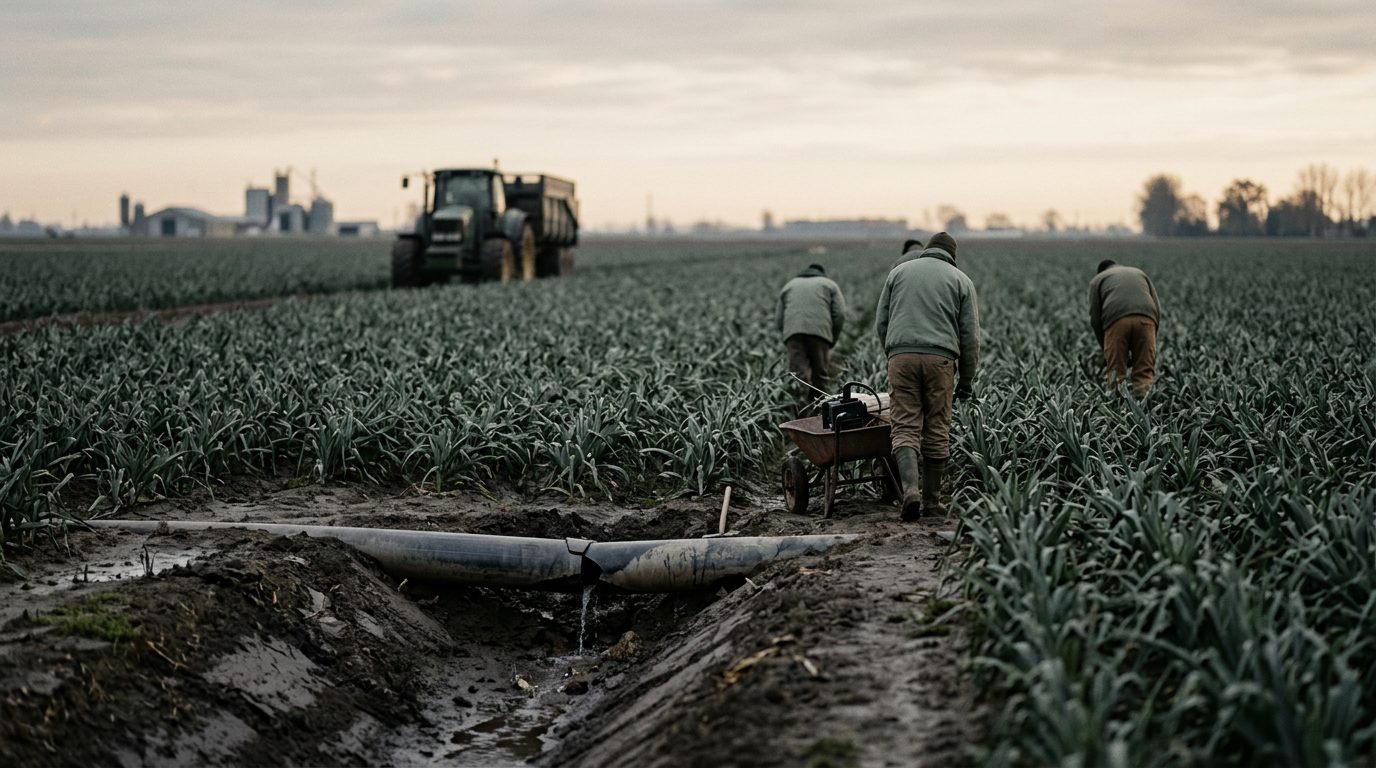
A carton of milk costs less today, adjusted for inflation, than it did in 1980. So does a pound of chicken, a bag of refined sugar, a fast-food value meal. None of that got genuinely cheaper to produce. The price at the register simply stopped reflecting most of the actual bill. The rest, the diabetes ward visit two decades later, the dead zone off the Gulf Coast, the farmworker sleeping in her car because a season of field labor still doesn't cover rent, gets paid somewhere else, by someone else, later. The United Nations Food and Agriculture Organization has now tried to put a number on that gap, and the number is staggering: something in the range of 10 to 12 trillion dollars a year, roughly the combined economic output of Japan and Germany, in costs that global agrifood systems generate but nobody pays at checkout.
That figure comes from FAO's State of Food and Agriculture reports, first published in 2023 and refined in 2024, and it represents the most ambitious attempt yet at what economists call true cost accounting: pricing food not by what it costs to grow, process, and ship, but by everything its production and consumption quietly offload onto public health systems, ecosystems, and the people who grow it.
A Receipt That Only Tells Part of the Story
FAO's methodology, developed with researchers at Oxford University's Environmental Change Institute and applied across more than 150 countries, works by comparing the food system the world actually has against a hypothetical one in which health, environmental, and social harms were factored into prices and policy. The gap between those two scenarios is the hidden cost. In the 2023 report, that gap came out to at least 10 trillion dollars annually in quantifiable terms, close to 10 percent of global GDP, with FAO noting the true figure is likely higher once costs that resist measurement, biodiversity loss chief among them, are included. Some outlets covering the report's release put the fuller estimate closer to 12.7 trillion dollars. The 2024 update, drawing on more granular household and health data, refined the total to roughly 12 trillion dollars a year across 156 countries.
FAO Director-General Qu Dongyu framed the point bluntly at the report's release: the future of agrifood systems, he said, hinges on a willingness to "acknowledge these true costs, and understand how we all contribute to them." That is a different claim than saying food is expensive. It is a claim that food is priced dishonestly, and that the dishonesty has a specific, calculable shape.
The Diet Bill Comes Due in the Clinic, Not the Checkout Line
The single largest slice of that 10 to 12 trillion dollars, more than 70 percent by FAO's accounting, traces back to diet-related illness. The 2024 report isolated this at 8.1 trillion dollars a year in costs from non-communicable diseases linked to what people eat: heart disease, stroke, type 2 diabetes, certain cancers. The dietary patterns driving those numbers are familiar ones, diets short on whole grains, fruits, and vegetables and heavy on sodium, red meat, and processed and ultra-processed foods, but the accounting trick FAO is pointing at is not about willpower. It is about who absorbs the downstream cost. A bag of chips or a liter of soda is priced to recover the cost of corn, oil, sugar, packaging, and marketing. It is not priced to recover the cost of the cardiologist, the dialysis machine, or the lost workdays that show up in a national health system's ledger fifteen or thirty years later. Those costs are real, they are large, and in FAO's framework they land disproportionately on wealthier and middle-income countries, where industrialized diets have gone furthest and productivity losses from chronic illness compound the direct medical spending. Country-level work using the same methodology has found similarly outsized effects even outside the wealthiest economies; an FAO-linked estimate for India, reported by Down To Earth, put the country's annual hidden agrifood costs at roughly 1.3 trillion dollars, again overwhelmingly attributable to unhealthy diets rather than to farming itself.
Carbon, Nitrogen, and a Ledger the Planet Keeps Anyway
Environmental damage makes up the next largest share, on the order of a fifth of the global total in the 2023 accounting. This is the category closest to what people usually mean when they talk about food's hidden footprint: greenhouse gas emissions from livestock, fertilizer, and land clearing; nitrogen runoff that fuels algal blooms and dead zones in rivers, lakes, and coastal waters; groundwater depletion from irrigation-heavy monocultures; and biodiversity loss from converting forest and grassland into cropland, a cost so diffuse and long-tailed that FAO admits its models still undercount it. None of this shows up on a supermarket shelf tag. A farmer growing commodity corn is not billed for the fertilizer that leaches into the watershed; a feedlot is not billed for the methane it releases; a supermarket selling cheap beef is not billed for the rainforest that was cleared for pasture a decade earlier and a continent away. Those costs do not disappear. They get paid by a coastal fishing economy losing its catch to a hypoxic dead zone, by a city downstream funding water treatment, by future generations inheriting a warmer and less biodiverse planet. The market simply never sends them an invoice with today's date on it, which is precisely what lets a chicken breast stay cheap.
Poverty as a Line Item in the Food System
The smallest share of FAO's total, but arguably the most morally direct, is what the report categorizes as social costs: poverty and undernourishment among the people whose labor produces food in the first place. Millions of agricultural workers globally, from field hands to small-scale farmers, earn wages below the poverty line even as the food they produce moves through supply chains that generate substantial profit further downstream. This is not an accident of low productivity; it is a structural feature of how commodity prices get set, where buyers, processors, and retailers hold most of the negotiating leverage and squeeze the cost of labor to protect thin margins on cheap staples. A dollar shaved off a farmworker's wage is a dollar that never appears as a line item on any invoice, but it still represents a cost, transferred from the food system onto the worker and, eventually, onto the public assistance programs and informal safety nets that catch people whose full-time labor doesn't cover their own food and housing. FAO's report treats this as every bit as real a hidden cost as a hospital bill or a ton of carbon, because in true cost accounting terms it is: value extracted from the system without ever being priced into what the system sells.
Why the Same Trillion Dollars Lands Differently in Lagos and Los Angeles
One of the more revealing findings in the 2023 report is how unevenly these costs distribute by income level. In low-income countries, hidden costs amount to more than a quarter of GDP, and they skew toward poverty, undernourishment, and productivity losses tied to insufficient food rather than excess of it. In middle-income countries the share falls below 12 percent of GDP; in high-income countries, below 8 percent, but weighted heavily toward the diet-related disease burden of industrialized, calorie-dense food systems. Put plainly: a farmer in a low-income country is more likely to be personally absorbing the hidden cost of an underpriced food system, through hunger and poverty wages, while a consumer in a wealthy country is more likely to be absorbing it decades later, through a chronic illness that a subsidized, ultra-processed diet made statistically more likely. Cheap food is not free anywhere. It just collects payment through different channels depending on where you sit in the supply chain.
What Pricing the Whole Bill Would Actually Require
True cost accounting is not primarily a call for consumers to feel guilty at the grocery store; FAO's own recommendations point toward policy levers, not personal ones. That means recalibrating subsidies that currently favor commodity crops like corn, soy, and sugar over fruits, vegetables, and diversified farming systems; taxing externalities directly, the way a carbon price or a sugar tax attaches a cost to emissions or excess sugar consumption at the point of sale rather than leaving it to accumulate invisibly; building environmental and labor standards into public procurement, since governments and institutions are themselves enormous food buyers; and requiring the kind of disclosure that would let a true cost show up somewhere, even if not on the shelf tag itself, so that investors, regulators, and buyers can see it. None of this is hypothetical. Versions of true cost accounting are already being piloted by researchers, food companies, and a handful of national governments trying to figure out what a carrot or a steak would cost if its price reflected its actual footprint. The number is always higher than what's on the shelf. Sometimes dramatically so.
The Argument Cheap Food Was Never Actually Making
The deeper point FAO's work makes is that "cheap food" was never really a policy achievement in the way it has been sold for the past half-century. It was a bookkeeping choice, one that made staple calories abundant by routing their true cost around the price tag and into public health budgets, degraded ecosystems, and underpaid labor. That choice produced real benefits, food security and lower hunger rates chief among them, but it also produced a system where the true cost of feeding the world is still being paid every year, just not by whoever is standing at the register. A 10 to 12 trillion dollar bill does not vanish because no one printed it on a receipt. It gets paid regardless, in hospital wards, in polluted watersheds, in wages too low to live on, and the only real question left is whether the people setting food policy start pricing it honestly or keep letting someone else quietly cover the difference.
Sources: FAO, "The State of Food and Agriculture 2023: Revealing the true cost of food to transform agrifood systems"; FAO, "The State of Food and Agriculture 2024" (hidden cost update); FAO Newsroom, "Unhealthy dietary patterns drive $8 trillion in annual hidden costs of global agrifood systems"; FAO Newsroom, "Hidden costs of global agrifood systems worth at least $10 trillion"; World Economic Forum, "The hidden cost of agrifood is $10 trillion, finds the FAO"; UN News, "FAO report reveals hidden costs of agrifood systems"; SDG Knowledge Hub / IISD, "SOFA 2024 Exposes USD 12 Trillion in True Costs of Global Agrifood Systems"; Mongabay India, "FAO estimates $12.7 trillion worth hidden costs in the journey of food from farm to table"; Down To Earth, "India Faces $1.3 Trillion Hidden Costs in Agrifood Systems Due to Unhealthy Diets"; Environmental Change Institute, University of Oxford, "Trillions in hidden costs of agrifood systems revealed by Oxford research contained in UN report"
The Food Observatory Brief
Weekly briefing on food systems, climate, agriculture and policy — straight to your inbox.
More on Markets
Olive Oil, Orange Juice and the New Climate Price Shock
Crops concentrated in one or two climate-exposed regions now follow a boom and bust pattern, with heat, drought and disease compounding the swings. This piece looks at olive oil, orange juice and vanilla, explains why prices fall back but not to old levels, and asks who carries the risk when hedging is thin.
Fertilizer Prices Are the Hidden Driver of Food Inflation
Fertilizer is made from natural gas and from potash and phosphate controlled by a handful of exporters, so its price follows energy and trade policy more than crop demand. This piece argues that fertilizer affordability, not only grain prices, sets farmers' planting decisions and next season's food prices, and looks at what India, Africa and efficiency measures change.
GLP-1 Drugs Are Starting to Change What the Food Industry Sells
Semaglutide and tirzepatide are changing grocery baskets, restaurant portions and product launches in the United States. This piece argues that the food industry is facing its first pharmacological shift in appetite, traces the consequences for protein, fibre, portion size and the commodities behind them, and sets out why it will not become a universal change.