Who Really Shapes What We Eat?
Four companies move 90 percent of the world's grain, and four more control most of America's beef, long before any shopper makes a choice
In the hills outside Bologna, a group of Italian farmers has started meeting in barns to trade something that used to be free: seeds. The network, called Rete per l'Agricoltura Naturale, runs what it calls a "Casa Diffusa dei Semi," a distributed seed house where growers save, reproduce, and swap unpatented varieties outside the commercial market. They are not doing this out of nostalgia. Four companies, Bayer, Corteva, Syngenta, and BASF, now control 56 percent of the world's commercial seed market and 61 percent of the global pesticide market, and farmers who replant patented seed without a license can be sued. A choice that used to sit entirely in a farmer's hands, save your best grain and plant it next season, has become a legal liability in much of the world. That single fact says more about who controls the food system than any survey of consumer preferences ever could.
The romantic version of the food economy has a farmer growing crops, a shopper choosing what to buy, and a market connecting the two through price. The real version has a small number of firms sitting at nearly every chokepoint between the two, deciding what seed gets planted, what commodities move where, what makes it onto a shelf, and what price a farmer gets paid for growing it in the first place. Consumer choice exists, but it operates inside boundaries that were drawn well before anyone walks into a store.
The Four Firms That Move the World's Grain
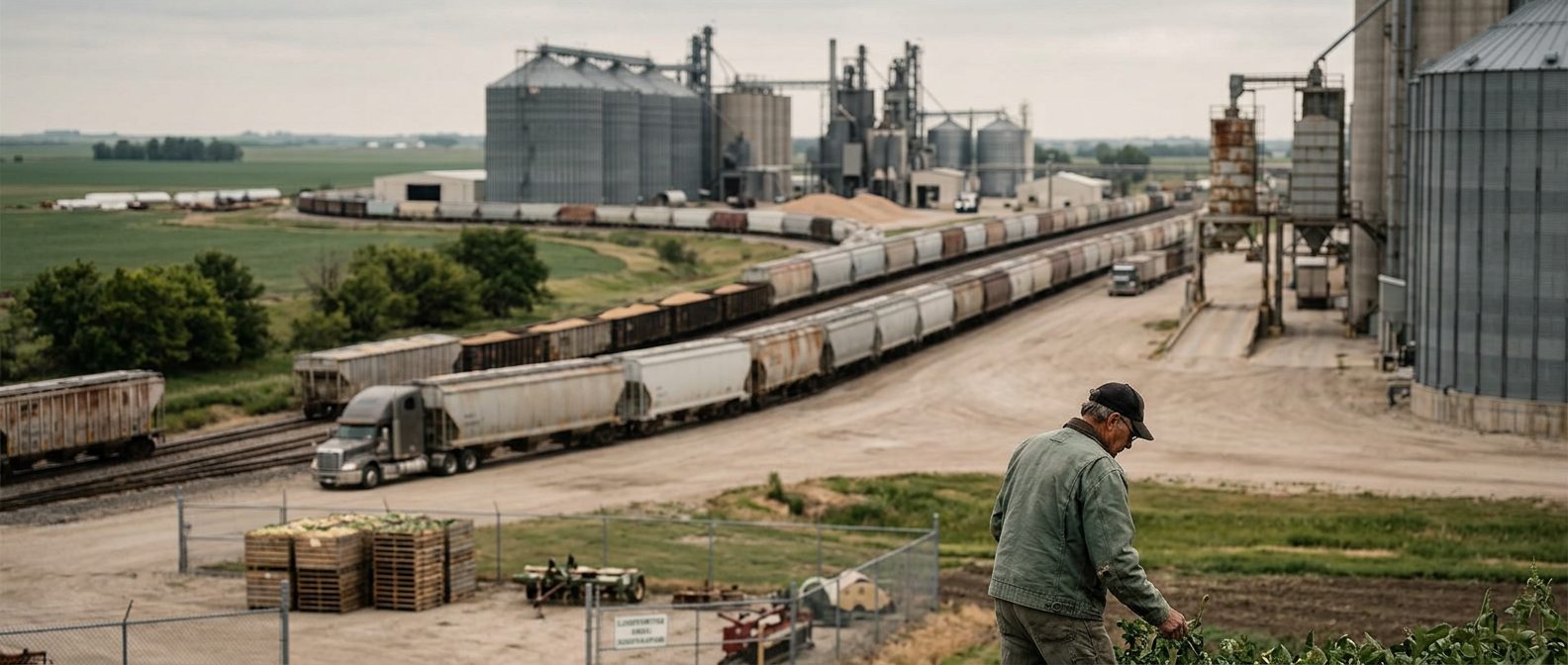
Start with the raw commodities themselves. Roughly 90 percent of the global grain trade passes through four companies known in the industry as the ABCDs: Archer-Daniels-Midland, Bunge, Cargill, and Louis Dreyfus. Between 2007 and 2017 these firms completed 99 acquisitions between them, with Cargill alone responsible for nearly half, buying up smaller rivals and vertically integrating storage, shipping, and processing so thoroughly that a wheat farmer in Kansas and a flour mill in Lagos are both, in practice, transacting with one of four counterparties. When commodity prices crashed in 2012, smaller traders folded or sold out, and the ABCDs absorbed the market share. That consolidation trend has continued: Archer-Daniels-Midland and Bunge have been in advanced talks over a roughly $16 billion combination that would fold two of the four giants into one, a deal that antitrust regulators in multiple countries are watching closely because it would leave effectively three firms controlling the arteries of global grain movement.
This is not a niche industrial detail. Grain trading concentration determines how fast, and how unevenly, price shocks travel. When Russia's invasion of Ukraine disrupted Black Sea grain exports in 2022, it was these four firms that decided which buyers got priority, which routes got rerouted through Romania and the Baltic states, and how quickly price spikes reached import-dependent countries in North Africa and the Middle East. The traders did not cause the war, but their concentrated control over logistics and storage meant the shock passed through a very narrow set of decision points rather than a diffuse market.
Four Companies, Four-Fifths of American Beef
Move downstream from the field to the slaughterhouse and the pattern repeats, often more starkly. In the United States, four companies, Tyson, Cargill, JBS, and National Beef, control an estimated 80 to 85 percent of the beef processing market, according to analysis compiled by Farm Action and reflected in USDA Economic Research Service data on meatpacking concentration. The consequence shows up directly in ranchers' bank accounts: cattle producers now receive less than 30 cents of every retail beef dollar, a historic low, even as beef prices at the register climbed through 2024 and 2025. The margin between what a rancher is paid and what a shopper pays has not vanished, it has simply moved upstream into processor profits and downstream into retail markup, with the people actually raising the animals squeezed in between.
The Trump administration ordered the Department of Justice to examine possible anticompetitive conduct in meatpacking in late 2025, following years of complaints from independent ranchers and a bipartisan group of senators, including Chuck Grassley and Ron Wyden, who introduced legislation aimed at breaking up the concentration. Whether that produces structural change or simply a settlement is still an open question, but the political attention itself is telling: concentration this severe has become impossible to wave away as ordinary market efficiency.
The Shelf Is Not Neutral Ground
Retail is the point where concentration becomes most visible to ordinary people, even if they rarely register it as concentration. In the United States, Walmart alone holds roughly a fifth of grocery sales nationally, and when combined with Kroger, Costco, and Albertsons, a handful of chains account for the large majority of where Americans actually buy food. That matters because shelf space is not a passive reflection of what shoppers want, it is an actively managed, often paid-for asset. Manufacturers pay slotting fees for eye-level placement, promotional endcaps, and inclusion in loyalty-app deals, meaning the products that appear easiest to buy are frequently the ones whose makers can afford to buy that visibility, not necessarily the ones consumers would choose from an unfiltered set of options. A smaller regional producer or a new entrant selling, say, a lower-sugar cereal or a plant-based protein without a marketing budget to match Kraft Heinz or General Mills starts the competition already several steps behind, regardless of taste or price.
Retailers also set the terms on which suppliers operate, from payment timelines to return policies to private-label competition, where the chain becomes both customer and rival to the same manufacturer stocking its shelves. That dual role gives retailers a form of power that extends well past the checkout counter and into how food companies design products in the first place, often toward shelf-stability, portion sizes, and price points that suit distribution logistics as much as nutrition or taste.
Wall Street's New Interest in Dirt
A less visible but fast-growing layer of power sits above all of this: who owns the land and the companies themselves. Farmland has become what asset managers now openly describe as an attractive alternative investment, prized for its low correlation with stocks and bonds and its inflation-hedging properties. Institutional investors, pension funds, and private equity vehicles such as AgIS Capital and various farmland-focused funds run by firms like PGIM have expanded steadily into US and international agricultural land over the past several years, buying not to farm it themselves but to lease it back to operators or hold it as a long-duration financial asset. This shift changes the incentives embedded in land use. A financial owner optimizing for portfolio returns and lease income does not necessarily share a working farmer's stake in soil health, crop diversity, or the long-term viability of a rural community, and tenant farmers renting from distant capital pools have less room to negotiate than they would with a neighboring landowner.
The same capital has moved into food and beverage companies directly, through buyouts, consolidation plays, and stakes in everything from packaged goods manufacturers to controlled-environment agriculture startups. The effect compounds the concentration already present in trading, processing, and retail: the same pools of capital increasingly touch multiple links of the same chain.
Lobbying and the Guidelines That Shape a Nation's Plate
Government sits over all of this as regulator, subsidizer, and dietary authority, and food companies have invested heavily in shaping how that authority gets used. The food and beverage industry consistently ranks among the highest-spending lobbying sectors in Washington, funding campaigns that touch everything from sugar tariffs to nutrition labeling rules. The most direct example is the fight over the US Dietary Guidelines for Americans, the document that shapes school lunch standards, SNAP benefits, and federal nutrition messaging for the entire country. Watchdog groups including the Union of Concerned Scientists and the Physicians Committee for Responsible Medicine have documented industry ties running through the advisory committee process for the 2025-2030 guidelines, with critics arguing that companies with a direct financial stake in sugar, meat, and processed-food consumption have disproportionate access to the scientists and officials drafting recommendations meant to serve public health rather than sales figures. Subsidy structures reinforce the same tilt: commodity crops like corn and soy, the base ingredients of processed food and animal feed, receive the bulk of federal agricultural support, while fruit and vegetable growers operate with comparatively little of that cushion.
Where Farmers and Shoppers Are Pushing Back
None of this concentration is total or uncontested. Cooperatives remain one of the oldest and most functional counterweights in the system, letting farmers pool bargaining power, share processing and storage infrastructure, and capture margin that would otherwise go to an intermediary. Dairy cooperatives in the US and agricultural cooperatives across the European Union still handle a meaningful share of production for their members, and research on EU farmer cooperatives shows they consistently improve bargaining position relative to buyers, even if they have not reversed the broader consolidation trend. Fair trade certification schemes, direct-to-consumer models, and regional food hubs represent smaller but real alternative channels, giving a slice of producers and shoppers a way to route around the dominant chain entirely. Regulatory scrutiny, however inconsistent, has also intensified, from the DOJ's meatpacking inquiry to European competition authorities examining the proposed ADM-Bunge merger, suggesting that the current level of concentration has crossed a threshold that governments feel obliged to at least investigate.
What ties all of these threads together is that the dinner plate is downstream of decisions made far earlier and by far fewer people than the phrase "consumer choice" implies. A shopper standing in a supermarket aisle is choosing among options that a handful of seed companies, four grain traders, four meatpackers, and a handful of retail chains have already narrowed, priced, and placed within reach. The Italian farmers trading seeds in a barn outside Bologna are not opting out of modernity, they are opting out of a specific, identifiable set of corporate gatekeepers, and their small experiment is a useful reminder that the structure of the food system, however entrenched, was built by choices that can still be made differently.
Sources: PitchBook, "The ABCDs and M&A: Putting 90% of the global food supply in fewer hands."; Farm Action, "Meatpacking: Four Corporations, Total Control."; USDA Economic Research Service, "Concentration in U.S. Meatpacking Industry and How It Affects Competition and Cattle Prices."; Fortune, "Four firms control more than half of the world's seed supply. Italian farmers are fighting back and returning to the bartering system."; USDA Economic Research Service, "Two companies accounted for more than half of corn, soybean, and cotton seed sales in 2018-20."; Farm Action, "Grocery Retail: The Last Link in the Monopoly Chain."; Statista, "Grocery retailers market share, U.S., 2025."; Union of Concerned Scientists, "'Big Food' Companies Spend Big Money in Hopes of Shaping the Dietary Guidelines for Americans."; Physicians Committee for Responsible Medicine, "2025-2030 Dietary Guidelines for Americans: A Mixed Bag and a Process Tainted by Industry Influence."; OpenSecrets, "Food & Beverage Lobbying Profile."; PGIM, "Agriculture Investing."; Oxfam, "Cereal Secrets: The World's Largest Grain Traders and Global Agriculture."
The Food Observatory Brief
Weekly briefing on food systems, climate, agriculture and policy — straight to your inbox.
More on Markets
Olive Oil, Orange Juice and the New Climate Price Shock
Crops concentrated in one or two climate-exposed regions now follow a boom and bust pattern, with heat, drought and disease compounding the swings. This piece looks at olive oil, orange juice and vanilla, explains why prices fall back but not to old levels, and asks who carries the risk when hedging is thin.
Fertilizer Prices Are the Hidden Driver of Food Inflation
Fertilizer is made from natural gas and from potash and phosphate controlled by a handful of exporters, so its price follows energy and trade policy more than crop demand. This piece argues that fertilizer affordability, not only grain prices, sets farmers' planting decisions and next season's food prices, and looks at what India, Africa and efficiency measures change.
GLP-1 Drugs Are Starting to Change What the Food Industry Sells
Semaglutide and tirzepatide are changing grocery baskets, restaurant portions and product launches in the United States. This piece argues that the food industry is facing its first pharmacological shift in appetite, traces the consequences for protein, fibre, portion size and the commodities behind them, and sets out why it will not become a universal change.