Can Food Systems Become Carbon Sinks?
Soil can absorb meaningful carbon, but its storage is reversible and its capacity has a hard ceiling that current climate math often ignores
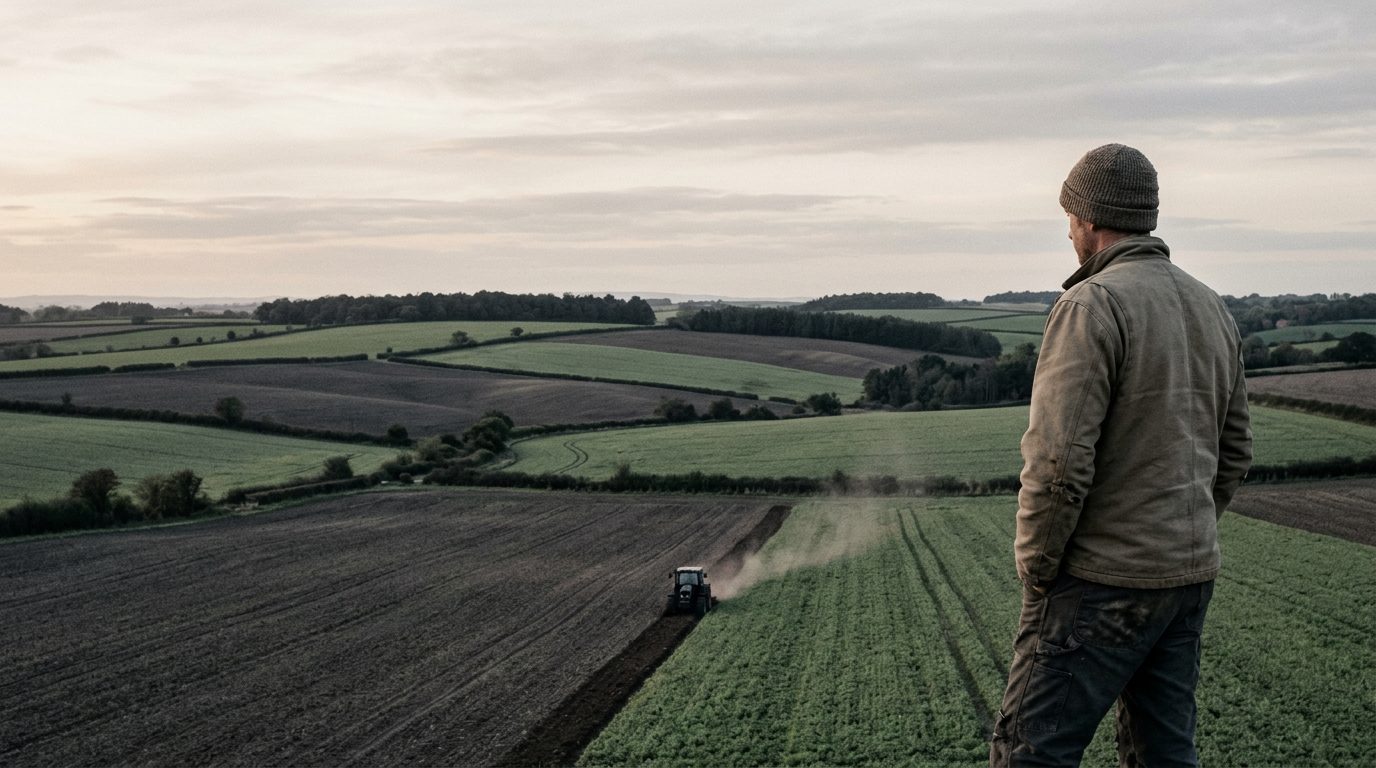
A field of no-till corn in Iowa and a stand of primary rainforest in the Congo Basin can both be described, in the language of atmospheric science, as carbon sinks. They are not the same thing, and the gap between them is where the entire debate over whether agriculture can help solve climate change actually lives.
A Sector That Emits More Than It Absorbs, By a Wide Margin
Global food systems, from fertilizer factories to cattle pastures to the diesel trucks that move grain, generated about 18 billion tonnes of carbon dioxide equivalent in 2015, or roughly a third of all human-caused greenhouse gas emissions, according to the UN Food and Agriculture Organization. Land use and land-use change, mostly deforestation and soil degradation, account for about a third of that figure on their own. The sector that grows humanity's food is also one of its largest single sources of warming gases, on par with the entire global transportation network.
Against that backdrop, the idea that farms could flip from source to sink has obvious appeal. If soils can pull carbon out of the atmosphere and hold it, agriculture would not just stop being part of the problem, it could become part of the cleanup crew. The science behind that hope is real. The scale of it is where things get complicated.
What the IPCC Actually Says About Land as a Sink
The Intergovernmental Panel on Climate Change's Sixth Assessment Report treats the land sector, formally called AFOLU (agriculture, forestry, and other land use), as simultaneously a source and a sink. Between 2010 and 2019, AFOLU activities produced somewhere between 13 and 21 percent of global emissions, largely from deforestation and agricultural soil loss. But when the carbon absorbed by regrowing forests, restored wetlands, and improved cropland is subtracted, the sector nets out to roughly negative 6.6 billion tonnes of CO2 a year, meaning land as a whole is already, on net, pulling carbon down rather than adding it.
That statistic gets misread constantly. It is driven overwhelmingly by forests, not farms. Agriculture's own contribution to land-based mitigation potential through 2050 is estimated by the IPCC at up to about 4.1 billion tonnes of CO2 equivalent per year, compared to as much as 7.4 billion tonnes from forests and other ecosystems. Agriculture is a meaningful piece of the land sink story, but it is the smaller piece, and it is also the piece with the least stable physics behind it.
The Ceiling on What Soil Can Actually Hold
Soil carbon sequestration works by building up organic matter, root biomass, and microbial residue in the ground faster than it decomposes. Practices like reduced tillage, cover cropping, and diversified rotations can measurably raise soil organic carbon over a period of years. The trouble is that soils are not infinite reservoirs. Every soil type has a rough ceiling, a saturation point, determined by its clay content, climate, and mineral chemistry, beyond which it simply cannot hold more carbon no matter what a farmer does. Research applying France's "4 per 1000" initiative, the internationally cited goal of raising global soil carbon stocks by 0.4 percent a year, has found that even under highly favorable practice-adoption scenarios, most agricultural soils approach that ceiling within a few decades, not centuries. After that point, sequestration essentially stops, even as emissions from fertilizer, livestock, and fuel use continue indefinitely.
The IPCC's own technical estimate puts global soil sequestration potential at around 5.3 billion tonnes of CO2 per year, with only about 3.8 billion tonnes considered achievable at a cost below 100 dollars per tonne. Global agriculture itself emits somewhere between 5 and 5.8 billion tonnes of CO2 equivalent annually. Even in the most optimistic technical scenario, soil sequestration is a near wash against agriculture's own direct emissions, before it can offset a single tonne from steel plants, jet engines, or coal power stations elsewhere in the economy. A newer strand of research, described in a 2026 paper on what its authors call "dual saturation," goes further, arguing that biophysical soil limits are compounded by a second, practical ceiling: the operational capacity of real farmers to sustain intensive management year after year at a landscape scale. Theoretical potential published in models is consistently higher than what shows up when scientists measure actual fields over actual growing seasons.
Temporary Storage Is Not the Same Thing as Permanent Removal
This is the distinction that gets flattened most often in popular coverage of regenerative agriculture, and it is the one that matters most scientifically. Carbon stored in soil organic matter is not locked away the way carbon injected into deep geological formations is. It sits in a dynamic pool that is constantly cycling, and it can be released again by a single deep tillage pass, a drought, a wildfire, a change in land ownership, or simply a farmer reverting to conventional practice once a contract or subsidy period ends. Recent soil science has also complicated an assumption the IPCC's own estimates were partly built on, that certain carbon-rich soil compounds are chemically stable and can persist for centuries. New work suggests some of that "stable" carbon cycles back to the atmosphere on a much shorter timescale than previously modeled, which matters enormously for climate accounting, because a tonne of CO2 kept out of the atmosphere for 200 years has a very different climate value than a tonne kept out for 15.
This is why climate scientists increasingly insist on separating two categories that get conflated in marketing materials: carbon sequestration, which is reversible storage in a biological pool, and carbon removal, which implies something closer to permanence. Soil carbon is overwhelmingly the former. That does not make it worthless, avoided emissions and slowed atmospheric buildup have real value, but it does mean soil carbon cannot be treated as equivalent to, say, a tonne of fossil CO2 permanently removed and buried.
Why Soil Carbon Credits Keep Running Into Trouble
The commercial market built around paying farmers for sequestered carbon has run headlong into exactly these physical realities, and the result has been a string of credibility problems. Measuring soil carbon accurately requires dense sampling across a field, accounting for bulk density and depth in ways many early protocols skipped, and repeating the process over years to detect a signal that is often smaller than the natural year-to-year variability in the soil itself. Verification bodies have struggled to agree on a single standard, and in voluntary markets verification is not even mandatory. Layered on top of the measurement problem is the additionality question that plagues carbon markets generally: a credit is only legitimate if the sequestration would not have happened without the payment, which by definition excludes farmers already using cover crops or no-till before a credit program existed, an outcome critics say perversely penalizes early, genuine adopters while rewarding late converts whose practices are easiest to attribute to the payment.
Reversal risk compounds all of this. A buyer purchasing a soil carbon credit is typically told the carbon will stay put for a crediting period, often 10 to 20 years, but there is no realistic mechanism to guarantee a given field will not be tilled, sold, or hit by drought within that window. High sampling and verification costs also mean the economics favor large industrial operations that can spread fixed costs across thousands of acres, while smallholder farmers, who manage a large share of the world's cultivated land, are frequently priced out of participating at all. None of this means soil carbon measurement is impossible, remote sensing and modeling are improving, but a soil carbon credit today carries meaningfully more scientific uncertainty than a credit from, say, destroying a potent industrial refrigerant gas.
The Scale Mismatch That Undercuts the "Farms as Offsets" Argument
Step back and look at the numbers side by side. Global anthropogenic emissions run in the neighborhood of 50 billion tonnes of CO2 equivalent a year. Even the most generous technical estimate for agricultural soil sequestration, 5.3 billion tonnes annually, would cover roughly a tenth of that, and only for the finite period before soils saturate. If soil carbon is instead framed narrowly as an offset for agriculture's own footprint, the numbers are closer but still short: achievable, cost-effective sequestration of around 3.8 billion tonnes against agricultural emissions of 5 to 5.8 billion tonnes leaves a persistent gap even in the optimistic case, and that gap ignores the emissions embedded in fertilizer manufacturing, land clearing, and methane from livestock and rice, all of which keep flowing regardless of how much carbon a cover crop pulls into the topsoil.
This is the core of the scientific critique of treating farms as a climate strategy on their own terms: agricultural soils are a genuinely useful, finite, temporary carbon reservoir, not a substitute for cutting emissions at their source. A tonne of methane not belched by a cow or a tonne of nitrous oxide not released by over-applied fertilizer is a permanent avoided emission. A tonne of carbon added to a cornfield's topsoil is a reversible, capacity-limited deposit that has to be actively maintained indefinitely just to stay put, let alone grow.
Where the Legitimate Optimism Still Lands
None of this means the pursuit of agricultural carbon sinks is a distraction, as some critics frame it, so much as a case for precision about what the strategy can and cannot do. Within its real limits, soil carbon buildup delivers genuine, near-term climate value: it slows atmospheric accumulation while the harder work of decarbonizing energy, industry, and transport proceeds, and co-benefits like better water retention and reduced erosion are valuable independent of the carbon accounting. Nature Food research published in 2024 found that enhanced agricultural carbon sinks can deliver benefits for both farmers and the climate even accounting for these constraints, a more modest and more defensible claim than "farms will offset industrial emissions."
The scientific consensus that is emerging, across IPCC assessments, soil science literature, and carbon market critiques alike, treats agricultural soils as one tool with a hard ceiling, not a lever that scales indefinitely with better management. Policy built on that premise, treating soil sequestration as a bridge measure with a known expiration date rather than a permanent offset for fossil emissions, is scientifically defensible. Policy that leans on soil carbon credits to justify continued fossil fuel extraction elsewhere in the economy is not, because the physics of a saturating, reversible carbon pool simply cannot carry that weight.
Sources: FAO, "Food systems account for more than one third of global greenhouse gas emissions"; IPCC AR6 Working Group III, "Chapter 7: Agriculture, Forestry, and Other Land Uses (AFOLU)"; Zero Carbon Analytics, "IPCC WGIII report: The land sector and climate mitigation"; CSIS, "Soil Carbon Sequestration: Myths, Realities, and the Biden Administration's Proposals"; Global Challenges (Wiley), "Dual Saturation in Soil Carbon Sequestration: Biophysical Limits and the Operational Capacity of Farmers," von Cossel et al., 2026; PMC/National Institutes of Health, "Feasibility of the 4 per 1000 aspirational target for soil carbon: A case study for France"; Earth.Org, "Soil Carbon Credits: The Promises and Uncertainties of a New Climate Market"; Environmental Defense Fund, "Surge of Interest in Soil Carbon Credits Requires Swift Action to Set Clear Standards"; Nature Food, "Enhanced agricultural carbon sinks provide benefits for farmers and the climate," 2024; Carbon Brief, "Food systems responsible for 'one third' of human-caused emissions"
The Food Observatory Brief
Weekly briefing on food systems, climate, agriculture and policy — straight to your inbox.
More on Climate

Warming Oceans Are Moving the World's Protein
Fish stocks are moving poleward and into deeper water as the oceans warm, while the countries that depend most on fish protein are often the least able to follow them. This piece argues that maritime boundaries, fisheries agreements and aquaculture investment have not caught up with moving fish.
Rice Paddies and the Other Greenhouse Gas Problem
Flooded rice is a major source of human methane, and alternate wetting and drying or direct seeding can cut it while saving water. This piece uses the first payouts at Punjab Agricultural University to show why a known fix still struggles to scale, and what verification, contracts and policy would move adoption across South and Southeast Asia.