Fertilizer Prices Are the Hidden Driver of Food Inflation
Urea passed \$850 a tonne in April, and nothing in wheat, maize or rice explained it
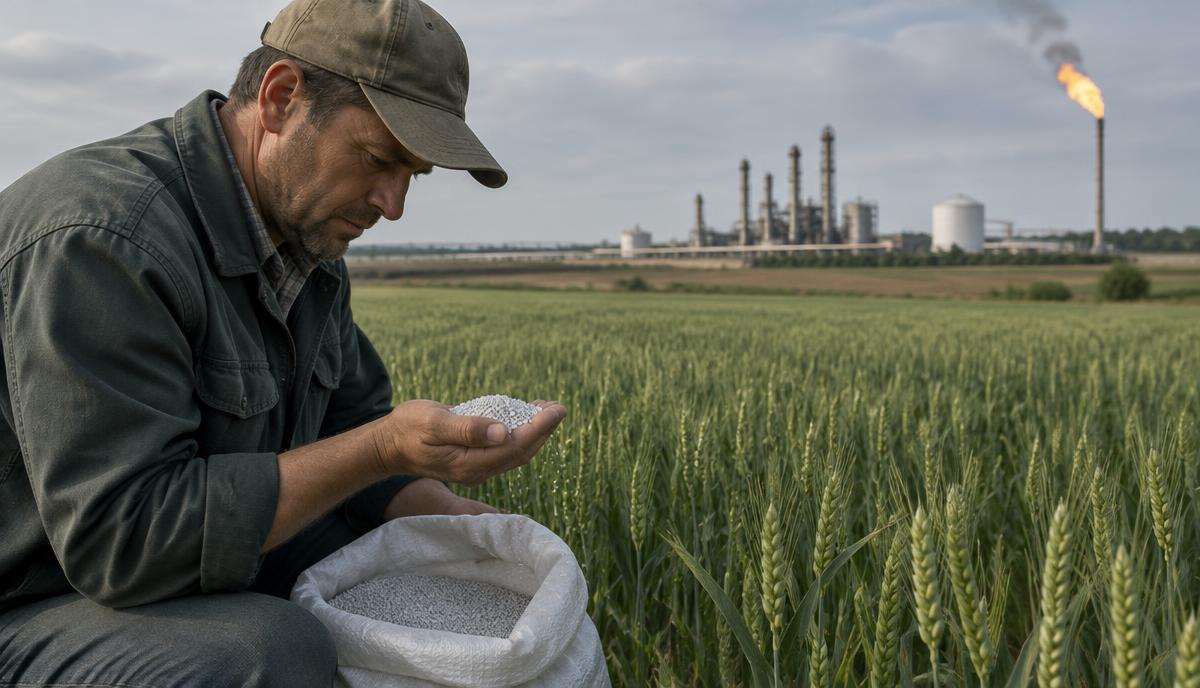
Two Months That Moved Urea by 80 Percent
By April 2026 the price of urea, the world's most widely used nitrogen fertilizer, had passed \$850 a tonne, up 80 percent since February and the highest since April 2022, according to the World Bank. Nothing had happened to wheat, maize or rice that explained it. The cause was a war and a closed shipping lane: disruption in the Strait of Hormuz had stalled cargoes from a region that supplies roughly a third of globally traded urea, according to the International Food Policy Research Institute (IFPRI). The World Bank's fertilizer price index rose more than 12 percent in the first quarter alone, its sixth quarterly increase in seven, and reached its highest point since October 2022.
The episode is a clean demonstration of an argument that gets little attention in discussions of food inflation. Fertilizer is the input that connects energy markets and trade policy to the supermarket shelf, and it does so on a delay. A farmer who cannot afford nitrogen in the spring does not make a speech about it. She plants less, applies less, or switches to a crop that needs less, and the consequence shows up as a smaller harvest and a higher price the following season.
Gas in the Bag
The reason fertilizer prices track energy more closely than they track crops is chemical. Nitrogen fertilizer is made by combining nitrogen from the air with hydrogen stripped from natural gas, a process that burns large volumes of gas as both feedstock and fuel. That is why the World Bank describes urea as heavily dependent on natural gas, and why its April 2026 Commodity Markets Outlook projected urea to rise about 60 percent in 2026 while potash, which needs far less gas, was forecast to rise about 12 percent.
A farmer's demand for fertilizer is also unusually inelastic in the short run, since yields fall quickly if nutrients are skipped, but supply is not. Ammonia and urea plants cannot be switched on and off like taps, and they cluster where gas is cheap: the Gulf, Russia, North Africa. When a conflict or a sanctions regime removes a share of that capacity, the remaining supply is rationed by price. Grain prices, by contrast, respond to harvests and stocks months later. The two series can move in opposite directions for a whole season, and when they do, the farmer is squeezed from both sides.
Potash From Three Countries, Phosphate From One Kingdom
The mined nutrients are less volatile with energy but more concentrated in ownership. The US Geological Survey's 2026 summary puts 2025 potash mine output at about 15 million tonnes of K2O equivalent in Canada, 10 million in Russia and 6 million in Belarus, which together dwarf every other producer on its list bar China. Russia holds the largest reserves, followed by Canada and Belarus. In phosphate, China mined an estimated 110 million tonnes of rock in 2025, but Morocco holds 50 billion of the world's estimated 73 billion tonnes of reserves, around 68 percent. Whoever controls those mines controls the floor under the price.
Concentration matters because it turns trade policy into a price lever. In 2022 the World Bank noted that Russia accounted for about 16 percent of global urea exports and that Russia and Belarus together supplied around two-fifths of potash exports, as sanctions and Chinese export suspensions pushed fertilizers to their least affordable levels since the 2008 food crisis. The market that emerged was not one of ordinary competition. It was a set of governments deciding, for security reasons, who gets what.
The Ratio That Decides What Gets Planted
The World Bank tracks this squeeze with an affordability measure: its fertilizer price index divided by an index of food prices. When the ratio rises, a tonne of fertilizer costs more kilograms of grain, and the marginal hectare, the one where the return on fertilizer was thin to begin with, drops out of intensive production. After its 2022 spike the ratio eased for a time. By spring 2026 it had turned again: fertilizer affordability for farmers hit its weakest level since mid-2022, and the Bank expected fertilizers to reach their least affordable levels since 2022 across the year.
Farmers respond to the ratio, not to the grain price alone. The World Bank's June 2026 Food and Nutrition Security Update expected wheat, maize and rice production to fall from 2025's record levels, partly because of high input costs and weaker planting incentives, and noted that reduced applications earlier in the season would show up in later harvests. IFPRI's Rob Vos warned in July that farmers may decide to use less fertilizer, lowering yields and food supplies, and that recovery would come no earlier than the end of 2026, with pessimistic scenarios stretching into 2028. Next year's food price is being set by this year's purchasing decisions.
Export Controls From Beijing to Brussels
Export policy has become as important as production. In March 2026 China moved to rein in fertilizer exports as the war pushed prices up, with reports estimating that between 50 and 75 percent of China's 2025 exports were now restricted, including nitrogen-potassium blends and some phosphates, on top of existing urea quotas. China supplied about a fifth of fertilizer imports in Brazil, Indonesia and Thailand, a third in Malaysia and New Zealand, and 16 percent in India. BMI's Matthew Biggin put the pattern bluntly: China restricts supplies rather than coming to the rescue during global tightness.
Europe has added a different kind of friction by choice. Regulation (EU) 2025/1227, in force from 1 July 2025, phases in tariffs on Russian and Belarusian fertilizers over three years, adding a 6.5 percent duty and a per-tonne charge that starts at about 40 to 45 euros and reaches as much as 430 euros a tonne from 2028. The policy aims to cut a strategic dependence and, Brussels argues, to protect European producers. The effect for farmers is a structural premium on a major source of nitrogen, one that persists whether or not any shipping lane is open.
India Absorbs the Shock, and Africa Cannot
How a country handles a fertilizer spike depends on who pays for it. India fixes the farm-gate price of urea well below the market and sends the difference to the treasury. The budget for 2026-27 allocated 1.71 lakh crore rupees to the fertilizer subsidy, and as the war pushed prices up, estimates of the real bill reached 3.4 lakh crore. Business Today reported in June that, with global urea prices falling after the ceasefire and a below-normal monsoon expected to reduce use, the likely figure had come down to 2.5 lakh crore or lower, conditional on the ceasefire holding. The farmer sees no change in the bag price; the shock becomes a fiscal problem and a competitor for money that could go to irrigation or research.
In sub-Saharan Africa, there is no such buffer. According to IFDC, fertilizer use in the region stood at 34.5 kilograms of nutrients per hectare in 2022, below the 50 kilograms set by the 2006 Abuja Declaration, against 193 in India, 274 in the Netherlands and 369 in Brazil. Use peaked at 42.5 kilograms in 2019 and has slipped back since. The African Development Bank says about 80 percent of the fertilizer used in sub-Saharan Africa is imported, and estimates that a 10 percent cut in availability could lower maize, rice and wheat yields by up to 25 percent, with food inflation of as much as 8 percent. IFPRI puts the Gulf's share of the region's supply at about one-third. When prices rise for farmers who already apply little and have no subsidy, the response is to apply less still. The loss is of yield, not of waste.
Fewer Tonnes, Closer Plants, Different Nitrogen
There are three ways to loosen the link between farm incomes and a handful of exporters, and none is quick. The first is efficiency. Farmers worldwide apply about 115 million tonnes of nitrogen a year, and Our World in Data estimates that only about 35 percent of it ends up in crops. Over-application is concentrated in China, India and the United States, which together account for most of the excess. Soil testing, split applications and placement of fertilizer near roots cut the quantity that has to be bought without cutting yields, and the savings are largest where use is highest. This is also the one option that helps Africa's farmers least, because their problem is under-application, not waste.
The second is closer production. The African Development Bank calls for expanded domestic capacity and coordinated regional procurement, and its emergency food production facility already moved 3.5 million tonnes of fertilizer to about 16 million smallholders across 35 countries. A plant that converts local gas into urea near the farms that need it takes years to build and still prices its output against world markets, but it removes freight and a layer of financing cost from the final price.
The third is a different source of nitrogen. Legumes fix nitrogen from the air through root bacteria, and rotating or intercropping them with cereals replaces part of the fertilizer bill at no gas cost. Compost, manure and bio-based fertilizers do the same on a smaller scale. None of these matches the yield response of mineral fertilizer on its own, but they reduce the share of a farm's output that depends on a Gulf shipping schedule or a Chinese customs decision.
The practical test for food policy is therefore the fertilizer price in the months before planting, not the grain price after harvest. A government watching only wheat futures will see the next food price spike after it has arrived. One watching the ratio of fertilizer to food prices, and the order books of the three or four countries that supply the nutrients, will see it a season early, in time to finance inputs for the farmers who are about to cut back.
**Sources:** World Bank, "Commodity Markets Outlook, April 2026"; World Bank Data Blog, "Fertilizer prices surge as Strait of Hormuz disruptions tighten supplies"; World Bank Data Blog, "Fertilizer prices expected to remain higher for longer" (May 2022); World Bank, "Food and Nutrition Security Update, edition 123, June 2026"; IFPRI (Rob Vos), "Iran war: From fertilizer to food crisis?"; Taipei Times, "China curbs exports of fertilizer" (21 March 2026); European Commission, "EU increases tariff duties on Russian and Belarusian imports of agricultural products and fertilizers"; Business Today, "Big relief for Centre? Fertiliser subsidy bill may be Rs 90,000 crore lower than feared"; IFDC, "Measuring Fertilizer Consumption Progress in Africa"; African Development Bank, "African governments need to take urgent action on fertiliser shortages"; US Geological Survey, "Mineral Commodity Summaries 2026: Potash and Phosphate Rock"; Our World in Data, "Excess fertilizer use: which countries cause environmental damage by overapplying fertilizers?"
The Food Observatory Brief
Weekly briefing on food systems, climate, agriculture and policy — straight to your inbox.
More on Markets
Olive Oil, Orange Juice and the New Climate Price Shock
Crops concentrated in one or two climate-exposed regions now follow a boom and bust pattern, with heat, drought and disease compounding the swings. This piece looks at olive oil, orange juice and vanilla, explains why prices fall back but not to old levels, and asks who carries the risk when hedging is thin.
GLP-1 Drugs Are Starting to Change What the Food Industry Sells
Semaglutide and tirzepatide are changing grocery baskets, restaurant portions and product launches in the United States. This piece argues that the food industry is facing its first pharmacological shift in appetite, traces the consequences for protein, fibre, portion size and the commodities behind them, and sets out why it will not become a universal change.