Olive Oil, Orange Juice and the New Climate Price Shock
Spanish olive oil fell about 62 percent in thirty months from its record, and orange juice followed the same arc faster
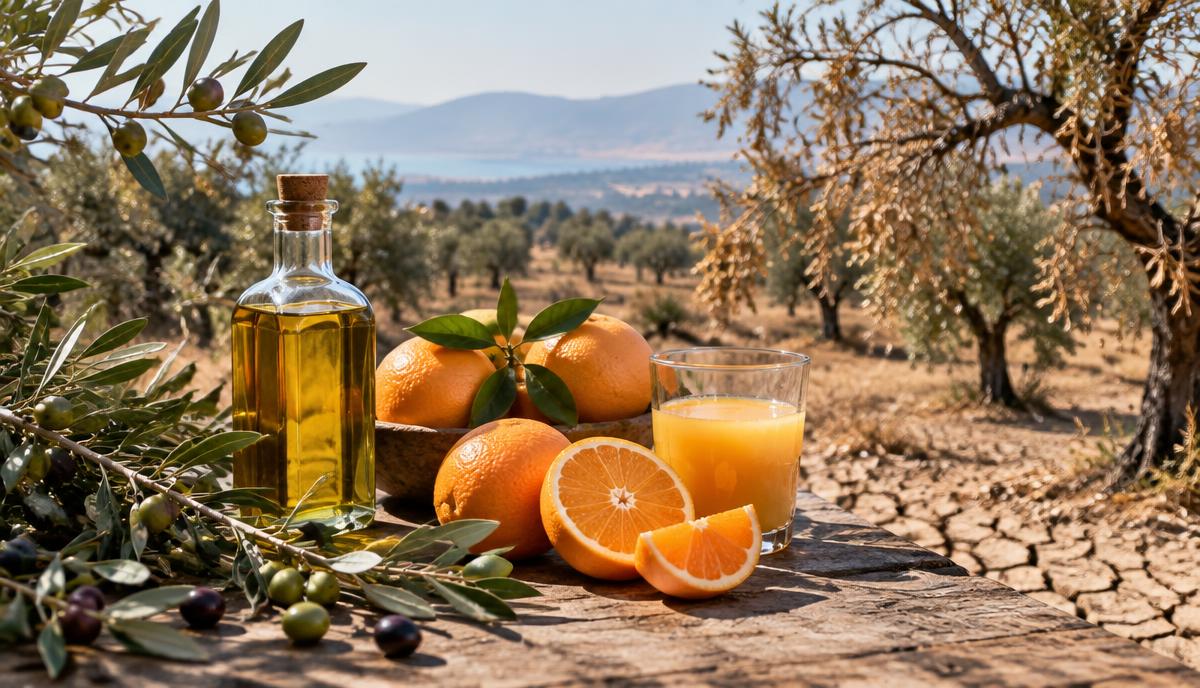
In January 2024, extra virgin olive oil at Spanish mills hit a record €9.20 a kilo. By July 2026 the same grade was trading at €3.43 to €3.52, a fall of roughly 62 percent in thirty months, and the growers who had waited out two droughts for that windfall found it had come and gone before many of them had a harvest to sell into it. Orange juice followed the same arc faster. The pattern is no longer a curiosity of one commodity. It is what happens to a crop when most of the world's supply sits in one or two regions, and those regions are now being hit by heat, drought and disease in the same few seasons.
A €9.20 peak and a €3.40 floor in thirty months
The olive oil spike had a simple origin: two consecutive years of drought in southern Spain, which Gro Intelligence called one of the worst in two decades. EU olive oil output fell from 2.27 million tonnes in 2021/22 to 1.39 million tonnes in 2022/23, a drop of 39 percent, according to figures reported by Euronews. Global production for 2023/24 was forecast at 2.28 million tonnes against consumption of 2.9 million, a shortfall of roughly 620,000 tonnes that only higher prices could close.
Prices closed it by destroying demand. Euronews reported that EU consumer olive oil prices rose 78 percent across 2022 to 2024, with annual inflation in the category peaking at 52.4 percent in March 2024. Shoppers moved to sunflower and rapeseed oil. When the rains and a bigger harvest returned, the market reversed: EU consumer prices fell 23 percent in 2025, and 38.9 percent in Spain, the first decline after four straight years of increases.
Why one region sets the world price
The mechanism is structural, not meteorological. Spain produces almost half of the world's olive oil. When a single climate system governs that much output, a bad season is not averaged away by a good one elsewhere. It sets the global price. Olive trees also cannot respond within a season: a grove planted or grubbed up today shapes supply for decades, so the market adjusts through price and demand rather than quantity.
That makes the price a transmission belt for weather. Temperatures of 42°C to 44°C in Andalusia between 5 and 9 July 2026, reported by the trade monitor Certified Origins, became a market event, with agricultural bodies urging caution on early forecasts for 2026/27 because extreme heat during fruit development stresses rain-fed groves. Spanish olive oil outflows reached about 95,000 tonnes in July, well above seasonal norms, against stocks of roughly 683,000 tonnes. A cheap, abundant harvest and a thin cushion can coexist.
Oranges: a bacterial disease in Florida, heat in Brazil
Orange juice shows the same concentration with a biological accelerant. Brazil's São Paulo belt and Florida together supply most of the world's juice oranges, and both are fighting citrus greening, a bacterial disease spread by an insect that starves trees and makes fruit drop early. Florida found it in 2005. The state's output peaked at 244 million boxes in 1997/98, and the Federal Reserve Bank of Atlanta recorded an 83 percent fall by 2021/22. USDA now forecasts 12 million boxes for 2025/26, a record low, according to FreshFruitPortal.
Brazil is the larger and more recent story. Fundecitrus, the industry research body, found greening in 47.6 percent of trees in 2025 and estimates the disease will cost nearly 50 million boxes in 2026/27. Weather sits on top of that: drought in May 2025, September temperatures about 2°C above historical norms, and a December heat wave. Its May 2026 forecast of 255.2 million boxes was 12.9 percent below the 292.94 million of the year before; a 10 September revision lifted it to 263.15 million, still about 10 percent lower. Disease sets the ceiling and heat decides how close to the ceiling a season lands.
The orange juice price curve: from \$7,000 a tonne to under \$3,000
Juice moved harder than olive oil did. Frozen concentrate stood at about \$7,000 a tonne in late 2024 and about \$2,850 by May 2026, according to FreshFruitPortal, while the spot price for a box of fruit in São Paulo dropped from around \$20 in 2024 to under \$6.
The cause was not a recovered crop alone. Brazil's 2025/26 harvest of nearly 293 million boxes met buyers who had already walked away, and global juice consumption is estimated to have contracted 40 percent over the past decade. Substitution did part of that work. The price spike accelerated a decline in demand that was already under way, and a crop that had been priced as scarce was suddenly in surplus.
Vanilla shows the shape in a smaller market
Vanilla is a useful third case because the cycle there has run through several turns. Madagascar has historically supplied roughly three-quarters of the world's vanilla, and a study in the journal Agricultural and Food Economics counted five price bubbles between 1980 and 2018. Cyclone Enawo in 2017 inflicted about \$400 million of damage on the crop and fed the last of them, with prices touching \$600 a kilo in May 2018.
What followed is the part that matters. High prices drew in planting across the island, and the Rio Times reports reference prices of \$15 to \$50 a kilo in 2026, with distressed lots at \$10 to \$16. After Madagascar liberalised export prices in May 2023, export revenue fell 64 percent by mid-2024 even as shipment volumes nearly doubled, and the government reinstated a farmgate floor in June 2026. A boom that rewards planting leaves behind a bust that punishes the farmers who planted.
Why prices fall back, but not to where they started
The retreat at origin is real, but the old equilibrium does not return, for three reasons. First, retail prices are sticky. Even as futures collapsed, US retail orange juice rose from \$9.46 a gallon in 2023/24 to \$11.73 in 2025/26, according to FreshFruitPortal, which tells you that the screen price is only one input into what a consumer pays. Second, the cost base has moved: FreshFruitPortal also reports higher labour and fertiliser costs squeezing Brazilian growers, and Tridge reports that production costs in traditional Spanish groves now exceed €5 a kilo, well above where origin prices stand, which would leave growers on those plots losing money at the bottom.
Third, demand has been permanently trimmed. The consumers who switched oils or drinks in the boom did not all switch back, and EU olive oil prices, on Euronews's numbers, remain well above their 2021 level even after the 2025 fall. Meanwhile the underlying supply risk has not eased: Tridge reports flowering fertility for Spain's 2026/27 crop down 37 percent, and Greek prices rose 177 percent between December 2025 and May 2026. The cycle is shorter and the swings wider, and the lows are no longer a reliable anchor for either side.
Who carries the risk: hedging gaps
Growers and buyers in these crops are poorly equipped to hedge. Frozen concentrated orange juice futures on ICE are small: Juice News estimated open interest at about 2,500 to 3,000 contracts in February 2025, with daily volumes typically below 1,000. A market that thin can gap on a few large orders, which makes margin calls punishing for processors who need to hedge and tempting for speculators who do not. Olive oil is priced at origin through daily mill quotations, and its dedicated futures market in Jaén is a small venue beside those for grain or sugar.
The practical result is that the risk settles on the least diversified party. A Brazilian grower sells fruit at under \$6 a box in a year when disease has already cut the yield. A Spanish rain-fed olive farmer sells at the origin price in a year when the crop is short, and sells at a loss in a year when it is not. Vanilla growers in Madagascar have no meaningful hedge at all, only the state's floor price, and that floor sits at about \$2.34 a kilo for long pods.
What diversification looks like
Diversification here means spreading exposure at three levels. At the buyer level it is multi-origin sourcing: juice makers have already turned to alternative fruits, and olive oil bottlers can draw more from Turkey, Portugal and Tunisia. At the farm level it is irrigation, shade and mixed cropping that reduce a single block's exposure to a heat week in July. At the contract level it is longer-term supply agreements with price corridors, which turn a price signal that arrives after the harvest into one agreed before it.
None of this is quick. Florida put nearly \$140 million into its citrus industry in the 2025/26 budget and may plant two to five million new trees, but those trees need three to five years to bear fruit. Fundecitrus issues its next Brazilian crop estimate on 10 December. The distance between those two timelines is the real shape of the problem: weather now moves prices within a season, while the supply that would calm them takes most of a decade to arrive.
**Sources:** Euronews, "Producers sound the alarm: why are olive oil prices falling in the EU" (February 2026); FoodNavigator, "The rising price of olive oil: What's causing it and how long will it last?"; Tridge, "\[Exclusive Report\] Olive Oil Prices Dropped. The Risk Hasn't."; Certified Origins, "Olive Oil Market Report - July 2026"; Fundecitrus, "Tree Inventory and Orange Crop Forecast 2026-2027" (executive summary, May 2026); Citrus Industry Magazine, "Brazilian Orange Crop Forecast Increased" (September 2026); FreshFruitPortal, "Orange juice supply to drop 13% on weak demand" (June 2026); FreshFruitPortal, "Florida citrus production hits new record low as greening disease and extreme weather devastate crops" (January 2026); Federal Reserve Bank of Atlanta, "Florida's Citrus Industry Faces an Uncertain Future"; Agricultural and Food Economics, "Are there bubbles in the vanilla price?"; Juice News, "The OJ Futures"; Rio Times, "Madagascar Economy Reels as Vanilla Collapses and Ambatovy Halts Again"
The Food Observatory Brief
Weekly briefing on food systems, climate, agriculture and policy — straight to your inbox.
More on Markets
Fertilizer Prices Are the Hidden Driver of Food Inflation
Fertilizer is made from natural gas and from potash and phosphate controlled by a handful of exporters, so its price follows energy and trade policy more than crop demand. This piece argues that fertilizer affordability, not only grain prices, sets farmers' planting decisions and next season's food prices, and looks at what India, Africa and efficiency measures change.
GLP-1 Drugs Are Starting to Change What the Food Industry Sells
Semaglutide and tirzepatide are changing grocery baskets, restaurant portions and product launches in the United States. This piece argues that the food industry is facing its first pharmacological shift in appetite, traces the consequences for protein, fibre, portion size and the commodities behind them, and sets out why it will not become a universal change.