School Meals Are the Most Underrated Food Policy
Brazil now requires 45 percent of federal school meal money to buy from family farms, a design choice other countries can copy
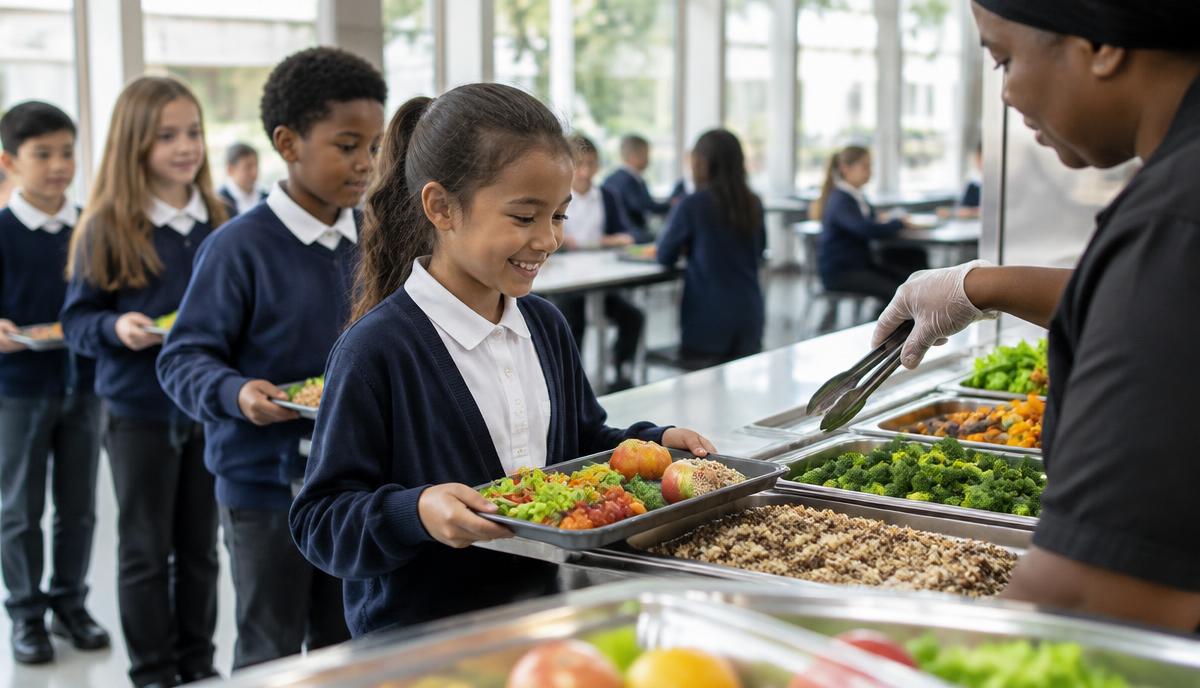
On 1 January 2026, a new rule took effect in Brazil that obliges every school and municipality in the country to spend at least 45 percent of its federal school feeding money on food bought from family farms. The previous floor was 30 percent. The change, set out in Law 15,226 of 2025, redirects roughly R\$2.4 billion a year from a programme budget of R\$5.5 billion towards small producers. The money was already going to lunch. The law decided who gets to sell it.
That is the idea worth taking seriously about school meals. They are usually filed under child welfare, and then ignored by people who work on food systems, climate or rural development. In fact they are one of the few places where a government buys food at scale, on a predictable schedule, for a population that cannot be accused of overeating or under-deserving. That combination makes them the most underrated food policy in use.
A Programme That Quietly Became the Largest Safety Net
The World Food Programme's State of School Feeding Worldwide report, published in September 2025, counted at least 466 million children receiving a meal at school, nearly 80 million more than in 2020. Governments now spend about US\$84 billion a year on school feeding, up from US\$43 billion in 2020, and 99 percent of that comes from national budgets rather than aid. The number of countries with a national school meals policy has risen from 56 to 107. The School Meals Coalition, which launched in 2021, has grown to 111 member governments after its second summit in Fortaleza that same month, and it has set the goal that every child has a healthy school meal by 2030.
The policy is already mainstream in practice. What is missing is recognition that it works on four fronts at once: the child eats better and learns more, the household receives an in-kind transfer, and a farmer gains a buyer. WFP and the Coalition cite returns of between US\$7 and US\$35 for every dollar invested, a wide range that reflects how differently countries run their programmes, not weak evidence.
Where Health, Farmer Income and Equity Point the Same Way
Most food policy forces a choice. Cheaper food squeezes farmers. Higher farm prices hurt poor consumers. Nutrition rules raise costs, and climate rules move them elsewhere. School meals avoid much of this because the buyer is public, the eater is a child, and the beneficiary is chosen by enrolment, not by a means test that excludes the near-poor.
The alignment is not automatic, but the logic is sound. A programme that serves the same number of meals every school day creates demand that a smallholder can plan around. A programme that serves every child in a class, rather than the ones who qualify, spares the poorest families the stigma and paperwork that cause eligible children to go without. And because the food is eaten by children at the age when stunting and learning gaps become fixed, the health return arrives earlier than most nutrition interventions can promise.
India's Evidence Base Is the Deepest
India runs the world's largest school meals programme, now called PM POSHAN. The Union Budget for 2026-27 allocates Rs 12,750 crore to it, covering about 11.2 crore children in government and government-aided schools from pre-primary to Class 8, according to the PRS Legislative Research analysis of the education demand for grants. The scheme has been studied for two decades, and the results are consistent.
Tanika Chakraborty and Rajshri Jayaraman, using annual education survey data on about 200,000 rural households, found that children with a full five years of exposure to midday meals scored 18 percent higher in reading and 9 percent higher in mathematics than those with minimal exposure. The effect built over years, a warning for anyone judging a programme after twelve months.
The more striking work concerns the next generation. A 2021 study in Nature Communications, led by researchers at the International Food Policy Research Institute, followed mothers who had received midday meals as girls. Their children were 0.40 standard deviations taller for their age than the children of mothers who had not, and the scheme accounted for between 13 and 32 percent of India's improvement in child height-for-age between 2006 and 2016. The mothers had about 3.9 more years of schooling, had their first child 1.6 years later and used antenatal care more often. A school meal, in other words, behaves like an education policy and a maternal health policy delivered through the same plate.
The programme still has gaps. India's parliamentary Standing Committee on Education has flagged weak monitoring of meal quality and persistent adolescent malnutrition, and has recommended extending coverage beyond Class 8 and adding breakfast, milk and protein. Tamil Nadu, which serves eggs and a state-funded breakfast, shows what a better-specified menu looks like.
Brazil Wrote the Procurement Rule Into Law
Brazil's National School Feeding Programme, PNAE, reaches nearly 40 million public school students every day. Since Law 11,947 of 2009 it has required that at least 30 percent of federal transfers go to food from family farms, and the 2025 amendment lifts that to 45 percent and gives priority to agrarian reform settlements, Indigenous and quilombola communities and women's groups.
The farm-income effect is measured. Research by the Institute for Applied Economic Research (Ipea), published in January 2025, matched purchasing records with the national register of family farmers and found that supplying PNAE raised incomes by between 23 and 106 percent, with the largest gains among lower-income producers. It also found that farmers in the South and Southeast gained access more readily because their cooperatives were better organised, which is a reminder that a quota only helps those equipped to meet it. The 45 percent rule works best where the state also invests in the cooperatives, paperwork and logistics that let a small producer actually bill a school.
Free Meals for All Spread Across US States
In the United States, the argument has been about eligibility rather than procurement. Nine states, California, Colorado, Maine, Massachusetts, Michigan, Minnesota, New Mexico, New York and Vermont, now provide healthy school meals to all students at no charge, according to the Food Research & Action Center.
The Center's report on the 2023-24 school year found nearly 15.4 million children eating school breakfast, up 7.4 percent in a year, and 29.4 million eating lunch, up 4.4 percent. Participation among low-income students rose even faster, by 8 percent for breakfast and 6.8 percent for lunch. The policy has an equity logic that is easy to miss: when every child eats the same meal, the child who would have been embarrassed to use a free-meal card eats, and the school stops chasing families for meal debt.
The Farmer Benefit Is Not Guaranteed
The weakest claim in the school meals case is the one about farmers, and the evidence says it holds only when the programme is built for it. A three-year randomised trial in 58 districts of Ghana, led by Aulo Gelli and Edoardo Masset at IFPRI, found no strong evidence that school feeding, or its home-grown variant, changed smallholder incomes or market structure. Traders stayed the main suppliers to caterers, and delayed disbursements left a gap of around 50 percent between budgeted and actual per-child meal costs. A caterer paid late and short buys from whoever extends credit, and that is rarely a smallholder.
Kenya shows the same pattern. A 2025 survey of smallholders in selected counties found that only 22.8 percent sold to schools, that maize and beans were bought by more than 90 percent of the schools, and that none reported using sorghum even where it was grown in quantity. A programme that buys two crops from traders cannot do much for a farmer who grows ten, or for a child who needs more than starch and pulses.
Where procurement is designed for small producers, the numbers change. WFP reports that in 2024 East African programmes bought 32,000 tonnes from 18,000 farmers, putting nearly US\$16 million into local economies, and that locally sourced meals in Burundi lifted farmer incomes by 50 percent.
The Financing Gap Is Concentrated Where Need Is Greatest
Coverage follows income. WFP's 2024 report shows school meals reaching 27 percent of children in low-income countries and 80 percent in high-income ones. The financing arithmetic for closing that gap is modest next to what governments spend elsewhere. A report launched at the World Bank and IMF Spring Meetings in April 2025 under the Coalition's sustainable financing initiative estimated that reaching 60 percent coverage in low and lower-middle-income countries by 2030, about 236 million more children, would need US\$3.6 billion in additional annual investment. It pointed to earmarked taxes on tobacco, alcohol, sugary drinks and ultra-processed foods, which it estimated could raise US\$52 billion a year, along with debt-for-food swaps. A US\$40 million Mozambique swap in 2017 financed meals for 300,000 children.
The risk is less the total than the quality of what is funded. The Center for Global Development notes that half of programmes in low and lower-middle-income countries report insufficient resources, and that 63 percent receive allocations below what a nutritious meal costs. A budget that sets the per-child allowance below the real price of food pushes caterers towards the cheapest ingredients and the least diverse menu, which undoes the nutrition and the farm benefits together.
Three Contract Terms Decide the Outcome
Across these cases, three design terms separate programmes that deliver on all four fronts from those that deliver only one. The first is a procurement rule that names who the buyer must buy from, as Brazil does, backed by money for the cooperatives and logistics that let small producers qualify. The second is a menu standard that requires variety, so that sorghum, millets, eggs, vegetables and fruit enter the kitchen instead of two commodities. The third is a per-child allowance set at the real cost of the meal and paid on time, because the Ghana trial showed that a late and short payment erases the first two.
The test for the Coalition's 2030 goal is therefore not only how many more children are counted. It is whether national budgets, as they grow, carry those three terms in the contract between the state and the people who cook and supply the food.
**Sources:** World Food Programme, "State of School Feeding Worldwide 2024" and "WFP report finds 80 million more children now supported by national school meal programmes worldwide"; School Meals Coalition, "Fortaleza report: Second School Meals Coalition Global Summit"; World Vision International, "New Global Report Confirms School Meals as a Proven Path to Progress"; Rede de Alimentação Escolar e Agricultura Familiar (RAES), "Law expands family farming purchases for the Brazilian National School Feeding Programme" and "Public Procurement Increase Family Farmers' Income by up to 106%, Study Reveals"; PRS Legislative Research, "Demand for Grants 2026-27 Analysis: Education"; Nature Communications, "Intergenerational nutrition benefits of India's national school feeding program"; VoxDev, "Midday meals in India improve children's learning outcomes"; Food Research & Action Center, "New Reports Show Offering School Meals at No Charge Increases Participation, Supports Health and Learning"; IFPRI, "School meals as a market for smallholder agriculture: Experimental evidence from Ghana"; Frontiers in Public Health, "Exploring smallholder farmers' access and participation in the Home Grown School Feeding Programme in selected counties of Kenya"; Center for Global Development, "Global School Meals at the Next Frontier: Why Economic Evidence Matters"; Rockefeller Foundation, "Sustainable Financing Initiative With Rockefeller Foundation Support Identifies Innovative Ways To Expand School Meals Worldwide"
The Food Observatory Brief
Weekly briefing on food systems, climate, agriculture and policy — straight to your inbox.
More on Health
Antimicrobial Resistance Starts on the Farm
A large share of the world's antibiotics goes to livestock and aquaculture, and resistance genes travel from farms to people through food, water and soil. This piece argues that drug resistance cannot be solved inside hospitals alone, and examines Europe's experience cutting farm use, the role of vaccines and husbandry, and the reality in places with almost no vets.
Ultra-Processed Foods and the Fight Over a Definition
Regulators, researchers and food companies are contesting what counts as ultra-processed food, because whatever the definition captures decides what gets labelled, taxed, restricted in school meals or marketed. This piece traces how the NOVA research category became a legal one, what the evidence on health outcomes does and does not show, and what a workable definition could look like.