The End of Stable Harvests: Why Climate Volatility Matters More Than Average Warming
Why year-to-year weather swings, not rising averages, are becoming the greater threat to global food production
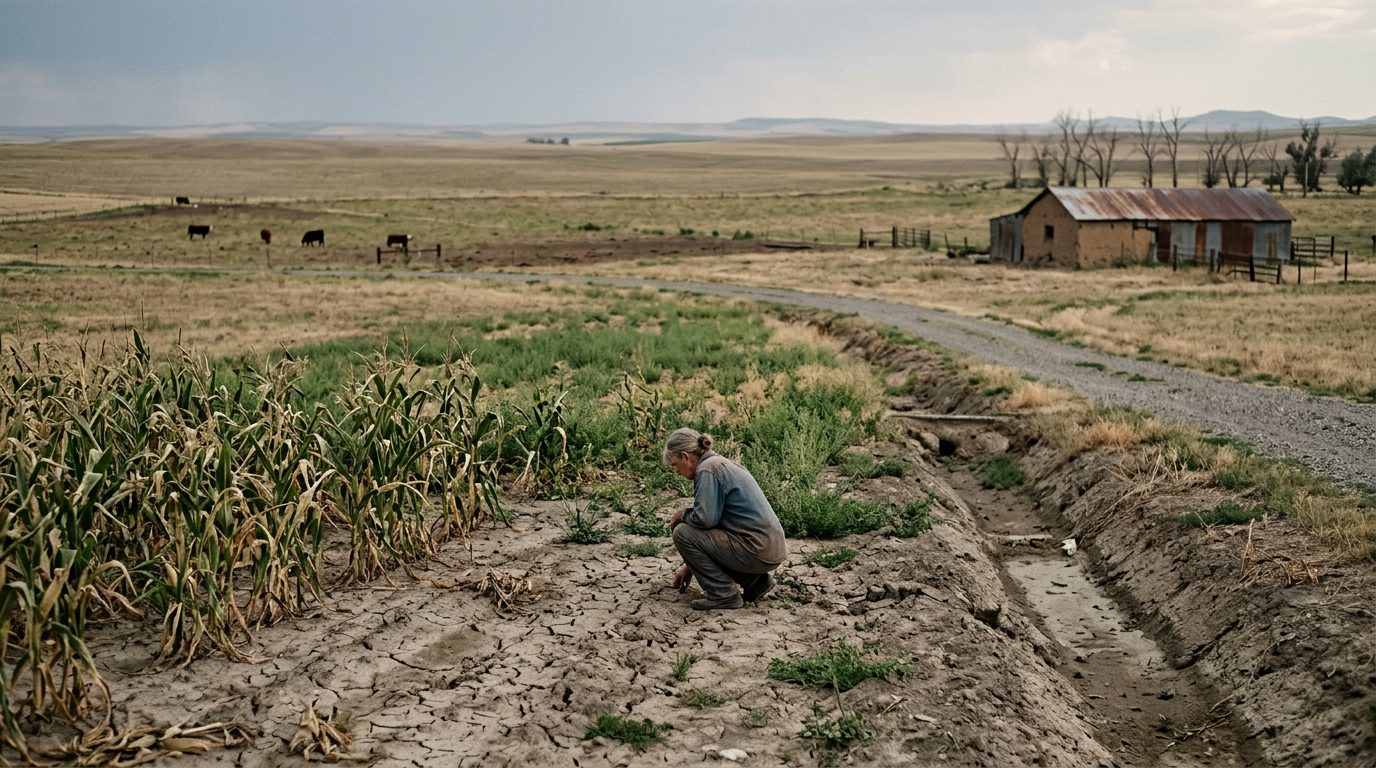
In May 2025, India recorded its wettest month since 1901, with rainfall more than double the seasonal norm; the monsoon reached Mumbai in two days instead of the usual ten. By August, roughly a fifth of the country was in drought, with rainfall deficits of 30 to 70 percent in states from Bihar to Arunachal Pradesh. Crop damage topped 158,000 hectares between April and July alone, and losses were estimated at more than 35,000 crore rupees. This was not two separate weather events, it was one growing season, in one country, that swung from record wet to widespread drought in twelve weeks.
That whiplash, not the slow creep of average temperature, is the more dangerous story in agriculture right now. Global mean temperature has risen by roughly 1.4 degrees Celsius above the pre-industrial baseline, and farmers have had decades to adjust planting calendars, seed varieties, and irrigation around that trend. What they have not adjusted to is the widening gap between one year and the next: a wet spring followed by a scorching summer, a bumper harvest followed by a collapse. Climate scientists increasingly describe that swing itself as the more consequential threat, because farming systems and supply chains are built to withstand shocks, not to absorb constant, unpredictable reversals.
The Statistics Behind the Swing
The scientific case for this shift in emphasis has been building for years. A widely cited analysis by Deepak Ray and colleagues at the University of Minnesota, published in Nature Communications, found that climate variability alone accounts for roughly a third of observed year-to-year yield variability across the world's major crops, reaching more than 60 percent in maize-growing regions like the U.S. Midwest and China's Corn Belt. Research published in Science Advances goes further, finding that climate change is actively increasing the interannual variance of summer crop yields globally, driven by growing swings in temperature and water availability rather than a rising average. A field that yields 10 percent above trend one year and 15 percent below it the next has a healthy long-run mean and a farmer who cannot plan a loan repayment, a labor contract, or a seed purchase around it.
A Planet Swinging Out of Balance
This is why the World Meteorological Organization's most recent assessment described the planet's climate system as swinging "increasingly out of balance," a framing UN Secretary-General António Guterres underscored by noting that 2015 through 2025 has been the hottest eleven-year stretch on record: "when history repeats itself eleven times, it is no longer a coincidence." WMO Secretary-General Celeste Saulo has put it more precisely: human activity is disrupting the climate system's natural equilibrium in ways that compound existing weaknesses in agriculture, rather than simply raising a thermostat. A joint FAO-WMO report on extreme heat released this year found that major crop yields begin declining once temperatures pass roughly 30 degrees Celsius during critical growth stages, and that more than a billion people now face direct livelihood threats from heat extremes, which have risen sharply over the past fifty years. FAO Director-General Qu Dongyu called extreme heat "a major risk multiplier": heat and erratic rainfall stack on existing fragilities in soil, water, and farmer finances rather than acting independently.
Europe's Rich Harvests Prove No Exception
Europe supplied a vivid recent example of how this plays out in a wealthy, technologically advanced system supposedly well insulated from climate shocks. A summer heatwave combined with prolonged dryness cut European Union cereal production by roughly 9 percent year on year, with maize output falling 13 percent to its lowest level since 2007. France, ordinarily one of the bloc's most reliable grain exporters, lost an estimated 8 million tonnes of cereal output, its largest single-year drop in the EU, while its maize harvest hit a 40-year low; Carbon Brief noted that four of the UK's five worst harvests on record have occurred within the past decade. Til Feike, a crop systems researcher who studied the damage, put it plainly: European agriculture has been "hit hard by a long-lasting dry period in combination with record-high heatwaves," and needs to adapt to variability itself, not just to a warmer normal. That June heatwave alone inflicted an estimated two billion euros in grain losses, with France absorbing nearly half. Swiss Re's own crop modeling reaches a similar conclusion from the insurance side: significant yield losses persist even under a moderate 1.5 degree Paris Agreement scenario, meaning insurers' models already understate the risk on their books.
Weather Whiplash Reaches the Corn Belt
The United States offers its own version of the same story, and it does not require a drought headline to make the point. Across Kentucky and much of the eastern Corn Belt in 2025, growers received 40 to 51 inches of rain by early July, well above normal, only for the tap to shut off almost entirely for the rest of the season. The result was a patchwork rather than a uniform bad year: fields planted on time in western Kentucky produced excellent yields with strong kernel fill, while fields a county away that were planted late, or sat on compacted soil, came up dramatically short, because the rain fell at the wrong time rather than the wrong amount, even as University of Kentucky agronomists confirmed the annual total would finish above normal. Pro Farmer's crop tour analysts described a season that flipped from drought concern in early summer to flooding risk by late summer, the kind of within-season reversal becoming the defining feature of American row-crop agriculture.
Australia's Wheat Belt Goes From Bust to Boom in a Single Year
Few agricultural regions demonstrate the cost of variability as starkly as Australia's wheat belt. In the drought-scarred 2019-20 season, national wheat production collapsed to 15.2 million tonnes, among the weakest harvests in decades. The very next season, as rain returned to New South Wales and Western Australia, production more than doubled to a record 33.3 million tonnes, according to the Australian Bureau of Agricultural and Resource Economics and Sciences, a 120 percent swing in twelve months that forces growers, grain handlers, and export logistics to reset capacity planning almost from scratch every season, with farmers who had spent years bracing for the next dry spell instead managing fungal disease and wet-finish quality risk in a crop that had grown almost too well.
China's Rivers Redraw the Grain Map
China's 2025 season delivered a similar lesson in a country whose food security planning depends heavily on stability. Record autumn rainfall across the Huang-Huai-Hai plain, the North China Plain region spanning Shandong, Henan, Hebei, Anhui, and Jiangsu that accounts for roughly 30 percent of the country's corn output, disrupted harvest across a belt that had spent earlier months fighting drought in its wheat-growing areas further north. Shandong received more than seven times its typical early-October rainfall, the heaviest such stretch in six decades for the province, forcing Beijing to route emergency funds toward drainage and grain drying to bring in a harvest that had looked secure only weeks earlier, a reversal that left little room for error given corn imports had already fallen more than 90 percent as the country leaned on domestic output to hit its roughly 700-million-tonne grain target.
Five Failed Seasons Break the Coping Mechanism
East Africa illustrates the same dynamic from the opposite direction of vulnerability. Attribution scientists found that the drought which gripped the Horn of Africa through repeated failed rainy seasons between 2020 and 2023 was made roughly a hundred times more likely by climate change, according to CNN's reporting and corroborating World Food Programme and UN disaster reduction analysis. What made that drought so devastating was not low rainfall in any single season, it was the failure of five consecutive rainy seasons in a row, breaking coping mechanisms pastoralist and farming communities had used for generations to ride out a single bad year. A system built to absorb one shock cannot absorb five in a row, and that compounding, sequential failure is precisely the variability signature scientists now track more closely than the average.
Insurance Built for a Climate That No Longer Exists
The practical consequence is that risk management tools built for a more stable climate are increasingly mismatched to the risk they are meant to cover. Weather-index insurance, championed by the World Bank, IFAD, and WFP to protect smallholders, depends on historical patterns to price premiums and set payout triggers, and the year-to-year distribution of outcomes has widened enough that those models now require constant recalibration. Swiss Re's research group has recommended agricultural reinsurers abandon static, backward-looking risk models entirely, pricing policies around a wider, faster-shifting distribution of outcomes rather than the narrow bands decades of stable data once justified. Munich Re's broader catastrophe tracking shows the same trend outside agriculture, with losses from smaller, more frequent events like localized flooding climbing as a share of overall claims, an accumulation of erratic disruptions reshaping the risk rather than any single catastrophe. Commodity traders and national reserves plan around expected variance too, and when that variance turns unstable, the machinery built to smooth out agricultural risk loses its footing.
What Averages Hide
None of this argues that average warming is unimportant. It sets the baseline temperature that variability now swings around, and it steadily narrows the margin for error in every growing season. But treating warming as the whole story misses what is actually breaking farming systems in real time, from the flooded fields of the Huang-Huai-Hai plain to the drought-then-record swings of the Australian wheat belt. Averages are what climate models publish and policymakers cite. Variance is what farmers live through, harvest by harvest, and it is the variance, not the mean, that is now outrunning the tools built to manage it.
Sources: Ray, D.K. et al., Nature Communications, "Climate variation explains a third of global crop yield variability"; Science Advances, "Climate change increases the interannual variance of summer crop yields globally through changes in temperature and water supply"; World Meteorological Organization, "Earth's climate swings increasingly out of balance"; FAO-WMO, "Extreme heat pushes agrifood systems to the brink"; Carbon Brief, "How this summer's heat and drought impacted crops in Europe – in six charts"; CEED India, "From Floods to Drought – The 2025 Climate Story of India"; CNN, "Horn of Africa: Catastrophic drought made 100 times more likely by climate change, analysis finds"; World Food Programme, "Insurance helps farmers protect livelihoods as climate shocks intensify"; World Food Programme, "Regional Drought Response Plan for the Horn of Africa: 2023"; Swiss Re, "Climate change impacts on crop yields in Europe"; Munich Re, "Severe thunderstorms, wildfires, and flooding – losses from non-peak perils are on the rise"; University of Kentucky Grain Crops Extension, "Wet Spring and Dry Summer Make Wild Yield Swings"; Pro Farmer, "Eastern Corn Belt flooding will test 'rain makes grain' adage as Crop Tour weighs impact"; Australian Bureau of Agricultural and Resource Economics and Sciences (ABARES), wheat production estimates, 2019-20 and 2020-21; World Grain, "Australia raises wheat crop estimate to new record"; ABC News Australia, "NSW crop production set to triple in size after sharp turnaround in rainfall"; Grain Central, "China flood jeopardises grain output"
The Food Observatory Brief
Weekly briefing on food systems, climate, agriculture and policy — straight to your inbox.
More on Climate
Warming Oceans Are Moving the World's Protein
Fish stocks are moving poleward and into deeper water as the oceans warm, while the countries that depend most on fish protein are often the least able to follow them. This piece argues that maritime boundaries, fisheries agreements and aquaculture investment have not caught up with moving fish.
Rice Paddies and the Other Greenhouse Gas Problem
Flooded rice is a major source of human methane, and alternate wetting and drying or direct seeding can cut it while saving water. This piece uses the first payouts at Punjab Agricultural University to show why a known fix still struggles to scale, and what verification, contracts and policy would move adoption across South and Southeast Asia.