Why Every Climate Story Is Also a Food Story
A fertilizer spreader in Iowa, a cleared pasture in Mato Grosso, and a saltwater-flooded paddy in Bangladesh are all the same story
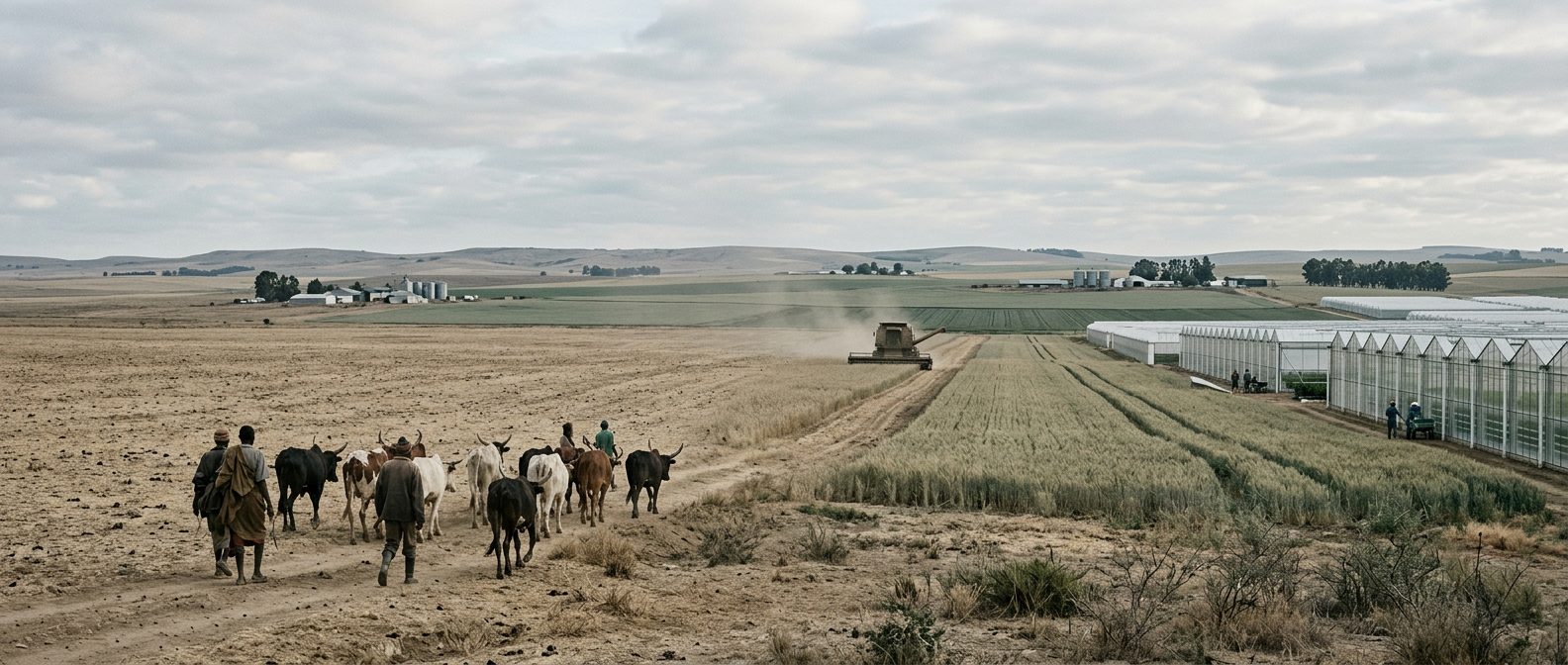
A tractor spreading nitrogen fertilizer on an Iowa cornfield, a cattle rancher in Mato Grosso clearing forest for pasture, a Bangladeshi farmer watching saltwater creep into a rice paddy: none of these routinely appear in a climate story, yet together they explain more of the crisis than most of what does. Food systems generate roughly a third of all human-caused greenhouse gas emissions, according to the UN Food and Agriculture Organization, which put the 2023 figure at 16.5 billion tonnes of CO2 equivalent, about 32 percent of the global total. That is a bigger share than every car, truck, ship and plane on Earth combined. And yet food rarely gets treated as a climate subject in its own right. It gets treated as a side dish.
This is not a minor blind spot in how newsrooms and negotiators divide up the crisis. It is structural. Climate coverage defaults to smokestacks, tailpipes and power plants because those are legible and easy to map onto an energy-transition narrative: swap coal for solar, gas cars for electric ones, and the emissions curve bends. Food does not fit that story. Its emissions come from soil microbes, cow stomachs, felled trees and leaking nitrogen, spread across hundreds of millions of farms rather than a few thousand facilities. Its solutions do not reduce to a single technological substitution, and its politics touch culture, sovereignty and survival in ways that resist the tidy swap-this-for-that logic that works for energy. The result is that a subject responsible for a third of the problem gets a fraction of the attention, the financing and the policy machinery devoted to fossil fuels.
The Emissions Story Nobody Leads With
The FAO's own accounting, drawn from FAOSTAT data spanning 2001 to 2023, breaks agrifood emissions into three roughly equal buckets: farm-gate activities like livestock digestion and fertilized soils (49 percent of the total and rising), land-use change such as deforestation for cropland and pasture (19 percent, the only category actually shrinking), and everything downstream of the farm gate, including processing, packaging, refrigeration, retail and food waste, which grew by nearly 80 percent since 2001 and now accounts for roughly a third of agrifood emissions. That last category is the part almost nobody talks about. When a supermarket chain announces a net-zero pledge, the diesel-cooled trucking fleet moving lettuce and the methane rising off landfilled scraps rarely make the ledger, even though the FAO's own EDGAR-FOOD dataset, developed with the Consultative Group on International Agricultural Research, found livestock alone produces more emissions than any other single source within the food system, 4.3 billion tonnes CO2 equivalent in 2023, followed by deforestation at 2.8 billion tonnes. Synthetic nitrogen fertilizer has its own separate reckoning: research published in Scientific Reports found its production and use account for more than 2 percent of global emissions on their own, a slice roughly comparable to global aviation, a sector that gets vastly more scrutiny.
Regionally, the story complicates the usual North-South emissions narrative. Asia now produces the largest share of agrifood emissions at 7.1 billion tonnes, having grown 53 percent since 2001 as diets shift and production intensifies, while Africa's emissions rose 17 percent even as the continent remains the most food-insecure. Europe and Oceania, by contrast, saw agrifood emissions fall 6 and 19 percent respectively, evidence that policy and dietary shifts can bend this curve too, just as they have started to for power generation.
What Climate Journalism Actually Covers
The gap is not just in the numbers; it shows up in what gets written. An analysis by Sentient Media and Faunalytics of 1,000 recent climate articles across ten major US outlets, including the New York Times and the Wall Street Journal, found that 68 percent mentioned mining, manufacturing or energy production and 53 percent mentioned fossil fuels, but only 7 percent mentioned animal agriculture at all. Even within that sliver, researcher Coni Arévalo noted that cattle, which account for more than 60 percent of livestock emissions, appeared in fewer than a third of the articles that mentioned animal agriculture in any form. The Los Angeles Times led the outlets studied, and even it mentioned animal agriculture in only 14 percent of its climate coverage. This is not bad faith reporting. It reflects an assignment structure: climate desks cover energy, environment desks cover conservation, business desks cover markets, and food, when it appears at all, lands on lifestyle or health pages where the climate math never enters the frame. A heat dome gets filed as weather. The wheat shortage it caused gets filed as economics. The connective tissue between them stays unwritten because no single beat owns it.
The Diplomatic Afterthought
The same fragmentation plays out at the highest levels of climate diplomacy. COP28 in Dubai was genuinely a turning point on paper: it produced the first-ever leaders' declaration on food and agriculture at a UN climate summit, folded food into the Global Stocktake, and gave it a foothold in the Global Goal on Adaptation. Momentum reversed almost immediately. As the International Institute for Sustainable Development documented in its assessment of COP29 in Baku, food systems, biodiversity and ecosystems barely featured in the final outcomes a year later, despite food systems driving an estimated 15 percent of annual global fossil fuel use, a figure that should have kept the sector inside energy-transition negotiations rather than sidelined as an adaptation afterthought. More than 30 countries signed a declaration on cutting methane from organic waste, covering nearly half of global methane emissions from that source, and Brazil and the UAE wrote agriculture explicitly into their new emissions pledges. But IISD's analysts were blunt that the roughly 300 billion dollars developed nations pledged in climate finance needs to be treated as a floor rather than a ceiling, given that aligning food systems with climate goals alone is estimated to require 1.1 trillion dollars a year. Food keeps getting acknowledged and then deprioritized within the same summit cycle, a pattern that mirrors how it gets covered in the press: present in the communique, absent from the headline.
The Ledger Runs Both Directions
What makes this omission stranger still is that food is not only a major emitter, it is also one of the crisis's most exposed victims, which should make it a double-billed story rather than a niche one. Carbon Brief's review of recent price shocks lays this out with unusual precision. Portugal's olive oil prices rose nearly 70 percent year-over-year through early 2024 as global olive oil production fell roughly a third between 2021 and 2024 amid Mediterranean drought. Florida orange production more than halved between the 2021-22 and 2022-23 harvests, part of a decline exceeding 40 percent since 2020, pushing US orange juice prices from $2.36 to $4.26 per 16 ounces. In England, the wettest 18-month stretch on record cut vegetable production by nearly 5 percent, with cauliflower yields down more than 9 percent and winter crop output projected to fall a further 17.5 percent. China's extreme rainfall, including a single event that dumped 600 millimeters in 24 hours, roughly three-quarters of an average year's total, has contributed to rice yield losses estimated at 8 percent since the late 1990s. A separate 2024 study found that a hotter month during Europe's 2022 heatwave alone added up to nearly a full percentage point of food inflation, with warming by 2035 projected to amplify such shocks by 30 to 50 percent. None of this is hypothetical. It is the last three years of grocery receipts.
Inflation, Migration and the Stories That Never Connect the Dots
Once food is understood as the crisis's transmission mechanism rather than a side effect, entire categories of coverage look incomplete. Central bank commentary on stubborn inflation routinely omits that climate-driven harvest failures are now a recurring, quantifiable driver of the food component of headline CPI, not a one-off shock to be smoothed over in forecasts. Migration coverage traces displacement to conflict and poverty while underplaying that crop failure and water stress are often the proximate trigger that turns chronic hardship into a decision to leave, particularly across the Sahel and Central America. Even energy-transition reporting, the genre climate journalism is most comfortable with, tends to ignore that agriculture is itself a major fossil fuel consumer through fertilizer manufacturing, irrigation pumping and cold-chain logistics, so a serious decarbonization story about diesel or natural gas is frequently also a food story that goes untold.
Where the Leverage Actually Sits
The flip side of food's outsized emissions footprint is that it offers mitigation options with few analogues elsewhere in the economy. The IPCC's Special Report on Climate Change and Land found that shifting global diets toward more plant-based patterns, cutting the roughly one-third of food lost or wasted after harvest, and restoring degraded agricultural land could together deliver a meaningful share of the emissions cuts needed to keep warming near 1.5 degrees Celsius, at lower cost than many industrial abatement pathways and with co-benefits for biodiversity, water and public health that a solar farm or an EV fleet cannot offer. Research published in PNAS on dietary shifts found that more plant-forward eating substantially increases the feasibility of Paris-aligned pathways precisely because it acts on multiple fronts at once: less land pressure, less methane, more sequestration capacity freed up on former pasture. That is a rare kind of lever in climate policy, one that reduces emissions and expands adaptive capacity simultaneously, and it barely registers next to the perennial debate over grid mixes and battery chemistry.
The Beat That Should Not Exist Separately
None of this argues that food deserves a bigger corner of the newsroom or the negotiating hall. It argues that the corner itself is a mistake. Treating climate and food as separate beats, separate ministries, separate line items in a national pledge, reproduces on paper a divide that does not exist in the physical system being described. Every input into a farm, and every mile food travels afterward, runs through the same atmosphere as every power plant, and every degree of warming that plant contributes comes back around to reshape what that farm can grow. A climate story that stops at emissions inventories and energy grids is not wrong, but it is unfinished, and readers and policymakers working from that incomplete picture keep discovering the food half of the crisis only when it shows up as a grocery bill, a bare olive oil bottle or a migration headline they did not see coming. The throughline was there in the data the whole time.
Sources: Food and Agriculture Organization of the United Nations, "Greenhouse gas emissions from agrifood systems: Global, regional and country trends, 2001-2023"; Carbon Brief, "Food systems responsible for 'one third' of human-caused emissions"; Carbon Brief, "Five charts: How climate change is driving up food prices around the world"; International Institute for Sustainable Development, "Good COP? Bad COP?: Food systems at COP29"; Sentient Media and Faunalytics, "93 Percent of Climate News Never Mentions Meat"; Scientific Reports, "Greenhouse gas emissions from global production and use of nitrogen synthetic fertilisers in agriculture"; IPCC, "Special Report on Climate Change and Land," Chapter 5: Food Security; PNAS, "Food matters: Dietary shifts increase the feasibility of 1.5°C pathways in line with the Paris Agreement"; CNN Business, "Extreme weather caused by climate change is raising food prices worldwide, study says"
The Food Observatory Brief
Weekly briefing on food systems, climate, agriculture and policy — straight to your inbox.
More on Climate
Warming Oceans Are Moving the World's Protein
Fish stocks are moving poleward and into deeper water as the oceans warm, while the countries that depend most on fish protein are often the least able to follow them. This piece argues that maritime boundaries, fisheries agreements and aquaculture investment have not caught up with moving fish.
Rice Paddies and the Other Greenhouse Gas Problem
Flooded rice is a major source of human methane, and alternate wetting and drying or direct seeding can cut it while saving water. This piece uses the first payouts at Punjab Agricultural University to show why a known fix still struggles to scale, and what verification, contracts and policy would move adoption across South and Southeast Asia.