AI Is Quietly Transforming Agriculture
John Deere machines sprayed herbicide across more than five million acres last year using AI-guided precision systems
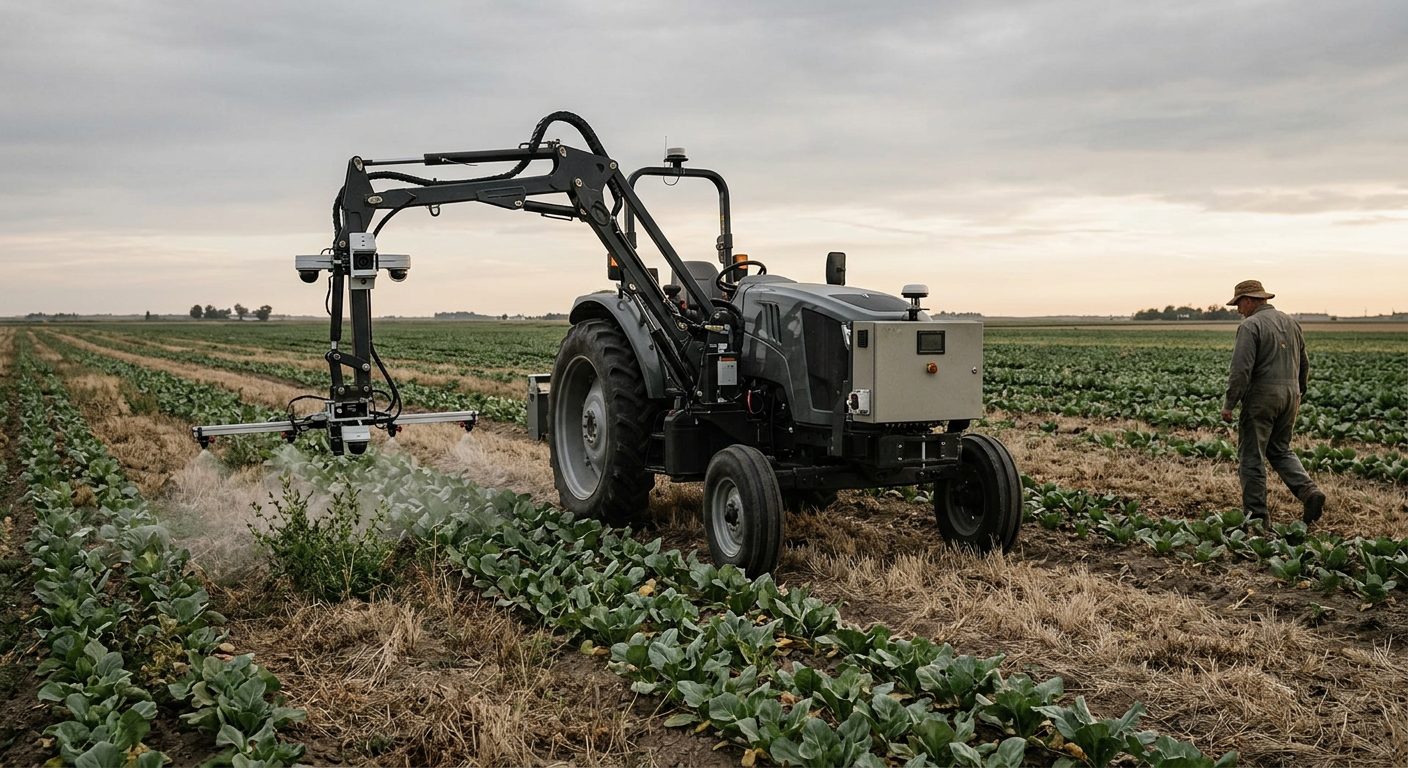
Last year, John Deere machines equipped with camera-and-nozzle systems sprayed herbicide across more than 5 million acres of American farmland, an area larger than New Jersey, while cutting the volume of herbicide mix applied by nearly half. That is not a pilot project or a demo at a trade show. It is a commercial product, sold by acre and by season, running on ordinary combines and sprayers across the Midwest. It is also a useful corrective to how AI in agriculture tends to get discussed, as a future of autonomous drone swarms and robot farmhands.
The real story so far is less cinematic: cameras that tell a soybean from a pigweed at 15 miles an hour, models that flag a diseased cassava leaf before an extension officer would notice, satellites that classify a continent's farm fields by crop type in an afternoon, tractors in Florida cane fields running overnight with no one in the cab, and credit algorithms that decide, from a satellite photo and a mobile-money history, whether a farmer in Kenya gets a loan for fertilizer. None of it looks like science fiction. All of it is already changing how food gets grown, financed, and insured.
Cameras That Know a Weed From a Soybean
The clearest evidence of real adoption is computer vision applied to narrow, well-defined tasks. Deere's See & Spray system uses boom-mounted cameras to scan roughly 2,500 square feet of ground per second, identifying weeds against crop and soil and triggering individual nozzles through the company's ExactApply system. Farmers using it in 2025 saved an estimated 31 million gallons of herbicide mix, and multi-state research found yield gains of two bushels an acre on average, with an upper range near 4.8 bushels, compared with blanket spraying. Deere now charges by the acre, a sign the technology has moved past subsidized pilots into a product farmers choose because it saves them money, not because a manufacturer is giving it away to build a customer base.
A Cassava App That Outperforms the Field Agent
A similar pattern shows up in pest and disease detection, in a very different setting. PlantVillage, a Penn State-linked project, built a smartphone tool called Nuru that diagnoses cassava diseases like cassava mosaic disease and cassava brown streak disease from a photo, working offline in rural Kenya, Tanzania, Zimbabwe, and India. In trials, Nuru identified disease symptoms about twice as accurately as the human extension workers it was tested against. One documented farmer used the app to select disease-free cuttings for propagation and, over a single season, raised her yields by 146 percent and her revenue by 55 percent. These are small numbers relative to the scale of African smallholder agriculture, but they show something hype cycles usually skip: a computer vision model cheap enough to run on a basic smartphone, solving a problem that once required a scarce agronomist to drive out and look at a field in person. The bottleneck it removes is travel time, not judgment.
The Loan Officer Is a Satellite Photo
Where AI is doing arguably the most consequential work is in finance, not farming itself. Apollo Agriculture, operating in Kenya and Zambia, has extended credit to nearly 400,000 farmers since 2016 by combining satellite imagery, mobile app data on farm size and cropping history, mobile money transaction patterns, and whatever credit bureau records exist, to score farmers who have no collateral and no formal financial history. Farmers financed through Apollo report yields two to two-and-a-half times the Kenyan national average, largely because the loans guarantee quality seed and fertilizer rather than cash a farmer might spend elsewhere. Pula Advisors runs a parallel model for crop insurance, using satellite and weather data to trigger index-based payouts without a claims adjuster ever visiting a flooded field. Pula scaled from 31,000 insured farmers in Zimbabwe in its first year to more than a million within three years, and has partnered with the Bayer Foundation to reach 10 million farmers across seven countries by 2030. This is the least visible form of agricultural AI and possibly the most structurally important, because credit and insurance access, not seed genetics, is often the binding constraint on whether a smallholder can afford better inputs at all.
Watching Farmland From Orbit
The satellite layer underneath those credit models is itself becoming a distinct AI story. Planet Labs, whose small satellites image most of the earth's land surface daily, worked with the Technical University of Munich and the EU-funded Open Earth Monitor project to classify crop type across 51 million field boundaries in 15 European countries, using a transformer model trained on Sentinel-2 imagery. The system sorted every field into one of 28 crop types in about four hours, reaching roughly 88 percent overall accuracy and topping 90 percent on wheat, rapeseed, and barley, with maize exceeding 98 percent. Accuracy drops to around 72 percent on fields smaller than a hectare, a reminder that resolution limits still bind at smallholder scale even where they no longer matter for the large, regular fields typical of American and European row-crop farming. Planet also supplies FAO's geospatial tools for tracking cropland expansion. Satellites have photographed farmland for decades; what changed is a model that turns a pixel grid into a crop-by-crop map without analysts drawing polygons by hand.
The Tractor With No One in the Cab
Autonomous field equipment has moved further into commercial use than most coverage suggests, though not as far as "self-driving tractor" implies. In early 2026, U.S. Sugar, one of the country's largest cane producers, put five John Deere tractors, four 8R models and one 9R, into commercial service across its 255,000 acres of South Florida farmland, using automation kits and fleet software from Autonomous Solutions Inc. to run land preparation and cultivation up to 24 hours a day. The deployment followed an 18-month pilot and is the largest such fleet in the sugar industry, a real capital bet by a slim-margin commodity business, not a demo. But the tractors are remotely supervised from a central control station, one operator overseeing multiple machines, and the tasks are bounded ones, tillage on flat, mapped fields, not the judgment-heavy work of a mid-season problem. That is the same pattern as See & Spray and Nuru: real autonomy, narrowly scoped.
Editing Genes Before Planting a Seed
Crop breeding is the domain where the gap between promise and delivery is widest. Inari, a Massachusetts-based ag biotech that has raised more than $720 million, pairs multiplex gene editing with AI models trained to predict which genetic edits will improve yield before anyone plants a seed. The company argues conventional breeding has delivered roughly 1 percent annual yield gains in corn, soybeans, and wheat for three decades, and that its AI-guided editing could push increases into the 10 to 20 percent range without additional fertilizer or water. Its soybean line is closest to commercial demo plots this year, with corn and wheat still in field trials. These are real products in a real pipeline, but breeding cycles are long, regulatory review is not instantaneous, and a claim about what a gene edit does in a lab is not the same as a claim about what it does across thousands of variable fields. Skepticism is warranted not because the science is fake, but because agriculture has heard yield-doubling promises before, and the timeline to verify them runs in years, not launch cycles.
Why the Data Problem Comes Before the Model Problem
The honest caveat running through all of this, made pointedly in a 2026 MIT Technology Review analysis, is that AI models in agriculture are only as good as the data feeding them, and most farm data is fragmented across incompatible systems, from equipment sensors to weather feeds to decades-old paper records. Cited research suggests properly deployed AI could improve yields by 26 percent and cut water use by 41 percent, but those numbers describe a ceiling, not the current floor, and the same reporting's account of Wilbur-Ellis, a 104-year-old ag distributor, shows the unglamorous work of unifying supplier and pricing data has to happen before any model can be trusted with a real decision. CGIAR researchers make the same point about smallholder deployments: the barrier is rarely the algorithm, it is connectivity, device cost, digital literacy, and the risk that badly designed systems exclude the farmers who need them most.
The Skeptics Are Not Just Being Contrarian
Not everyone studying this sector agrees that narrow adoption is unambiguously good news. Celize Christy of the HEAL Food Alliance argues precision agriculture is often marketed as close to a sustainability cure-all when the evidence does not support that framing, and a HEAL report found pesticide and fertilizer use has in some cases risen, not fallen, since precision tools became common. A peer-reviewed assessment in the Nature portfolio journal npj Sustainable Agriculture reached a similar conclusion, that environmental sustainability claims for precision agriculture are not yet fully supported by evidence. Lim Li Ching and Pat Mooney of the International Panel of Experts on Sustainable Food Systems raise a different concern, less about whether the tools work than about who controls them: satellite imagery, mobile money histories, and farm sensor data accumulate as proprietary assets inside a handful of technology and equipment companies, and that concentration is itself a form of power over farmers, independent of whether any individual model performs well. None of this contradicts the acreage and accuracy figures above. It is a reminder that a tool being real and narrow does not automatically make its downstream effects neutral.
The Narrow Jobs Are the Real Story
What separates genuine adoption from hype is not the sophistication of the model but the narrowness of the job it is asked to do. Spraying decisions, disease flags, crop-type maps, tillage on a mapped field, and credit scores are bounded, repeatable problems with clear feedback loops, and that is precisely where AI in agriculture is earning its keep, acre by acre and loan by loan. Reinventing plant genetics, running a tractor through a full season of judgment calls with nobody watching, or predicting yield across an entire unstructured supply chain remains a harder, slower problem, and treating the two as the same story is where most coverage of this space goes wrong.
Sources: John Deere, "Deere Customers Use See & Spray Technology Across 5 Million Acres in 2025"; Michigan Farm Bureau (Michigan Farm News), "John Deere See & Spray tech use hit 5M acres in 2025"; CGIAR Platform for Big Data in Agriculture, "PlantVillage Nuru: Pest and Disease Monitoring Using AI"; GSMA Mobile for Development, "AI-Driven Smallholder Farmer Lending in Africa: Insights from Apollo Agriculture"; Bayer Foundation, "Partnership with Pula Foundation: Insuring 10 Million Smallholder Farmers Across Africa & Asia"; AgTech Navigator, "Combining AI with Gene Editing Set to Boost 'Stagnating' Corn Yields, Says Inari"; AgTech Navigator, "Inari Raises $144M as Investors Back Gene Editing Tech"; CGIAR System, "How AI Is Transforming Extension Services for Precision Smallholder Farming"; MIT Technology Review, "Agriculture Is Ready for AI, But Its Data Isn't"; Planet Labs, "Continental Crop Type Mapping Leveraging AI, Open Datasets and Planet's Infrastructure"; Planet Labs, "Innovative Forest Monitoring Platform SEPAL 2.1 Goes Mobile" (on Planet imagery in FAO's geospatial toolkit); Future Farming, "U.S. Sugar Deploys Autonomous John Deere Tractor Fleet Across 255,000 Acres"; Inside Climate News, "The Farming Industry Has Embraced 'Precision Agriculture' and AI, but Critics Question Its Environmental Benefits"
The Food Observatory Brief
Weekly briefing on food systems, climate, agriculture and policy — straight to your inbox.
More on Innovation
Biologicals and the Quest for Less Nitrogen Fertilizer
Microbial products sold as ways to cut synthetic fertilizer have strong commercial pull because of price volatility and nitrous oxide targets. This piece looks at independent trial evidence, India's nano urea experience and regulatory gaps to set out which claims farmers can reasonably trust.
The Race to Cut Cattle Methane With Feed Additives
Methane inhibitors and seaweed additives promise large cuts in cattle emissions. This piece explains why the technology works in feedlots and dairies but struggles with grazing herds where most emissions sit, and why cost, consumer reaction and who pays are the real bottlenecks.
Alternative Proteins After the Hype
Alternative protein companies raised billions on the promise of rapidly displacing conventional meat, then hit a wall of stalled sales, layoffs, and investor retreat. This piece looks past the hype cycle's collapse to what alternative proteins are actually achieving now, and where the technology still has a credible path forward.