Biologicals and the Quest for Less Nitrogen Fertilizer
In 59 of 61 Midwestern trials, microbial nitrogen products added no yield beyond fertilizer alone
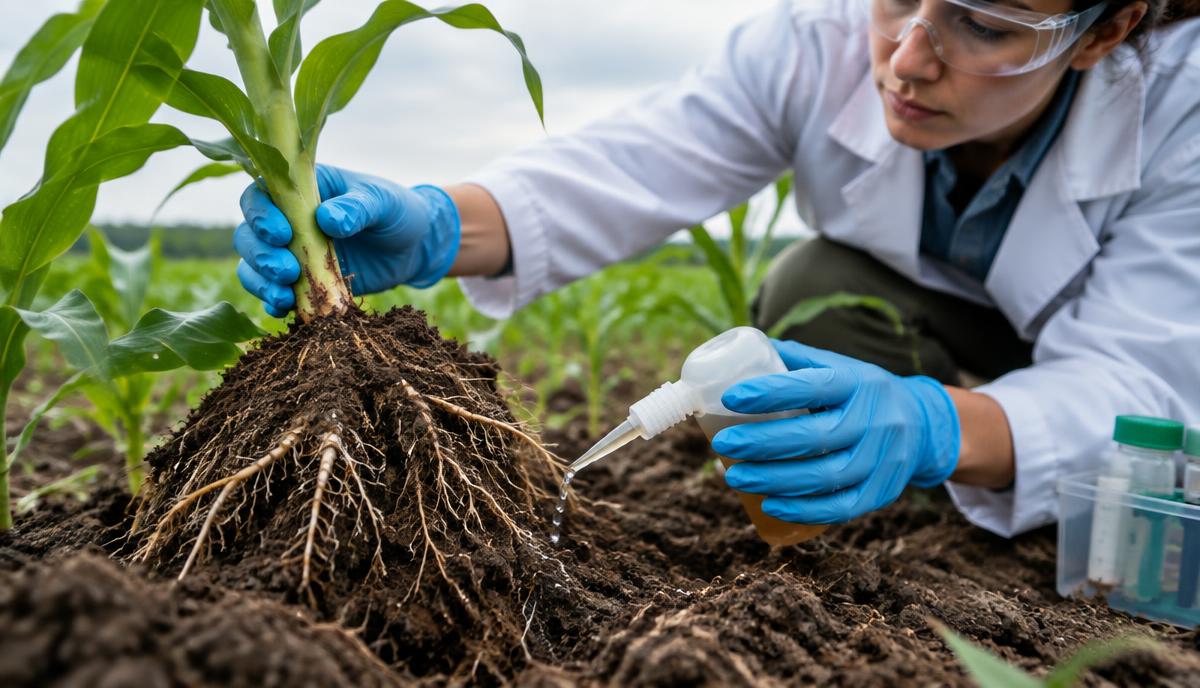
University agronomists in ten US Midwestern states ran 61 nitrogen-rate trials on commercial products that claim to fix nitrogen from the air or help crops use it better. In 59 of them, the product added no yield beyond what fertilizer alone delivered. The two that did respond were worth roughly 12 to 20 pounds of nitrogen per acre. Dave Franzen of North Dakota State University, who led the work for a committee of regional experiment station directors, said that if the split had been even he would have considered the products. Two in 61, he said, was not close.
Those results sit awkwardly beside a market that analysts at MarketsandMarkets value at US\$18.44 billion in 2025 and expect to reach US\$34.99 billion by 2030. Both things are true at once, and the gap between them is the story of biologicals as a fertilizer substitute: a real commercial need, attached to products whose benefit depends heavily on how and where they are tested.
A product can fix nitrogen without saving any
The central confusion in this market is between a biological process happening and a farmer's fertilizer bill falling. Pivot Bio, the best-funded company in the field, sells gene-edited bacteria that colonize corn roots. A peer-reviewed study from the University of Illinois, with Purdue and Wisconsin collaborators, published in Agronomy Journal in January 2025, used nitrogen-15 tracing to confirm that the bacteria supply up to 35 pounds of nitrogen per acre from the atmosphere early in the season. That is a genuine finding, and the isotope method is the right way to prove it.
But an amount of nitrogen fixed is not the same as an amount of fertilizer avoided. Corn takes up most of its nitrogen in the weeks after the early window when the microbes are most active, so a contribution measured early does not map neatly onto a rate cut at planting. An Illinois Corn Growers summary of the work describes the product as filling nitrogen gaps and supplementing traditional sources without replacing them. The company's own framing is that its latest formulation replaces around 20 percent of synthetic nitrogen per grower, a modest claim set against the sector's rhetoric. Whether even that holds on a given field depends on soil organic matter, weather, previous crop and the fertilizer program it sits inside.
Trial design decides the answer
Most disputes over biologicals are disputes over method. A strip trial on a single farm, with the product on one half and untreated corn on the other, tells you little unless the untreated half receives the same fertilizer and the product half receives less. Only then does the result speak to fertilizer savings. Company-sponsored aggregation helps in a different way: Pivot Bio points to results across more than 6,000 fields in 34 states, which shows scale, but farm-run comparisons are rarely randomized or replicated, and they cannot separate the product from the farmer's own choices.
The independent protocol that the North Central committee used is dull and effective: replicated plots, multiple nitrogen rates so that a full response curve is drawn, and a comparison of the product against fertilizer at each rate. Products tested included Pivot Bio's ProveN and ProveN 40, Corteva's Utrisha N, Azotic's Envita and TerraMax's MicroAZ-ST. The committee's advice was blunt: be skeptical of any product claiming that asymbiotic nitrogen fixation lets a farmer cut the nitrogen rate, and run replicated on-farm trials before buying at scale. Products are reformulated often, which is a reason to ask for current, product-specific data and not to rely on a single year's headline.
Mycorrhizal inoculants show the same variance
Mycorrhizal fungi are a better-understood partner than free-living nitrogen fixers. They extend root reach and improve uptake of phosphorus and, to a lesser degree, nitrogen. The trouble lies in predicting when adding more of them helps. In a Nature Microbiology study across 54 maize fields in northern Switzerland between 2018 and 2020, inoculation moved yields anywhere from 12 percent below to 40 percent above untreated plots. The abundance of pathogenic fungi in the soil, not nutrient supply, was the best single predictor of success, and soil microbiome measurements could forecast the outcome with about 80 percent accuracy.
Product quality adds a second layer of doubt. A 2025 meta-analysis in New Phytologist, led by Liz Koziol, found that fewer than 12 percent of commercial arbuscular mycorrhizal products delivered both viable root colonization and a measurable growth benefit, against 63 percent of trials using laboratory-grown inoculants. Spore counts on labels did not reliably indicate performance. A farmer buying such a product may be paying for an organism that was dead before it left the warehouse.
Nano urea and the cost of a claim without a long trial
India's experience with nano urea is not a story about microbes, since the product is a nanoformulation of nitrogen sprayed on leaves, but it belongs here because it was sold on the same promise: a bottle that replaces a bag. IFFCO, the cooperative that makes it, launched a 500 millilitre bottle priced at about Rs 240 as an equivalent to a 45 kilogram bag of urea at roughly Rs 267. The product was notified as a nano fertilizer in February 2021, and a parliamentary standing committee report in March 2023 cited field trials showing an average yield 8 percent higher, while noting that those trials had run for only one year.
Punjab Agricultural University then ran its own trials. Rajeev Sikka and colleagues reported in early 2024, after two years of field work, a 21.6 percent loss in wheat yield and a 13 percent fall in rice yield with nano urea, along with lower grain nitrogen content, smaller root volume and less tiller biomass. They noted that farmers would likely use it as a supplement, not a replacement, which raises cultivation costs, and concluded it could not be recommended for wheat and rice without five to seven more years of evaluation. A later PAU study of nano DAP found wheat yield 16.1 percent lower than with conventional DAP, at 47.61 quintals per hectare against 56.75.
The lesson reaches beyond India. A national program built manufacturing capacity for hundreds of millions of bottles before independent multi-season evidence existed. Farmers then carried the agronomic risk, in some cases applying the product several times to approximate one dose of conventional urea.
Why the commercial pull will not fade
The disappointing trials have not slowed investment because the underlying problem is large and recurring. Nitrogen fertilizer is a volatile cost. According to the World Bank, urea rose 80 percent between February and April 2026 to above US\$850 a tonne, the highest since April 2022, as disruption around the Strait of Hormuz hit a region that supplies nearly a quarter of global urea exports. The Bank projected a rise of nearly 60 percent in urea over 2026. The earlier spike of 2021 and 2022, during the Russia and Belarus supply shocks, showed that this is not a one-off. A product that credibly cut even a fifth of a farm's nitrogen would be worth real money in such years.
The climate case is equally concrete. Agriculture produced 74 percent of human-caused nitrous oxide emissions in the decade to 2019, according to the Global Carbon Project's 2024 budget, and anthropogenic emissions grew 40 percent between 1980 and 2020. Nitrous oxide traps about 273 times as much heat as carbon dioxide over a century. India's emissions rose 157 percent over that period. Governments writing national targets, and food companies writing scope 3 commitments, need levers on nitrogen, and a microbe in a seed coating looks easier to deploy than changing how millions of farmers apply fertilizer.
Commercial momentum has been uneven even for the leader. Pivot Bio passed US\$100 million in revenue in 2023 and covered five million acres of corn, with its newest product positioned as replacing about a fifth of a grower's synthetic nitrogen. That is real adoption, but it rests on a modest claim, and the independent trial record does not yet back even that.
Regulation checks the label, rarely the claim
Biologicals sit in a regulatory gap. In the United States, plant biostimulants have no federal definition, and the industry group BPIA has noted that EPA's guidance on distinguishing them from plant growth regulators stayed in draft for years. The Plant Biostimulant Act, introduced in 2022 by Representatives Jimmy Panetta and Jim Baird, proposed a federal definition and an exemption from pesticide law, but it was designed as a placeholder for a farm bill. State fertilizer regulators fill the gap unevenly. A company can therefore sell a microbial product with an efficacy claim that no authority has examined against a reduced-nitrogen control.
India shows what the opposite correction looks like. Biostimulants entered the Fertiliser Control Order in February 2021, with provisional registrations granted to more than 9,000 products pending data on efficacy, toxicity and chemistry. After successive extensions, the final deadline passed in June 2025, and by September 9,352 provisional registrations were cancelled, leaving 146 fully approved products. The purge removed products that had never needed to prove anything. It also showed how much of the market had been selling on registration alone.
What a farmer can reasonably trust
Three kinds of evidence deserve weight. The first is independent, replicated trials run over several seasons with a nitrogen-rate curve, which is the only design that separates a product from the fertilizer it sits beside. The second is mechanism data such as nitrogen-15 tracing, which proves that fixation happens but not that it matters to yield. The third is the farmer's own trial, run with a reduced-nitrogen strip and a full-rate strip side by side for at least two years. Claims built on grower surveys, single-year demonstrations or colonization counts printed on a label deserve less.
The test that matters for both the farmer's budget and the nitrous oxide inventory is narrow and specific: does yield hold when the nitrogen rate comes down? A product that matches yield only at the full fertilizer rate saves nothing and changes no emissions. Until sellers are asked to publish reduced-rate results, and regulators in the United States require them as India now requires efficacy data, the biologicals market will keep selling the idea of less nitrogen faster than anyone can show it.
**Sources:** North Dakota State University Extension, "Performance of Selected Commercially Available Asymbiotic N-fixing Products in the North Central Region"; DTN Progressive Farmer, "University Research Casts Skepticism on Nitrogen-Fixing Biologicals"; PR Newswire (Pivot Bio), "Peer-Reviewed Study Validates Pivot Bio's Gene-Edited Microbes as a Third Source of Nitrogen Delivery"; AgFunderNews, "Bio-input startup Pivot Bio blazes past \$100m revenue mark, appoints a new CEO"; Illinois Corn Growers Association, "University of Illinois Study on Pivot Bio's Nitrogen Fixation Technology"; Nature Microbiology, "Soil microbiome indicators can predict crop growth response to large-scale inoculation with arbuscular mycorrhizal fungi"; New Phytologist, "Meta-analysis reveals globally sourced commercial mycorrhizal inoculants fall short"; PRS Legislative Research, "Nano-Fertilizers for Sustainable Crop Production"; Global Agriculture, "Use of Nano Urea decreases Wheat yield by 20%: PAU"; Down To Earth, "After nano urea, research finds dip in yield and plant growth with nano DAP"; World Bank Data Blog, "Fertilizer prices surge as Strait of Hormuz disruptions tighten supplies"; Global Carbon Project, "Global Nitrous Oxide Budget 2024"
The Food Observatory Brief
Weekly briefing on food systems, climate, agriculture and policy — straight to your inbox.
More on Innovation
The Race to Cut Cattle Methane With Feed Additives
Methane inhibitors and seaweed additives promise large cuts in cattle emissions. This piece explains why the technology works in feedlots and dairies but struggles with grazing herds where most emissions sit, and why cost, consumer reaction and who pays are the real bottlenecks.
Alternative Proteins After the Hype
Alternative protein companies raised billions on the promise of rapidly displacing conventional meat, then hit a wall of stalled sales, layoffs, and investor retreat. This piece looks past the hype cycle's collapse to what alternative proteins are actually achieving now, and where the technology still has a credible path forward.
The Next Generation of Crop Breeding
Gene editing and computational breeding tools have collapsed the timeline for developing new crop varieties from decades to single growing seasons. This piece explains the science behind the new generation of crop breeding, the companies racing to commercialize it, and what faster breeding cycles could mean for climate-resilient agriculture.