The Next Generation of Crop Breeding
Trait development that once took a quarter century is now compressed into a single growing season
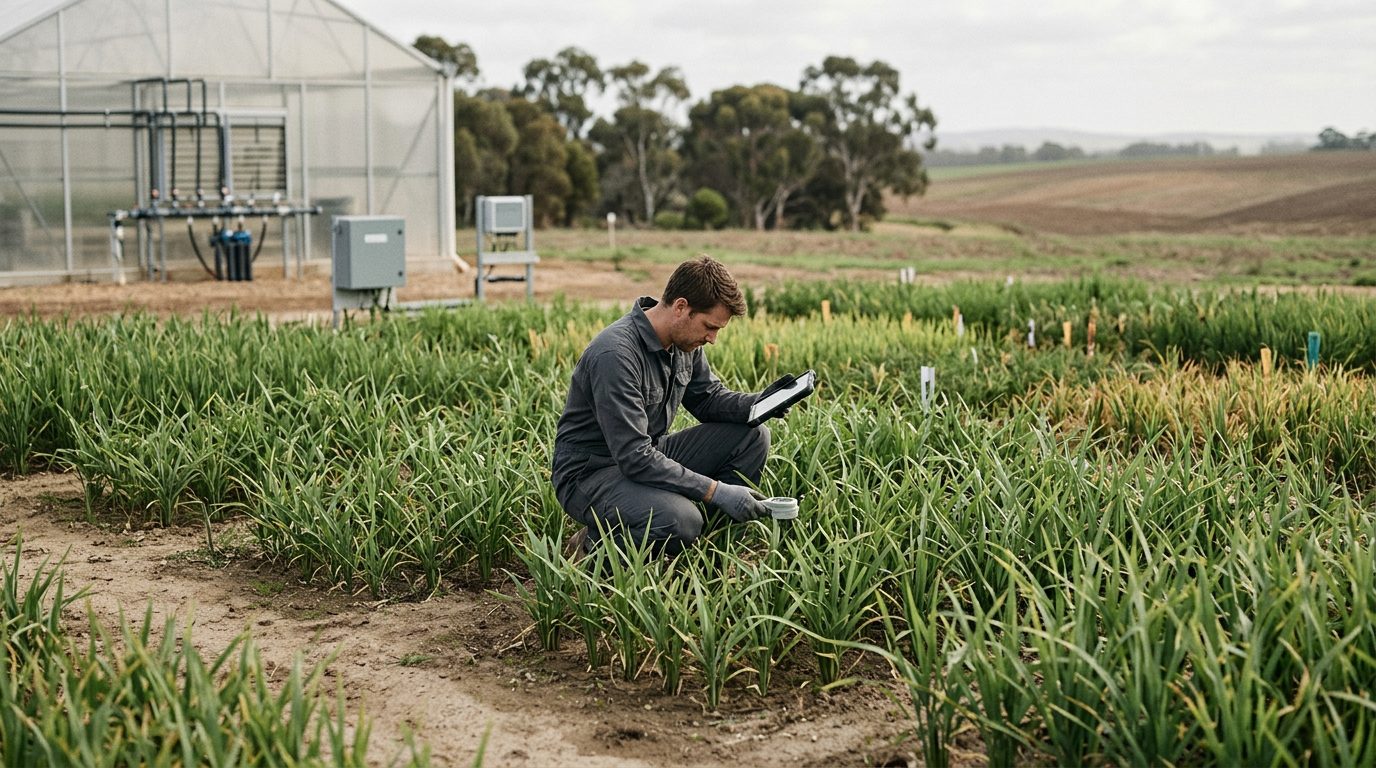
A quarter century of trait development compressed into a single growing season used to be science fiction. Now it is a line item in a seed company's investor deck. When Pairwise co-founder Haven Baker describes how his team removed the bitter-flavor gene from mustard greens, he does not talk in decades. He talks in a quarter of the time traditional breeding required, start to finish, from concept to a commercial salad blend sold under the Peak Fresh Produce label. That sentence captures what is happening across the seed industry right now: the timeline for building a new crop variety, long treated as an immovable constant of biology, is being renegotiated.
For most of the twentieth century, plant breeding ran on a fixed clock. Crossing two parent plants, growing out the offspring, selecting the best performers, and repeating that cycle for enough generations to stabilize a trait took ten to fifteen years before a variety reached a farmer's field, a timeline set by how many breeding cycles a plant naturally completes in a year and how long it takes to know, with confidence, whether a trait holds up. Three converging technologies, gene editing, genomic selection, and speed breeding, now attack each piece of that constraint separately, and the combined effect is a breeding pipeline that increasingly measures itself in years rather than decades.
Editing the Genome Instead of Gambling on It
Traditional breeding is a numbers game. Cross two plants, grow thousands of offspring, and hope the right combination of genes lands in a single plant. CRISPR and related gene-editing tools replace that gamble with direct intervention, cutting, deleting, or rewriting specific letters of DNA already present in a plant's own genome, without introducing genes from an unrelated species. Inari Agriculture, a Cambridge, Massachusetts-based seed design company that raised $144 million in new funding in January 2025, describes its platform as working "like a word processor edits written documents, adding, deleting and replacing letters in the cell's natural genetic code." The company claims that results which would otherwise take fifteen years can be achieved in four to five, and it is chasing traits that traditional breeding has struggled to deliver at all, including a 40 percent cut in corn's nitrogen and water needs without sacrificing yield.
Corteva, the seed and crop-protection giant spun out of DowDuPont, uses its CRISPR-Cas platform to identify and stack native genetic variants already present somewhere in corn's gene pool. Its reduced-stature hybrids, which cut plant height by roughly 30 percent and ear height by about 25 percent to improve wind resilience and allow higher planting density, are moving toward commercial launch by the middle of this decade, according to Corteva scientist Dan Christensen. Bayer has folded genome editing into a broader push pairing CRISPR with artificial intelligence and high-throughput phenotyping, aiming to shorten the guesswork phase of breeding as much as the modification phase itself.
The Mustard Greens That Beat the Clock
Pairwise, a Durham, North Carolina startup that partnered with Bayer for distribution, offers the clearest public proof that gene editing can compress a real commercial timeline, not just a lab demonstration. It used CRISPR to knock down the myrosinase enzyme responsible for bitterness in mustard greens, then brought the resulting Purple Power Baby Greens Blend to grocery shelves as one of the first CRISPR-edited foods sold in the United States, declining to pursue a non-GMO label, a bet that shoppers will accept gene-edited food once they understand it sits in a different regulatory category than older transgenic crops. Its pipeline now includes seedless blackberries and pitless cherries, traits conventional breeding has pursued unsuccessfully for generations because the genetics involved are too diffuse to select for through crossing alone.
Not every company betting on faster breeding has survived the wait for revenue to catch up with the technology. Benson Hill, a St. Louis soybean company built around a computational breeding platform called CropOS, filed for Chapter 11 bankruptcy in March 2025 after furloughing more than a third of its workforce and relocating its headquarters, citing "a combination of industry challenges and financial constraints." Its assets, including ultra-high-protein and high-oleic soybean lines, were picked up by St. Louis-based Confluence Genetics. The episode is a useful corrective to any narrative that faster science automatically means an easier business: shortening a ten-year breeding cycle to three years does not shorten the time it takes to build a customer base or reach profitability, and several well-funded ag-biotech startups have learned that gap the hard way.
Predicting a Plant's Future From Its DNA Alone
Gene editing solves the problem of making a specific change. Genomic selection solves a different problem: figuring out, before a plant has ever set foot in a field, which of thousands of candidate lines are worth growing out at all. The technique uses DNA markers scattered across a plant's genome to build a statistical model predicting yield, disease resistance, or drought tolerance from genotype alone, letting breeders discard most low-potential lines before spending years and acres testing them.
CIMMYT, the CGIAR-affiliated wheat and maize research center in Mexico, has used genomic selection to cut the time needed to recycle parent lines for its wheat breeding program from five to seven years down to three. Wheat molecular geneticist Susanne Dreisigacker described the shift bluntly: "What we basically did here is that we only genotyped. We selected the best lines based on the genotype and recycle," skipping years of field phenotyping once required to know if a cross was worth keeping. The program targeted resistance to septoria tritici blotch and spot blotch, two fungal wheat diseases spreading as climate patterns shift across South Asia and East Africa, and Dreisigacker compared the method to "baking a cake with a ready-made preparation," where resistance comes pre-loaded into the parent stock and breeders only layer additional traits on top. Because CGIAR varieties are distributed royalty-free to smallholder farmers, gains made at a breeding station outside Mexico City translate directly into seed reaching farmers in Ethiopia, Bangladesh, and Nepal, at a scale few private programs can match.
Growing Six Generations a Year Under Purple Light
Even a perfectly designed genetic edit still has to grow into a plant, and speed breeding attacks that final bottleneck directly. By manipulating light duration, intensity, and temperature inside controlled growth chambers, often using LED lighting tuned to wavelengths plants respond to most efficiently, researchers can push some crops through four to six generations a year instead of the one or two a normal growing season allows outdoors. Wheat, barley, and chickpea lines that would take a decade to stabilize in the field can be cycled to genetic uniformity in two to three years inside a speed-breeding facility, and public breeding programs increasingly run these chambers alongside conventional trials, using accelerated cycles for early-generation selection before final rounds move outdoors for real-world validation.
Washington Changes Its Mind, More Than Once
Regulation has moved almost as unpredictably as the science. The USDA's 2020 SECURE rule had exempted many gene-edited crops from the permitting process required of older transgenic GMOs, reasoning that edits producing changes indistinguishable from conventional breeding, deletions or single-letter changes rather than the insertion of foreign genes, did not need the same scrutiny as products made by inserting bacterial DNA. That framework was upended in December 2024, when a federal court in California vacated SECURE after anti-GMO groups sued, arguing the agency had acted arbitrarily in granting so many exemptions. The ruling produced a genuinely strange outcome: rather than tightening oversight as the plaintiffs intended, it reverted regulation to a pre-2020 framework under which gene-edited crops containing no plant-pest DNA fall outside APHIS review entirely, while older-style transgenic crops face the permitting process SECURE had tried to streamline. About two hundred crops already cleared under SECURE were not required to reapply, but the legal footing for future gene-edited products is now murkier than a year ago.
Brussels Finally Draws a New Line
Europe's shift has been slower but arguably more consequential, since EU rules have effectively kept gene-edited crops out of cultivation there since a 2018 European Court of Justice ruling classified them under the bloc's strict 2001 GMO directive. Only one transgenic crop, MON810 maize, has been approved for EU cultivation since 1998. That began to change in late 2025 and early 2026, as the European Parliament and Council reached a provisional deal on new genomic techniques legislation, sorting gene-edited plants into two tiers. Plants with fewer than twenty genetic modifications that could plausibly have arisen through conventional breeding, the NGT 1 category, will be treated like conventional crops and exempted from GMO authorization, tracing, and labeling requirements, though barred from organic certification. More heavily edited NGT 2 plants stay under the existing GMO regime, with full risk assessment and labeling. The regulation enters into force in March 2026 but does not begin applying until March 2028, giving companies a runway to prepare what is expected to be the first wave of NGT 1 approvals.
The Field Still Sets the Pace
None of this erases the part of breeding no laboratory can shortcut. A gene edit or a genomically selected line still has to prove itself across real farms, in wet years and dry ones, against pests and diseases that shift from season to season, and across the latitudes and soils where a variety will actually be planted. Multi-year, multi-location field trials remain the only way regulators, seed companies, and farmers can be confident a trait performs as promised rather than as modeled, and that validation step has not compressed nearly as much as the design phase preceding it. Corteva is still running characterization trials on its reduced-stature corn years after the underlying genetics were finalized, and CIMMYT's three-year wheat recycling still ends in a field, not a spreadsheet. The honest version of this story is not that breeding now takes a season instead of a decade. It is that the part requiring genuine inventiveness, deciding what to change and finding it, has been compressed dramatically, while the part requiring patience, proving it works everywhere it needs to, has not, and the seed companies now separating themselves from the pack are the ones treating that gap as the real engineering problem left to solve.
Sources: Inari, "Delivering on the Need for Speed"; AgTech Navigator, "Inari raises $144M as investors back gene editing tech"; Food Ingredients First, "Pairwise commercializes 'first gene-edited food' in US with CRISPR-altered salad blend"; Innovative Genomics Institute, "CRISPR in Agriculture: 2024 in Review"; DTN Progressive Farmer, "Specialty Soybean Company Benson Hill Files Voluntary Chapter 11 Bankruptcy Petitions"; St. Louis Magazine, "Confluence Genetics is picking up where Benson Hill's bankruptcy left off"; Corteva Agriscience, "Reduced Stature Corn: A Big Deal"; CGIAR System, "Accelerating wheat breeding, from Toluca in Mexico to the world"; Managing IP, "EU provisionally approves framework for new genomic technique plants from 2028"; Plant Science Today / ASPB Policy Update, "Federal Judge Vacates Rule on Biotech Crops"; Congress.gov (Congressional Research Service), "Gene-Edited Plants: Regulation and Issues for Congress"; Agriculture Dive, "Bayer teams with CRISPR startup Pairwise for bitterless mustard greens"
The Food Observatory Brief
Weekly briefing on food systems, climate, agriculture and policy — straight to your inbox.
More on Innovation
Biologicals and the Quest for Less Nitrogen Fertilizer
Microbial products sold as ways to cut synthetic fertilizer have strong commercial pull because of price volatility and nitrous oxide targets. This piece looks at independent trial evidence, India's nano urea experience and regulatory gaps to set out which claims farmers can reasonably trust.
The Race to Cut Cattle Methane With Feed Additives
Methane inhibitors and seaweed additives promise large cuts in cattle emissions. This piece explains why the technology works in feedlots and dairies but struggles with grazing herds where most emissions sit, and why cost, consumer reaction and who pays are the real bottlenecks.
Alternative Proteins After the Hype
Alternative protein companies raised billions on the promise of rapidly displacing conventional meat, then hit a wall of stalled sales, layoffs, and investor retreat. This piece looks past the hype cycle's collapse to what alternative proteins are actually achieving now, and where the technology still has a credible path forward.