The Race to Cut Cattle Methane With Feed Additives
Feed additives cut enteric methane by around 30 percent in trials, but Denmark's mandate shows what happens when a product meets real herds
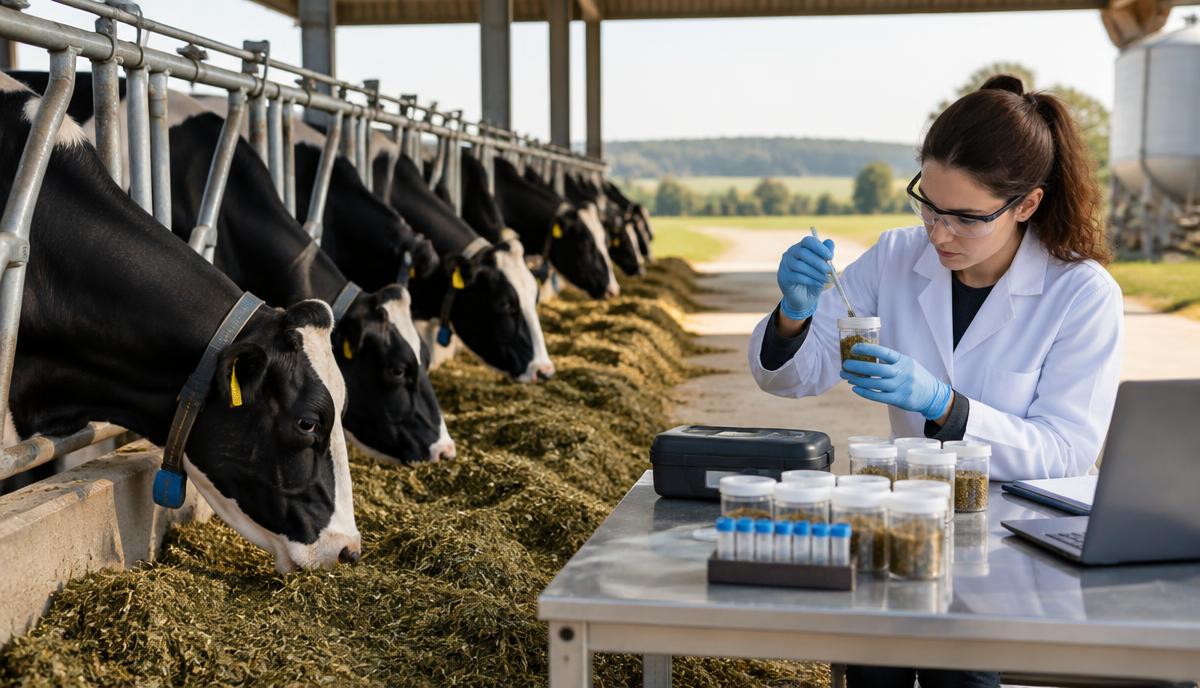
On 1 October 2025, most of Denmark's larger conventional dairy farms began feeding a methane inhibitor to their cows, because the state required it. Within weeks, a survey by the farm advisory body SEGES Innovation found that 434 of 644 responding farmers reported falling milk yield and 410 reported digestive or metabolic problems. A product that had passed years of trials and regulatory review had met real herds, a real winter and a real social media cycle all at once. The chemistry works. What decides whether cattle methane actually falls is who can deliver the additive, who pays for it, and whether the people who buy the milk accept it.
A 30 percent cut that holds up in the trial data
The efficacy case is strong. A meta-analysis in the Journal of Dairy Science, pooling 13 articles and 48 treatment comparisons, found that 3-nitrooxypropanol (3-NOP, sold by DSM-Firmenich as Bovaer) at an average dose of 70.5 milligrams per kilogram of dry matter cut methane production by 32.7 percent, methane yield by 30.9 percent and methane intensity by 32.6 percent in dairy cattle. The effect was larger on diets low in fibre and fat, which tells a farmer where the product will underperform. DSM-Firmenich cites roughly 45 percent for feedlot beef.
Seaweed-based bromoform products go further. A UC Davis trial on feedlot steers reported methane reductions of 82 percent with Asparagopsis, and over 50 percent in dairy cows. Rumin8, an Australian company using a synthetic bromoform, reported a 95.2 percent cut in a UC Davis cattle trial and says roughly 80 percent is achievable in products it plans to sell commercially from late 2027, starting in Brazil. These are large numbers, but they come from animals measured in controlled conditions.
Why the feedlot and the dairy are the easy case
Feed additives work in confined systems because they solve a delivery problem that confinement has already solved. A dairy cow in a stall or a steer in a feedlot eats a mixed ration at least once a day, so a few grams of active ingredient can be blended into every mouthful. The dose is verifiable because the farm already weighs its feed.
Adoption has followed. The United States approved Bovaer in 2024, and its distributor Elanco reports more than 150,000 American dairy cows receiving it, with about 90 percent of farmers continuing. The difficulty is that these systems are not where the heaviest emissions problem sits.
The grazing problem is where the tonnes are
FAO's global assessment of ruminant supply chains put their emissions at 5.7 gigatonnes of CO2 equivalent a year, about 80 percent of the livestock sector, with enteric methane alone accounting for around 47 percent of sector emissions. The same assessment shows how unevenly the burden falls. Milk produced in Europe carries about 1.6 kilograms of CO2 equivalent per kilogram, while milk in sub-Saharan Africa carries about 9. Beef ranges from 14 kilograms per kilogram of carcass weight in Eastern Europe to 76 in South Asia. Animals on poor forage, spread across common land and rangeland, emit more per unit of food and are far harder to reach.
A grazing animal eats pasture, not a ration, so there is no daily moment at which an additive can be added. A 2024 study in PNAS gave 24 grazing steers on a Montana ranch a pelleted bromoform supplement and recorded a drop of about 38 percent in methane, with no penalty to growth, from a supplement the animals chose to eat. That is a real result, but it is well below the feedlot figures and covered 24 animals. New Zealand's Ruminant BioTech has raised US\$9.5 million for a slow-release bolus that it says cuts methane by 75 percent for more than 100 days from a single dose, and it hopes to reach 100 million cattle by 2035, funded by carbon markets and corporate climate commitments. Asparagopsis also grows in tropical waters, and a PNAS perspective notes that shipping and processing it to distant markets could offset part of the benefit.
A price tag that lands on the farm
The additive rarely adds to the farmer's margin, and sometimes subtracts from it. A 2025 Journal of Dairy Science economic analysis of United States herds found that 3-NOP lowered income over feed costs by US\$0.35 per cow per day for a cow producing 39 kilograms of milk, because dry matter intake fell by 0.5 kilograms a day and milk yield by 0.7. Methane fell 27.9 percent. The authors calculated that a 1,000-cow dairy would need compensation of about US\$128,320 a year to break even, or about US\$2.01 per kilogram of methane abated, and concluded that farmers would need carbon credits, other incentives or both.
Rumin8 argues the opposite for beef, claiming feed efficiency gains of 4.1 to 10.7 percent and up to US\$137 per animal a year in combined productivity and carbon credit income. Those are company figures, and a further trial on more than 1,000 animals is planned before launch. The pattern is that the party carrying the cost, the farmer, rarely holds the benefit, which is a lower footprint credited to a retailer, a processor or a government. Until a payment crosses that gap, adoption depends on mandates or on companies buying reputational cover.
Denmark shows what happens when a mandate meets a herd
Denmark chose both routes. In June 2024 it agreed a livestock emissions tax, the first national tax of its kind, of 300 kroner per tonne of CO2 equivalent from 2030 rising to 750 kroner by 2035, with a 60 percent deduction that brings the effective rate to 120 kroner and then 300. A dairy cow emits around 6 tonnes of CO2 equivalent a year, so the effective initial charge is roughly 720 kroner per cow. In the meantime, conventional farms with more than 50 cows were required to feed Bovaer for at least 80 days a year or switch to a high-fat diet.
The autumn 2025 reports of sick animals pushed the arrangement into crisis. On 5 November 2025, the Danish Veterinary and Food Administration let farmers suspend Bovaer on a good-faith declaration without a fine. Aarhus University's Charlotte Lauridsen said the disease pattern described in the press had never appeared in the university's trials, and possible explanations included corn silage quality and mixing errors on farms. In May 2026, a study from the same university covering 73 herds and about 27,650 cows, reported by DSM-Firmenich, found no negative effect on milk yield, mortality, mastitis or metabolic disorders, and attributed the autumn problems to a seasonal production dip combined with rapid, widespread adoption. If that analysis holds, the lesson is not that the additive failed but that a mandate with a fixed start date moves a technology from the research herd to every herd at once, with mixing errors included.
Boycotts in Britain and a retreat in New Zealand
Consumers saw the same product through a different lens. When Arla announced on 26 November 2024 that 30 UK farms supplying Morrisons, Aldi and Tesco would trial Bovaer, with a claimed 27 percent average methane cut, social media filled with boycott calls and claims that the additive passed into milk. Arla said it does not, and that the product had approval from the UK Food Standards Agency and the European Food Safety Authority. Grahams and Yeo Valley distanced themselves publicly. The trial ended earlier than planned in November 2025, just as the Danish reports spread. The boycott rested largely on misinformation, but it exposed a structural weakness: a methane additive gives the shopper no taste or visible benefit, so the only thing a customer notices is the story attached.
New Zealand took the opposite approach to the political risk. On 13 October 2025, its government ruled out pricing agricultural emissions and cut its 2050 methane target to a 14 to 24 percent reduction from 2017 levels, down from 24 to 47 percent, with a review in 2040. Climate minister Simon Watts said that "technology and partnership, not taxes, will deliver the reductions that we need," pointing to NZ\$400 million of existing funding for methane tools. Scientists objected that this sits poorly with the Paris goals. Beef + Lamb New Zealand welcomed it, noting that methane needs only modest cuts to stop adding further warming. It leaves the technology pipeline without the price signal that would pay for it.
Per litre of milk is not the same as less methane
Arla's commitment, which underpins the UK trial, is a 30 percent cut in emissions per kilogram of milk by 2030. The 3-NOP meta-analysis reports a 32.6 percent fall in methane intensity, so on paper the target is met by the additive alone. Intensity metrics, however, can improve while total emissions grow, if herds expand or milk output rises. The Clean Air Task Force's review for the European Union grants that intensity is useful for growing or exporting sectors, but says absolute emissions are the primary determinant of warming outcomes. The Danish tax, which charges per tonne emitted, takes the absolute view.
An additive cuts emissions per animal, and whether total methane falls depends on how many animals there are. Cutting 30 percent from a dairy sector that is expanding by 30 percent achieves a standstill. The strongest case for additives is therefore where herd numbers are stable or falling and the cut can be counted against a ceiling, which in practice means rich-country dairies and feedlots.
What would have to be true for the cut to reach the herds that matter
The additives are good enough for confined systems and not yet for the world's herds. For the grazing and smallholder herds that dominate emissions in South Asia and sub-Saharan Africa, three conditions would have to hold at once: a delivery route that reaches animals which are not fed daily, a payment that reaches the herder and not only the retailer, and verification cheap enough to be trusted. Carbon markets are the most likely source of that payment, and Ruminant BioTech and Rumin8 are both counting on them. Denmark's tax and mandate show the price signal can be built in a rich country with dense records and a single regulator. Building the equivalent for a herd of 20 cattle on common land in Rajasthan or Kenya is a different order of task, and the pilots cited here have not attempted it. The most useful next trial is not another feedlot result with a higher percentage but a grazing system in the tropics, where someone other than the farmer pays and an independent party measures the cut.
**Sources:** Journal of Dairy Science, "A meta-analysis of effects of 3-nitrooxypropanol on methane production, yield, and intensity in dairy cattle"; Journal of Dairy Science, "Effects of feeding 3-nitrooxypropanol for methane emissions reduction on income over feed costs in the United States"; PNAS, "Mitigating methane emissions in grazing beef cattle with a seaweed-based feed additive: Implications for climate-smart agriculture"; PNAS, "Can seaweed mitigate methane from cows on a global scale?"; UC Davis via ScienceDaily, "Feeding grazing cattle seaweed cuts methane emissions by almost 40%"; FAO, "Greenhouse gas emissions from ruminant supply chains: A global life cycle assessment"; Undark, "In Denmark, Sick Cows and a Lot of Questions"; dsm-firmenich, "Aarhus University confirms Bovaer works safely on Danish dairy farms"; The Grocer, "Arla to continue with Bovaer trial despite boycott calls"; Euronews, "Denmark cow and pig burp tax to be rolled out in 2025"; Beef + Lamb New Zealand, "Announcement on emissions pricing and methane targets a significant step forward"; Clean Air Task Force, "Integrating Agricultural Development and Methane Mitigation as part of the EU Livestock Strategy"
The Food Observatory Brief
Weekly briefing on food systems, climate, agriculture and policy — straight to your inbox.
More on Innovation
Biologicals and the Quest for Less Nitrogen Fertilizer
Microbial products sold as ways to cut synthetic fertilizer have strong commercial pull because of price volatility and nitrous oxide targets. This piece looks at independent trial evidence, India's nano urea experience and regulatory gaps to set out which claims farmers can reasonably trust.
Alternative Proteins After the Hype
Alternative protein companies raised billions on the promise of rapidly displacing conventional meat, then hit a wall of stalled sales, layoffs, and investor retreat. This piece looks past the hype cycle's collapse to what alternative proteins are actually achieving now, and where the technology still has a credible path forward.
The Next Generation of Crop Breeding
Gene editing and computational breeding tools have collapsed the timeline for developing new crop varieties from decades to single growing seasons. This piece explains the science behind the new generation of crop breeding, the companies racing to commercialize it, and what faster breeding cycles could mean for climate-resilient agriculture.