Can Agriculture Produce More While Restoring Nature?
A wetland restored from carrot fields in the English fens now hosts breeding cranes absent from the region for three centuries
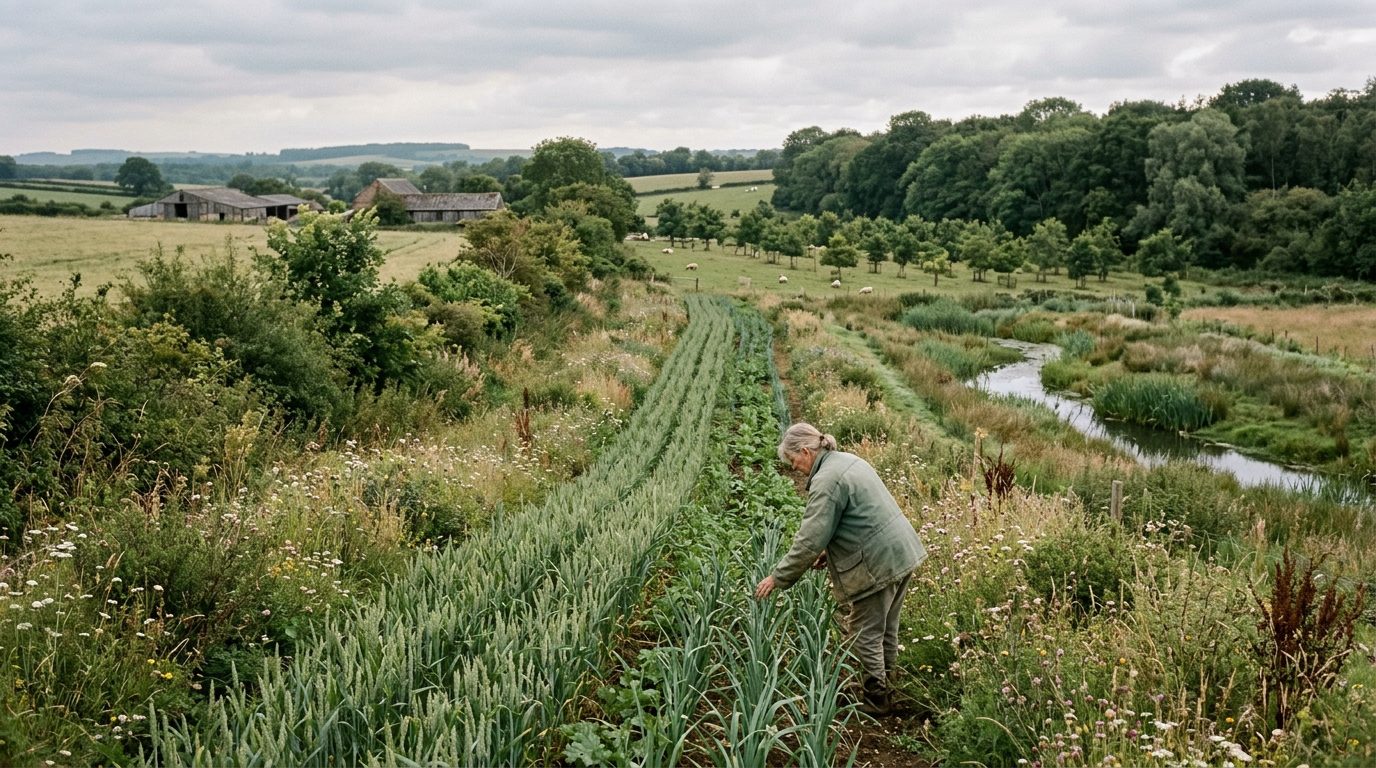
Near Lakenheath in the English fens, a four-square-kilometer stretch of former carrot fields now hosts breeding cranes, a species absent from the region for more than three centuries. The wetland exists because farmers elsewhere grew more food on less land, freeing this patch entirely for nature rather than diluting agriculture across it. It is a small, vivid answer to a question that has divided conservation science for two decades: when farmland and wildlife compete for the same acres, do you concentrate the farming and let nature have the rest, or do you soften the farming everywhere and let the two coexist on every field?
The debate has a name, "land sparing versus land sharing," and it is not academic hairsplitting. It shapes how governments write subsidy rules, how conservation NGOs spend money, and how the next several billion tons of food get grown on a planet that has already converted roughly 40 percent of its ice-free land to agriculture. The honest answer, after years of increasingly rigorous data, is neither side's slogan. But getting to that answer requires taking both arguments seriously first.
The Cambridge Case for Concentrating Farms
The land-sparing argument is most closely associated with Andrew Balmford, a conservation scientist at the University of Cambridge who has spent more than a decade building the empirical case with collaborators including Ian Bateman. Their method, refined across studies of more than 2,500 plant, insect, and vertebrate species on five continents, compares how populations of individual species respond across a gradient from high-yield, intensively farmed land to low-yield, wildlife-friendly farmland to untouched habitat. The consistent finding is that most species do better under a landscape of high-yield farming paired with protected wild habitat than under lower-yield farming spread thinly across the same total area. "Most species fare much better if habitats are left intact, which means reducing the space needed for farming," Balmford has put it.
The logic follows from a simple accounting problem. If wildlife-friendly farming produces less food per hectare, then either people eat less, or more land somewhere gets converted to make up the shortfall. In a 2023 paper in Nature, Balmford, Bateman, and colleagues argued that this displacement effect is exactly what many well-intentioned green farming policies miss. Reducing pesticide and fertilizer use, or converting land to organic production, benefits common farmland species but does little for the rarer ones that need intact habitat, while the resulting yield losses tend to be compensated through imports that shift environmental damage to other countries, often with weaker regulation. Their modeling suggested organic conversion in particular could be "even more likely to be damaging" once that displacement is accounted for, and that a land-sparing strategy targeted at Britain's least productive farmland (the bottom third of English farmland produces only about 15 percent of national output) could deliver equivalent bird conservation outcomes at roughly half the cost to taxpayers compared with conventional agri-environment schemes, while taking a smaller bite out of food production.
Why Ecologists Pushed Back Hard
That 2023 paper drew a swift and pointed response. Researchers including Matthew Selinske and Sarah Bekessy at RMIT and Brendan Wintle and Georgia Garrard at the University of Melbourne argued in Nature that the sparing framework, taken as policy advice rather than one input among many, oversimplifies both the ecology and the politics of land use. Intensive monocultures do not exist in a vacuum next to nature reserves; they degrade soil, pollute waterways, and eliminate the hedgerows, field margins, and mixed cropping that many species depend on to move between habitat patches. "To meet global biodiversity-conservation goals, land sparing needs to be combined with land sharing in a strategic and socially just way," their reply concluded, adding that intensification also concentrates land ownership and displaces smallholders, an equity cost the yield-per-hectare math leaves out.
The ecological case for sharing has its own body of evidence. Coffee-growing landscapes are among the better-studied systems, and multiple analyses have found shaded, agroforestry-style coffee farms support meaningfully more bird diversity than sun-grown monocultures, with sparing and sharing elements providing complementary rather than substitutable benefits for different guilds of species. Hedgerow research shows a similar pattern: a widely cited global meta-analysis found hedgerows reliably boost pollinator and bird abundance on and near farmland, a service a purely spared landscape, with its stark line between intensive fields and reserve, cannot replicate. The case for sharing also rests on adjacency: farmland embedded with habitat features often protects water quality, pollination, and pest control for the farm itself, benefits a distant reserve cannot provide to the field next door.
What a Large Systematic Review Actually Found
The most useful recent contribution to the debate is not a study that sides with either camp but one that measured the debate itself. A 2025 systematic review in PNAS Nexus, led by Eva Augustiny of Switzerland's Research Institute of Organic Agriculture, combed through 57 peer-reviewed studies that had directly compared sparing and sharing outcomes, applying PRISMA methodology to filter for genuinely comparable cases. Among the smaller set of studies rigorous enough to compare production and biodiversity metrics side by side, 41 percent favored land sparing outright, only 7 percent favored land sharing outright, and 52 percent found that some context-specific mixture of the two performed best. "There is no universal solution," Augustiny said. "Rather context-specific solutions are needed."
The review's more uncomfortable finding was about the evidence base itself. Nineteen of the twenty-seven highest-quality comparisons concerned tropical forest birds, a heavily studied but narrow slice of biodiversity, while soil organisms, fungi, and microbial communities, which underpin the productivity of both systems alike, were almost entirely absent from the literature. Augustiny also flagged a directional bias, noting that "studies from the land sparing fraction tend to be oversimplified, neglecting adverse impacts of high-yield agriculture" such as pesticide runoff and fertilizer pollution that fall outside a study's chosen plot boundaries. Much of the twenty-year argument, in other words, has been fought with a dataset that is both too narrow and, on the sparing side, prone to leaving real costs off the ledger.
Geography Decides More Than Ideology Does
A parallel body of work suggests the sparing-versus-sharing question may be less important than where the question is being asked. A study led by Silvia Ceaușu at University College London, with Tim Newbold and David Leclère of the International Institute for Applied Systems Analysis, modeled the biodiversity consequences of closing "yield gaps" (raising existing farmland to its attainable productivity) against the consequences of expanding farmland into new territory, across four crops that together represent more than half of global calorie production. The result cuts against the sparing movement's core intuition: intensifying existing farmland sometimes causes greater local biodiversity loss than expanding onto new land would, depending on how much natural habitat already surrounds that farmland and how degraded it already is. "Simple suggestions like favoring farmland intensification over expansion are not always effective," Newbold said, with Leclère arguing the real task is striking "a balance between intensification and expansion, informed by local and crop-specific data" rather than a global rule of thumb.
This matters because both the sparing framework and its critics have tended to speak in universal terms, when the underlying biology is stubbornly local. A landscape in the Amazon, where a 2024 Journal of Applied Ecology study found land sparing outperformed sharing for bird communities regardless of surrounding forest context, behaves nothing like the hedgerow-fragmented lowlands of England, where multiple studies along the sharing-sparing continuum found intermediate, mixed strategies score best for farmland birds. Treating either finding as globally portable is where the debate goes wrong.
Sustainable Intensification as the Working Compromise
Between the two camps sits a body of research and, increasingly, policy under the banner of "sustainable intensification": raising yields on farmed land using techniques that reduce, rather than ignore, ecological cost, while treating conservation gains as a deliberate design goal rather than an afterthought. This is not simply rebranded sparing. It draws on findings like a widely cited set of Chinese soil-matched fertilization trials that lifted yields by roughly 11 percent while cutting fertilizer use by around a sixth, precision agriculture that targets inputs to where crops actually need them, and crop diversification research showing that rotational and intercropping systems can narrow the yield gap with monocultures while adding the structural complexity that sharing advocates want.
The approach has found institutional traction because it lets governments avoid choosing a side outright. Britain's post-Brexit Environmental Land Management schemes fund both productivity-boosting measures and habitat features on the same farm, an implicit bet on blended strategies over segregated ones. What sustainable intensification has not resolved is the problem Ceaușu's geography-dependent findings expose: a generic playbook of efficiency gains will outperform business as usual almost everywhere, but it will not automatically produce the specific mix of sparing and sharing a given landscape's species actually need, and getting that mix wrong still carries a biodiversity cost even under an intensification banner.
What the Evidence Actually Supports
Two decades of data converge on an answer more precise than "it depends," even if it is less quotable than either side's original slogan. Land sparing has the stronger claim wherever a small number of species are highly sensitive to habitat conversion and a landscape has room for large, contiguous protected blocks, and it has the stronger economic claim wherever agricultural land is genuinely fungible, meaning yield gains on the best land can substitute for output on the worst without simply pushing the same production, and the same environmental cost, somewhere else. Land sharing has the stronger claim wherever farmland is already the dominant land cover with little prospect of large-scale conversion to reserve, wherever species depend on connectivity between fragments rather than acreage of a single block, and wherever the ecosystem services in question, water quality, pollination, pest suppression, need to be delivered on the working farm itself rather than in a reserve miles away.
What the evidence does not support is picking one strategy as a global rule and applying it regardless of geography, crop, or species group, which is precisely the mistake both the original sparing advocacy and some of its sharing-focused critics have made in their most sweeping public claims. The more defensible position, and the one now driving serious agricultural policy, is to treat sparing and sharing as tools sized to the landscape rather than as competing ideologies, with sustainable intensification research providing the technical means to make farmed land more productive without assuming that productivity alone settles the conservation question. Agriculture can, in specific and well-evidenced circumstances, produce more while restoring nature. It cannot do so by formula, and any policy that promises otherwise is selling certainty the data does not have.
Sources: University of Cambridge, "Concentrate farming to leave room for species and carbon"; University of Cambridge, "Current conservation policies risk damaging global biodiversity, warn researchers"; Nature, "Biodiversity needs both land sharing and land sparing" (Selinske, Bekessy, Wintle, Garrard reply); PNAS Nexus, "Empirical evidence supports neither land sparing nor land sharing as the main strategy to manage agriculture–biodiversity tradeoffs" (Augustiny et al.); Anthropocene Magazine, "The debate over land sparing vs land sharing may be a draw"; IIASA, "Intensifying farmland could degrade biodiversity more than expansion" (Ceaușu, Newbold, Leclère); Journal of Applied Ecology, "Land sparing outperforms land sharing for Amazonian bird communities regardless of surrounding landscape context" (Birch et al., 2024); Biological Conservation, "Land-sparing and land-sharing provide complementary benefits for conserving avian biodiversity in coffee-growing landscapes"; Frontiers in Conservation Science, "Contributions of Hedgerows to People: A Global Meta-Analysis"; Conservation Biology, "Bird conservation and the land sharing-sparing continuum in farmland-dominated landscapes of lowland England"
The Food Observatory Brief
Weekly briefing on food systems, climate, agriculture and policy — straight to your inbox.
More on Agriculture
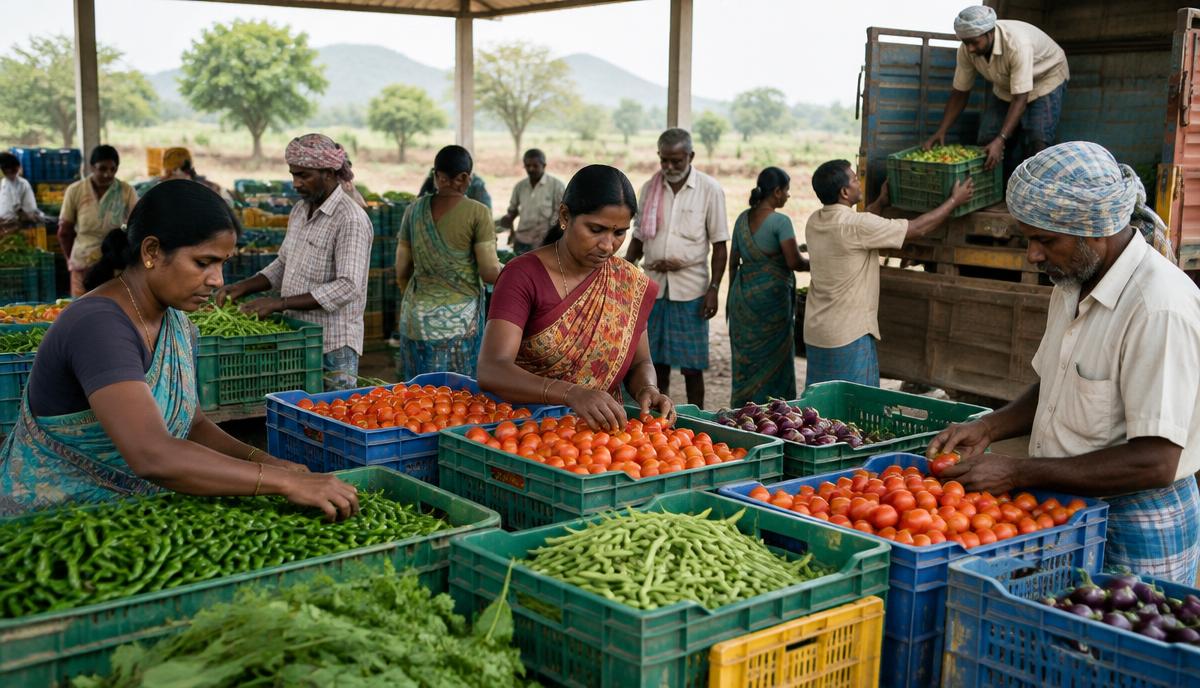
Farmer Producer Organisations and the Case for Collective Scale
Collective structures are the missing link between smallholder fragmentation and market power, yet most farmer producer organisations fail on governance, working capital and market linkage rather than enthusiasm. This piece draws on India's scheme data and examples from Anand, Oromia and Nashik.
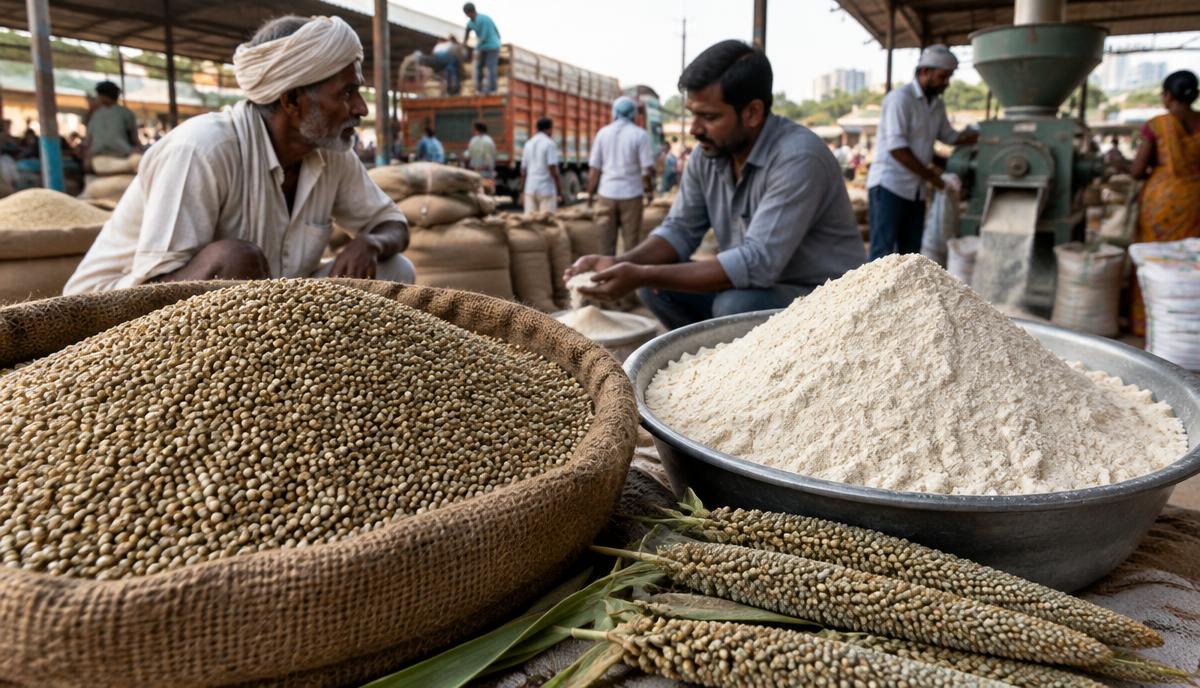
Millets Are Having a Moment. Can the Market Keep Up?
After the 2023 International Year of Millets, demand-side attention has outrun the supply chain behind these crops. This piece looks at yields, processing, shelf life, public procurement and farmer incentives in India and Africa to explain whether the moment lasts.
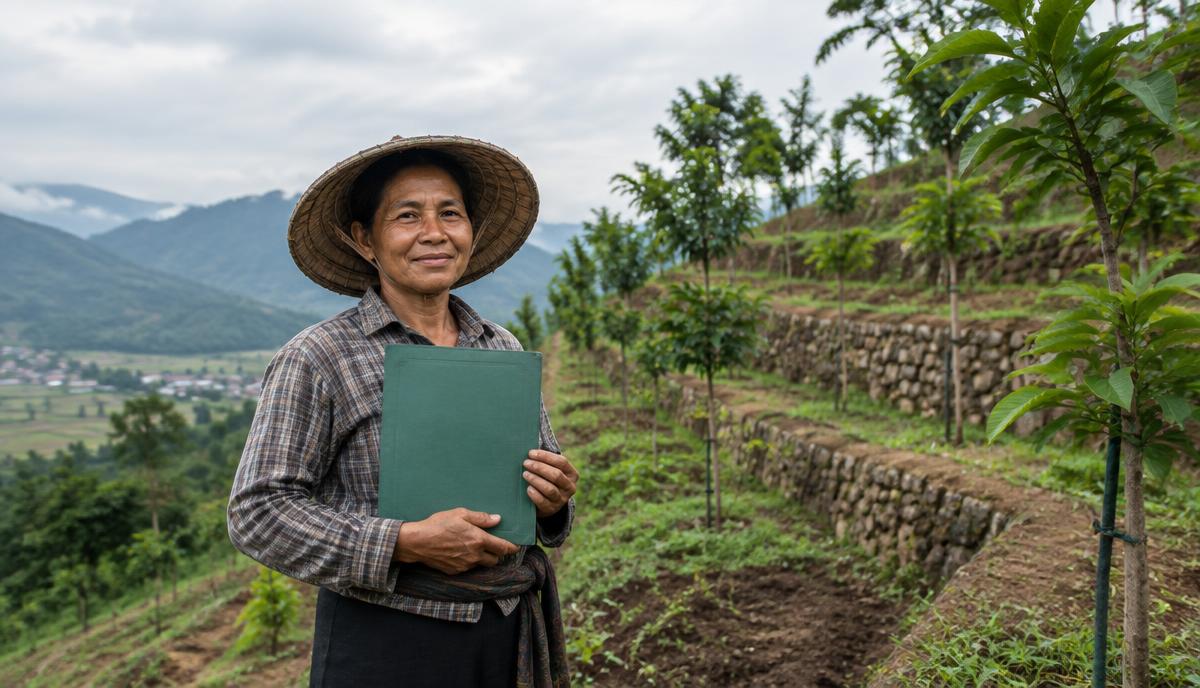
Land Tenure Decides Whether Farmers Invest
Whether a farmer plants trees, builds terraces or takes a loan depends heavily on confidence of holding the land. This piece argues that tenure security is a precondition for the soil and climate agendas that donors promote, and that women, tenants and pastoralists are the most exposed.