Land Tenure Decides Whether Farmers Invest
A Rwandan land certificate raised soil conservation by 10 percentage points, and 19 for female-headed households
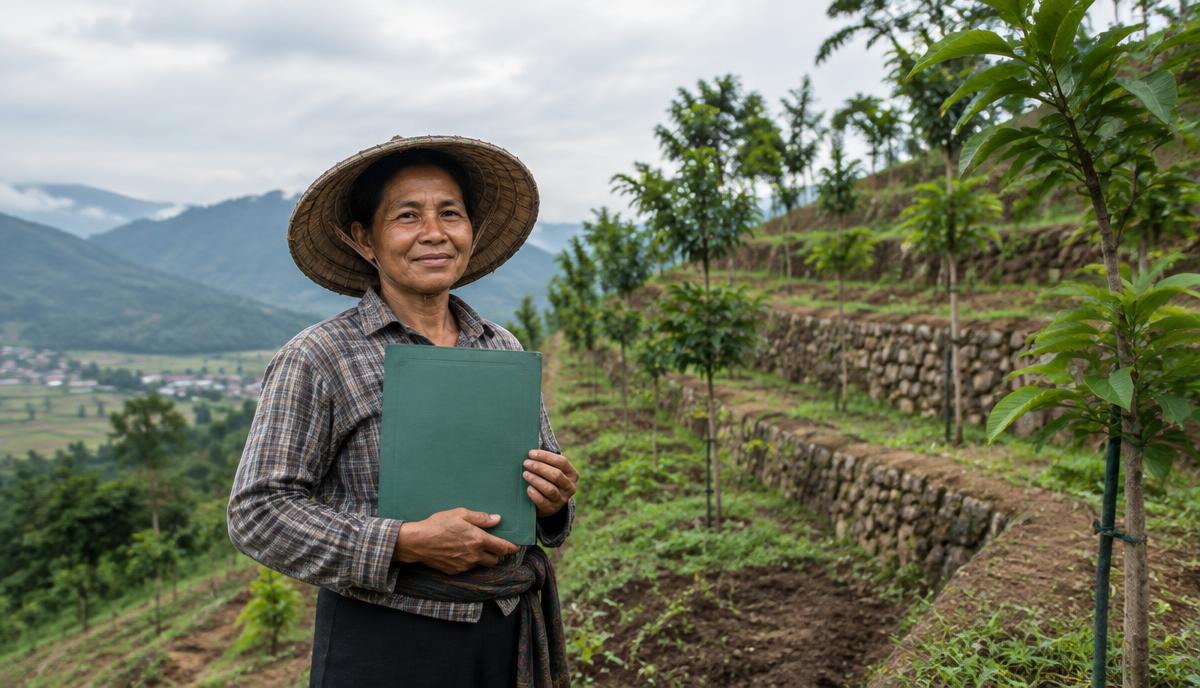
In four rural cells of Rwanda, researchers surveyed 3,554 households and 6,330 parcels in 2010 to find out what a land certificate does to a hillside. Farmers who had been registered under the country's pilot programme were about 10 percentage points more likely to have started or maintained soil conservation works such as bunds and terraces. For female-headed households the gain was 19 points. Nothing about the soil, the rainfall or the price of maize had changed. What had changed was the farmer's confidence that the person who dug the terrace would be the person who harvested behind it.
That confidence is the missing input in most climate and soil programmes. Donors fund cover crops, agroforestry, terracing and credit lines, and then measure uptake. Rarely do they ask whether the person being paid to change practice can expect to hold the plot long enough to see the return.
The Rwandan pilot showed what a certificate buys
The study, by Daniel Ayalew Ali, Klaus Deininger and Markus Goldstein, compared registered parcels with unregistered ones across an administrative boundary. The pilot ran in 2007 and 2008, and the survey came about two and a half years later. The authors also found that land market activity fell modestly in the treated areas, which answered the common fear that registration triggers distress sales.
Rwanda then did the exercise at national scale. Between 2009 and 2013 it registered more than 11 million parcels at a reported cost of roughly six dollars a plot, according to Thierry Hoza Ngoga. The same account is candid about the weak point: a register is only worth something if it is updated when land is sold, inherited or divided, and Rwanda still struggles to keep it current. A certificate that stops reflecting reality loses its power to reassure.
Ethiopia added trees, rentals and a cost-benefit result
Ethiopia's certification in the highlands gives the second large body of evidence. Deininger, Ali and Alemu, using four rounds of panel data from Amhara, found in a 2011 Land Economics paper that certification raised households' perceived tenure security, increased land-related investment and brought more people into the rental market. They also concluded that benefits ran well above the cost of the programme, in part because new legislation and cheap, community-based registration avoided the expense that sank earlier African titling efforts.
A separate panel study in Amhara and Tigray found that certification increased tree growing on private plots. It also found a smaller effect on plots that had been enrolled in public conservation schemes, because rules barred planting trees on land designated for food crops. The lesson is that a certificate is necessary but a bad rule can still cancel its effect. A farmer with a secure title who is forbidden to plant what the land needs has gained only half of what the programme promised.
Climate goals run on long time horizons
The reason tenure matters so much to the climate agenda is arithmetic. A terrace, a shelterbelt or a restored pasture pays back over years or decades, while a seasonal input pays back by harvest. A farmer who might lose the plot, or whose landlord might not renew the lease, rationally chooses the second kind of spending.
A meta-analysis published in February 2026 in Frontiers in Sustainable Food Systems, covering 35 empirical studies from 1990 to 2024, fits this pattern. It reported a positive association between tenure security and soil and water conservation (an effect size of 0.42) and a more moderate one with productivity (0.32). Irrigation, planting and conservation responded to secure rights, while spending on fertiliser showed little or negative response. The authors warn that results vary with institutions, credit and markets, so they argue against one-size-fits-all reform. That caution is useful, but the direction of the evidence is consistent: the investments climate funders most want are the ones most sensitive to insecurity.
India has digitised its records but not its tenants
India offers a different case: a vast records modernisation effort running alongside a tenancy regime that keeps millions of cultivators off the record. By October 2024 the government reported that about 95 percent of land records in rural areas were computerised, cadastral maps were 68 percent digitised, 87 percent of sub-registrar offices were linked to land records, and a 14-digit parcel identifier had been adopted in 29 states and union territories.
Digitisation does not settle who holds a right. India relies on presumptive titling, in which a registered deed records a transaction but the state does not guarantee ownership. The Vidhi Centre for Legal Policy points to impact assessments that found ownership and possession discrepancies in 34 percent of cases in rural Shimla, and notes that errors in a digital record can still lead to long litigation. A PRS Legislative Research report cites a 2007 World Bank study estimating that land disputes make up two-thirds of pending court cases.
Tenants sit outside most of this. A World Bank discussion note from 2021 found that about 14 percent of rural households leased land in 2013, that only 13 percent of leased-in area was formally registered, and that 86 percent of tenants were small or marginal farmers. Several states restrict who may lease out land or on what terms. The cost shows up in access to institutional credit, crop insurance and public programmes, and in lower investment in durable improvements. A survey by the farmers' organisation Rythu Swarajya Vedika of 7,744 farmers in 20 Telangana districts found 36 percent cultivating leased land, none of them receiving the state's Rythu Bandhu cash transfer, and 44 percent unable to sell at minimum support price because procurement requires proof of ownership. A soil health scheme that reaches only owners would miss a third of the people who work the soil in that state.
Women hold the weakest claims
Women are the most exposed because tenure rights follow inheritance, marriage and custom, all of which tend to favour men. FAO's gender dataset, launched in June 2026, shows that in 85 percent of countries with data women are less likely than men to own agricultural land or hold secure rights to it. In the Status of Women in Agrifood Systems report for sub-Saharan Africa, published in September 2025, FAO found men more likely to own land or hold secure rights in 28 of 33 countries with data.
The Rwanda result suggests why this matters for restoration. When women's rights were documented, their conservation investment rose most. A 2024 evidence scan by Landesa pulled together further examples: tree-planting and seedling survival gains among female household heads in Zambia, a stronger effect of second-level certification for widows in Ethiopia. A Haitian case in the same scan shows that registration does not by itself deliver security. The durability and completeness of the right matter as much as the paper.
Pastoralists, titling and the limits of a plot-by-plot approach
Pastoralists present the hardest case because their security depends on access across seasons and boundaries rather than on a single parcel. Individual titling can cut that access. A 2025 study in Pastoralism of two Maasai group ranches in Kenya found that, even after the Community Land Act of 2016 offered a route to register communal land, both communities chose to subdivide into private parcels, because the law left the future of collective holdings unclear. One ranch folded private parcels into community-managed conservancies, and 84 percent of 285 surveyed residents backed the arrangement. At the other, subdivision was captured by elites and followed by heavy clearing of the Nyekweri Forest.
The pattern is a warning for programmes that count titles issued as success. Kenya's government aimed to issue community title deeds in 24 counties by the end of 2024. Whether those titles protect grazing corridors or hasten their sale depends on how they were registered and who sat in the room.
When titling backfires
Critics of titling have a point, and the best evidence for tenure security comes from programmes that took them seriously. A Kenyan study using 2005/06 household survey data found titled land associated with higher consumption, yet it also recorded how decades of settlement and group-ranch schemes drifted toward unqualified beneficiaries, unauthorised subdivision and corrupt land boards, and that only 39.4 percent of Kenyan holdings were titled, from about 10 percent in the North Eastern region to 70 percent in Nairobi. Titles issued in a system that elites can manipulate tend to strengthen those elites.
Three conditions separate the programmes that worked from those that failed. They were cheap and run in communities, as in Rwanda and Ethiopia, rather than parcel by parcel through a distant court. They recorded women and secondary claimants as right-holders from the start. And they paid for the register to stay current. India's records effort shows the opposite risk, a technically complete database sitting on a legal base that does not guarantee what it records.
What the UNCCD has agreed, and what is missing
The UNCCD has been circling this evidence for seven years. Decision 26/COP.14, adopted in New Delhi in 2019, asked parties to follow the Voluntary Guidelines on the Responsible Governance of Tenure when carrying out land degradation neutrality activities, with protection for vulnerable groups. Critics at the time said the Delhi political declaration had dropped earlier language on legal recognition of tenure rights and on the rights of women, youth and indigenous communities. At COP16 in Riyadh in December 2024, parties encouraged the integration of tenure into national implementation, invited countries to nominate tenure focal points and asked for tenure information to be built into capacity-building and data tools. A separate rangelands decision stressed tenure security for pastoralists.
The gap is between those texts and the money. A restoration pledge, a carbon-farming contract or a soil health subsidy can be audited for hectares and tonnes, but almost none are audited for whether the person signing can still be on the land in ten years. A practical test would be to require every public or donor-funded restoration and soil programme to state who holds rights on the target land, whether tenants and women are recorded, and whether anyone can be removed from it before the investment pays off. Where the answers are poor, the first dollar belongs in the registry, not the seed.
**Sources:** Ali, Deininger and Goldstein, Journal of Development Economics, "Environmental and Gender Impacts of Land Tenure Regularization in Africa: Pilot Evidence from Rwanda"; Deininger, Ali and Alemu, Land Economics, "Impacts of Land Certification on Tenure Security, Investment, and Land Market Participation: Evidence from Ethiopia"; CABI, Thierry Hoza Ngoga, "Rwanda's Land Tenure Reform: Non-existent to Best Practice"; World Bank, "Agricultural Land Leasing Reform in India"; Frontiers in Sustainable Food Systems, "Is the relationship between agricultural performance and land tenure security uniform across the world? Evidence from meta-analysis"; FAO, "The Status of Women in Agrifood Systems in Sub-Saharan Africa"; FAO, "FAO releases most comprehensive dataset to date on women in agrifood systems"; Landesa, "Women's Land Tenure Security as a Pathway to Climate Change: Evidence Scan"; Earth Negotiations Bulletin (IISD), "Summary report, UNCCD COP16, 2-13 December 2024"; Global Landscapes Forum, "Tenure Rights for Restoration and Land Degradation Neutrality"; Vidhi Centre for Legal Policy, "Is land digitisation enough?"; Pastoralism: Research, Policy and Practice, "The Community Land Act and the subdivision of Kenya's Maasailand's remaining commons: implications for community conservation"
The Food Observatory Brief
Weekly briefing on food systems, climate, agriculture and policy — straight to your inbox.
More on Agriculture
Farmer Producer Organisations and the Case for Collective Scale
Collective structures are the missing link between smallholder fragmentation and market power, yet most farmer producer organisations fail on governance, working capital and market linkage rather than enthusiasm. This piece draws on India's scheme data and examples from Anand, Oromia and Nashik.
Millets Are Having a Moment. Can the Market Keep Up?
After the 2023 International Year of Millets, demand-side attention has outrun the supply chain behind these crops. This piece looks at yields, processing, shelf life, public procurement and farmer incentives in India and Africa to explain whether the moment lasts.
Can Agriculture Become Nature Positive?
A West Sussex estate that replaced unprofitable wheat and dairy operations with free-roaming cattle and returning turtle doves has become a conservation icon, but its model depends on taking land out of production altogether. This piece examines whether nature positive agriculture can scale to farms that still need to grow food.