Can Countries Meet Their Climate Goals Without Reforming Agriculture?
A growing body of research says the math on national climate targets does not work without reforming how food is produced
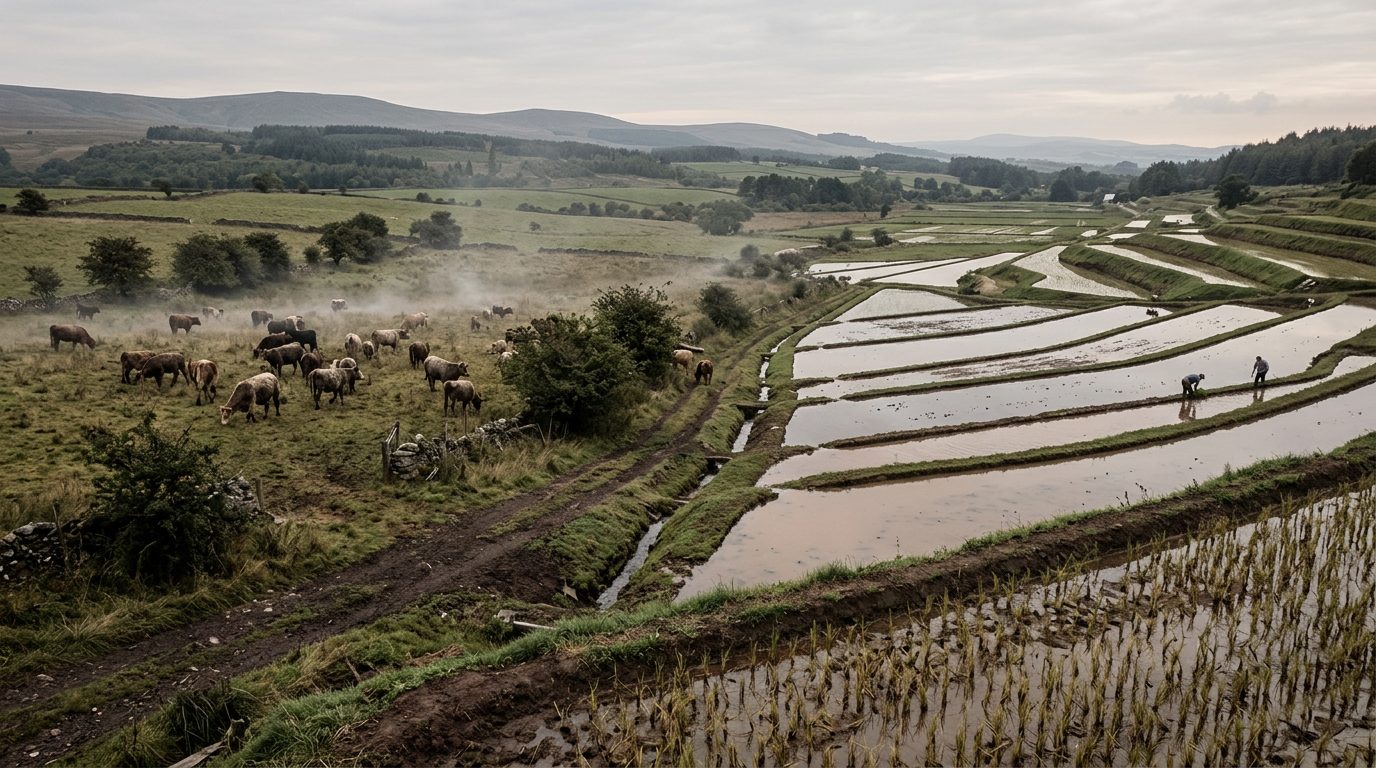
Run the numbers on almost any national climate plan and a stubborn residual appears near the bottom of the ledger, a wedge of emissions that does not shrink no matter how aggressively power grids decarbonize or how quickly gasoline cars disappear. That wedge is agriculture, and in particular the methane from cattle and rice paddies and the nitrous oxide from fertilized soil. It is not a rounding error. It is large enough, and rooted deeply enough in how the world feeds itself, that a growing body of research now says most countries cannot mathematically reach their stated climate targets without changing how food is produced, not just how energy is generated.
This is a different claim than saying agriculture gets too little policy attention, though that is also true. It is a claim about arithmetic: given the size of agricultural emissions, their chemical stubbornness, and the pace at which other sectors can plausibly decarbonize, the sums do not close. The gap is not a matter of ambition. It is a matter of physics and land.
The Sector That Doesn't Behave Like the Others
Every other major source of greenhouse gas emissions has a fairly clean technological answer sitting on the shelf. Coal and gas plants have solar, wind, and batteries. Gasoline engines have electric drivetrains. Even steel and cement, long considered "hard to abate," now have credible if expensive routes to near-zero emissions through green hydrogen and carbon capture. Agriculture has no equivalent silver bullet. A cow's rumen produces methane as a biological byproduct of digesting grass, a process that resists straightforward electrification or substitution at anything like the scale required. The IPCC's Sixth Assessment Report, in the Working Group III chapter on agriculture, forestry and other land use, puts the sector at roughly 22 percent of net global greenhouse gas emissions when land-use change is included, and if the full food system, including fertilizer manufacturing, processing, packaging, refrigeration and transport, is counted, earlier IPCC land-use assessments put the figure between 21 and 37 percent. That is a fifth to more than a third of the global total sitting in a sector whose core biological processes have barely changed since the Green Revolution.
Why Methane Rewrites the Deadline
Methane's chemistry makes the problem more urgent, not less. It is roughly 80 times more potent than carbon dioxide as a warming agent over a 20-year window, but it also breaks down in the atmosphere within about a decade, compared to centuries for CO2. That combination means agricultural methane, unlike a coal plant's carbon dioxide, delivers most of its warming damage almost immediately after release. The United Nations Environment Programme's Global Methane Assessment found that livestock, primarily cattle through enteric fermentation and manure, account for roughly 32 percent of human-caused methane emissions, making agriculture the single largest source of anthropogenic methane, ahead of oil and gas and ahead of landfills. The 2021 Global Methane Pledge, now signed by more than 150 countries, commits signatories to cutting methane 30 percent by 2030 relative to 2020 levels, a target UNEP's own modeling says is achievable mostly through fossil fuel leak fixes and waste management, precisely because agricultural methane is so much harder to touch. In practice, that means the pledge's easiest gains bypass the sector responsible for the largest share of the problem.
What the Fertilizer Problem Adds on Top
Nitrous oxide compounds the difficulty. It carries a global warming potential roughly 273 times that of carbon dioxide over a century, and agriculture, chiefly synthetic nitrogen fertilizer applied to soils, is its dominant human source. Unlike methane, nitrous oxide lingers in the atmosphere for over a century, so emissions locked in today by fertilizer-intensive farming keep warming the planet for generations. Cutting nitrogen use without cutting yields requires precision application technology, cover cropping and soil management practices that are being piloted in parts of Europe and North America but remain marginal globally, especially across South Asia and sub-Saharan Africa, where fertilizer access is still expanding rather than being optimized. Rice paddies add a third hard-to-abate stream, flooded soils that produce methane through anaerobic decomposition, concentrated in emitters like China, India, Indonesia and Vietnam, countries whose national diets and food security politics make rice cultivation close to untouchable as a policy target.
The Study That Did the Math to 2100
In 2020, researchers led by Michael Clark, then at Oxford University, published a paper in Science that ran the actual numbers rather than gesturing at them. The study, "Global food system emissions could preclude achieving the 1.5°C and 2°C climate change targets," modeled what happens if fossil fuel and industrial emissions were halted entirely, immediately, while food system emissions continued on their current trajectory. The finding was stark: food system emissions alone, left unchecked, would likely breach the carbon budget for holding warming below 2°C by the end of the century, and would make 1.5°C essentially unreachable regardless of what happens in energy or transport. The paper's central point was not that food emissions are large in isolation, but that they are large relative to what remains of the global carbon budget once other sectors decarbonize, meaning the food system's share of the problem only grows as everything else shrinks.
The Modeling That Shows a Way Through, Barely
More recent work has tried to identify how much of this gap dietary and production changes could close. A 2024 study in Science Advances, "Food matters: Dietary shifts increase the feasibility of 1.5°C pathways," used integrated assessment modeling in the tradition of institutions like IIASA, home of the GLOBIOM land-use model widely used in food-system scenario work, to show that shifting diets away from resource-intensive animal products materially increases the odds of holding to 1.5°C, primarily by freeing agricultural land for reforestation and carbon removal and by directly cutting methane from livestock. The implication cuts both ways: dietary and farm-practice change is not a nice-to-have layered on top of energy transition, it is a load-bearing part of the pathway. Remove it, and the land needed for both food production and carbon removal simply does not exist in most 1.5°C-consistent scenarios.
Where National Pledges Quietly Give Up
This is where the gap between science and policy becomes visible in the actual documents governments submit to the UN. Analysis from NewClimate Institute on the treatment of non-CO2 emissions in Nationally Determined Contributions has repeatedly found that many countries either omit methane and nitrous oxide targets entirely or set them with far less rigor than energy-sector goals. The UN Food and Agriculture Organization's own mapping of NDCs ahead of COP29 identified persistent gaps between the ambition agrifood systems would need to show and what governments have actually committed to, alongside financing shortfalls that a follow-up FAO report tied to COP30 found were undermining even the modest agrifood ambitions that do exist. The pattern is consistent across major emitters: energy targets are quantified, sector-specific and monitored, while agricultural targets are vague, voluntary or simply absent, an asymmetry that lets the aggregate national pledge look more credible on paper than the underlying sectoral math supports.
What Closing the Gap Would Actually Require
None of this is an argument that farmers alone should shoulder the climate burden, and none of the researchers behind this work frame it that way. It is an argument that the sequencing implicit in most national climate strategies, decarbonize energy first and worry about agriculture later, is not compatible with the emissions budgets those same strategies claim to respect. Methane's short atmospheric life means agricultural cuts made this decade deliver outsized near-term cooling, exactly when the world most needs to bend the temperature curve before triggering feedbacks like permafrost thaw or coral reef collapse. Waiting, in other words, is not a neutral choice. It is a choice to spend down a carbon and methane budget that food systems research increasingly shows does not have room for delay. Countries can keep writing climate targets that route around agriculture, but the atmosphere does not grade on that curve, and the modeling now says plainly that the targets and the food system, as currently structured, cannot both survive intact.
Sources: IPCC, "AR6 Working Group III, Chapter 7: Agriculture, Forestry and Other Land Uses (AFOLU)"; Science, Clark et al., "Global food system emissions could preclude achieving the 1.5°C and 2°C climate change targets" (2020); Science Advances, "Food matters: Dietary shifts increase the feasibility of 1.5°C pathways in line with the Paris Agreement" (2024); UNEP and Climate and Clean Air Coalition, "Global Methane Assessment: Benefits and Costs of Mitigating Methane Emissions"; Global Methane Pledge, "The Imperative for Methane Action"; NewClimate Institute, "Global Overview on Inclusion of Non-CO2 Emissions in NDCs"; FAO, "COP29: New FAO analysis maps Nationally Determined Contributions, identifies opportunities, gaps and risks related to agrifood climate solutions"; FAO, "COP30: Landmark report finds countries' climate agrifood ambitions undermined by funding gaps"; World Resources Institute, "Climate Action This Decade: Sectoral Emissions Reductions Needed in 2030 and 2035"; IIASA, "Global Biosphere Management Model (GLOBIOM)"; Inside Climate News, "Climate-Warming Methane Emissions from the World's Biggest Livestock Companies Are Bigger Than From Major Oil and Gas Companies" (2025)
The Food Observatory Brief
Weekly briefing on food systems, climate, agriculture and policy — straight to your inbox.
More on Policy
Governments Buy Billions of Meals a Year. Is That Food Policy?
Public procurement is a food policy lever most governments already hold and rarely use deliberately for health, local farmers or climate. This piece looks at Brazil, Copenhagen, US city programmes and India's public distribution system, and at the tender rules that decide what actually gets bought.
Desertification Is a Food Security Story
Land degradation affects up to 40 percent of the planet's land and drives yield loss, migration and conflict. This piece reads the outcomes of UNCCD COP17 in Ulaanbaatar as food policy, looks at where restoration pledges outrun finance, and argues that restoring land is the cheapest food security investment available.
Front-of-Pack Labels Are Becoming a Trade Fight
Warning labels, traffic lights and Nutri-Score are spreading, and food exporters now challenge them in trade bodies. This piece argues that the label is the visible edge of a larger fight over whose evidence and whose interests decide diets, with a look at India's court-driven debate.