Desertification Is a Food Security Story
Mongolia, where 77 percent of land is degraded, hosted the UN desertification conference that most people do not read as food policy
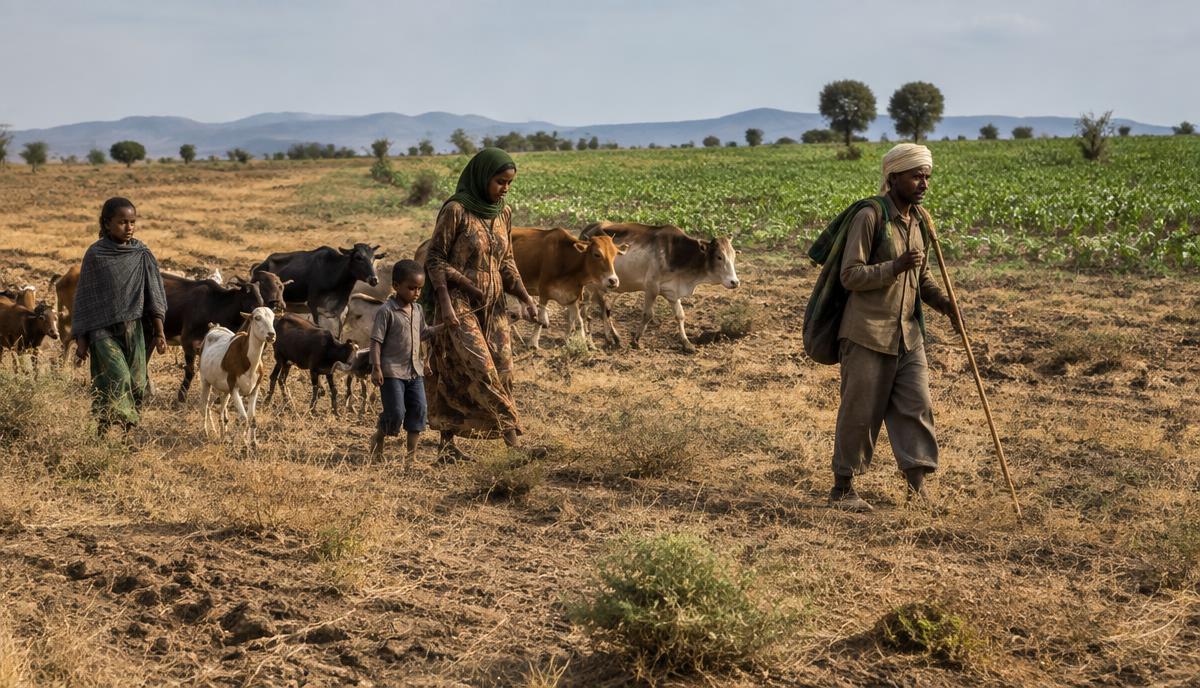
When Mongolia's prime minister, Nyam-Osoryn Uchral, opened the UN desertification conference in Ulaanbaatar on 17 August, he put the figure for his own country at 77 percent: that share of Mongolian land is affected by degradation and desertification. Mongolia is a nation of herders, and its grass is its food system. Livestock, dairy and meat are what the steppe produces, and when the steppe thins, the protein supply thins with it. The country that hosted the seventeenth session of the UN Convention to Combat Desertification (UNCCD) is, in effect, a case study in why the convention is a food treaty that rarely gets read as one.
Up to 40 Percent of the World's Land Is Losing Its Productivity
The UNCCD's 2024 Data Dashboard, built on satellite and national reporting, states that up to 40 percent of the world's land is degraded, with more than 3 billion people affected. Roughly 1 million square kilometres of productive land degrades every year, and the UN counts the annual cost of degradation, desertification and drought at US\$878 billion. Droughts have grown more frequent and severe, up 29 percent since 2000 according to the UN.
The argument that follows from these numbers is about supply, not scenery. Degraded land grows less, holds less water and recovers more slowly from a bad season. The UNCCD's own modelling, published at COP16, warns that crop yields could fall by as much as 50 percent by 2050 if current trends hold, pushing food prices up by about 30 percent. Those are projections, and they sit at the pessimistic end, but the direction is consistent with the 2022 Global Land Outlook, which found that restoring degraded cropland could raise yields by 5 to 10 percent in developing countries. A system running short of productive land does not need a new shock to hurt people. It needs an ordinary dry year.
Why Land Policy Gets Filed Under Environment
The convention's institutional home explains part of the neglect. Agriculture ministries negotiate at the FAO and the World Trade Organization, environment ministries negotiate at the UNCCD, and the two seldom share a room. Yet the questions debated in Ulaanbaatar were agricultural at root: who may farm or graze which parcel, how a herd moves across a drought-struck district, what a government does before a rainy season fails rather than after.
Food security analysis tends to start with prices, trade flows and stocks. Land degradation works further upstream, on the capacity to produce at all, and its effects arrive through channels that look like something else. A failed harvest becomes a migration statistic. A grazing dispute becomes a conflict report. The UN's own framing at COP16 in Riyadh warned that worsening land conditions will raise migration and insecurity, which is a food story told from the far end.
What Ulaanbaatar Decided, and What It Left Open
The most important decision at COP17, which ran from 17 to 28 August, was a non-decision. Parties again failed to adopt any drought instrument. The final text, as recorded by the Earth Negotiations Bulletin, decides to continue discussions at COP18 "with a view to adopting a decision on the proactive management of drought," and makes drought a stand-alone agenda item at that session and every ordinary session after it. The split is the same one that sank the Riyadh talks in December 2024, between countries wanting a legally binding protocol and those preferring flexible, country-led approaches. Two sessions have now passed without a rulebook for the hazard that the Saudi deputy minister described in Ulaanbaatar as affecting about 1.8 billion people.
The rangeland and tenure decisions were more concrete. Parties formally recognised the Coalition of Rangeland States as a strategic partner, endorsed the Rangelands Flagship Initiative, and asked the Secretariat to explore an International Day of Rangelands and Pastoralists, in a year the UN General Assembly had already designated as the International Year of Rangelands and Pastoralists. A separate tenure decision encourages countries to build secure land rights into their plans for combating degradation and invites developed countries to back tenure administration systems aligned with the FAO's Voluntary Guidelines on Tenure. Neither text is binding, but both move pastoral and tenure questions from the margins into the convention's formal agenda.
Secure Tenure Is a Yield Policy
Tenure belongs in a food security argument because farmers and herders invest in land they expect to keep. A smallholder without secure rights has little reason to plant trees, build terraces or rest a pasture, since the return may go to someone else. The 2022 Global Land Outlook noted how unevenly land is held: about 1 percent of farms control more than 70 percent of agricultural land, while 80 percent of farms are smaller than two hectares.
The tenure decision at COP17 is modest in its wording, but its logic is sound. Restoration that ignores who holds the rights tends to be restoration that does not last. For pastoralists the issue is sharper, because their security depends on mobility across boundaries, and a fence or a land concession can end a grazing system that took generations to build. The convention's recognition of pastoralists as stewards of rangelands, and its attention to herder participation, treats that mobility as part of the productive system rather than an obstacle to it.
The Great Green Wall Shows Where Pledges Break
The clearest evidence that restoration pledges outrun delivery is the Great Green Wall across the Sahel. The initiative set a target of restoring 100 million hectares by 2030. The independent review commissioned for its Accelerator found about a fifth of that area, in the range of 18 to 20 million hectares, restored by 2020, along with more than 350,000 jobs created.
The money tells the sharper story. At the One Planet Summit in January 2021, donors pledged around US\$19 billion for 2021 to 2025. By September 2022 the review found about US\$2.5 billion disbursed, roughly 12 percent of the total. Its diagnosis was not that donors had defaulted but that the system was built to be slow: countries expected a dedicated fund, yet money moved through existing bilateral and multilateral channels; the split between loans and grants was never settled; and around ten donors kept separate financial and reporting systems. A restoration programme in a semi-arid region cannot wait on that sort of plumbing, because planting windows are measured in weeks.
Why Pledges Outrun Finance
The same gap shows up at global scale. The UN estimates that US\$2.6 trillion must be invested by 2030 to restore degraded land and build drought resilience, about US\$355 billion a year, against roughly US\$66 billion now flowing. That leaves an annual shortfall of US\$278 billion. Countries have pledged to restore about 1 billion hectares by 2030, while the degraded area is put at 1.5 to 2 billion hectares, and about 40 percent of countries have not fully reported on their progress.
The convention's own budget reflects the squeeze. COP17 adopted a zero nominal growth core budget of EUR 17,744,748 for 2027 to 2028, and its resource mobilisation decision noted a 27 percent decrease in pledges to the ninth replenishment of the Global Environment Facility. Land degradation neutrality, the target at the centre of the whole system, got no stand-alone decision this time and was handled inside the rangeland, tenure and finance texts.
Part of the reason finance lags is that restoration pays back slowly and diffusely. A watershed gets greener, a downstream farm gets water, a herder gets fodder in a dry spring, and none of these returns appears on a project balance sheet. Private capital looks for a revenue line, and land restoration rarely supplies one without a public partner.
The Money That Did Appear
COP17 did produce some financial machinery. The Rangelands Flagship Initiative reported US\$1.2 billion in mobilised finance across 45 projects, described by the UNCCD as the largest single mobilisation for rangelands in the convention's history, within a broader US\$1.3 billion portfolio of land restoration and drought resilience finance covering 23 countries. A Drought Resilience Investment Facility was launched, and the Riyadh Global Drought Resilience Partnership, announced in 2024 with more than US\$12 billion in pledges, was advanced as a vehicle for vulnerable countries. Brazil announced it would protect or restore 3.67 million square kilometres, about 43 percent of its territory, by 2030.
These sums matter, but set against a US\$278 billion annual gap they mark a start. The Nature Conservancy's closing statement put the shortfall plainly and said outcomes had failed to match the pace of environmental change.
The Cheapest Food Security Investment Available
The financial case is where the food argument is strongest. The UN's Riyadh report puts returns on restoration at about US\$8 for each dollar invested, while the Global Land Outlook gave a range of US\$7 to US\$30. A report released at COP17, Rangelands Rising, estimated that restoring rangelands typically returns US\$4 to US\$6 per dollar, rising to US\$36 once public benefits such as water supply are counted. The UNCCD also estimates that better land management on just a quarter of sub-Saharan Africa's prime cropland could yield an additional 22 million tonnes of food a year.
Few food security instruments offer comparable returns. Grain reserves, emergency food aid and import financing treat the symptoms of a failed harvest, and they must be paid for again every time drought returns. Restoration changes the underlying capacity of the land, so the benefit repeats each season without a new appropriation. The UN notes that the US\$355 billion annual requirement is about what the world wastes each year on environmentally harmful subsidies, which means the money exists and is simply spent on the opposite objective.
The practical test arrives at COP18, where drought returns as a standing agenda item. Ministers of agriculture, finance and food who have not attended these negotiations should be in the room, because the decisions taken there on tenure, drought financing and restoration targets will shape harvests in Mongolia, the Sahel and every dry region in between more than most trade agreements will.
**Sources:** UNCCD, "Land - the foundation of it all" (Data Dashboard factsheet); UNCCD, "New UN estimates show the world could save billions" (Financial Needs Assessment press release, December 2024); UN News, "Three billion people globally impacted by land degradation"; Earth Negotiations Bulletin (IISD), "Summary report 17-28 August 2026" (UNCCD COP17); Earth Negotiations Bulletin (IISD), "Summary report 2-13 December 2024" (UNCCD COP16); World Resources Institute, "Statement: Desertification COP Produces Mixed Results on Land and Drought"; The Nature Conservancy, "UNCCD COP17 Closing Statement"; Down To Earth, "UNCCD COP17 Opens in Ulaanbaatar: From Land Declarations to Finance and Real Action on Drought"; Down To Earth, "Combat desertification COP17: Rangelands finally get a seat at the table"; UNCCD, "Rangelands and pastoralists: News and stories"; UNCCD, "Independent Review of the Great Green Wall Accelerator: Final report"; UNCCD, "Chronic land degradation: UN offers stark warnings and practical remedies in Global Land Outlook 2"
The Food Observatory Brief
Weekly briefing on food systems, climate, agriculture and policy — straight to your inbox.
More on Policy
Governments Buy Billions of Meals a Year. Is That Food Policy?
Public procurement is a food policy lever most governments already hold and rarely use deliberately for health, local farmers or climate. This piece looks at Brazil, Copenhagen, US city programmes and India's public distribution system, and at the tender rules that decide what actually gets bought.
Front-of-Pack Labels Are Becoming a Trade Fight
Warning labels, traffic lights and Nutri-Score are spreading, and food exporters now challenge them in trade bodies. This piece argues that the label is the visible edge of a larger fight over whose evidence and whose interests decide diets, with a look at India's court-driven debate.
What the Next Decade of Food Systems Will Look Like
Closing the series, this piece synthesizes where climate pressure, market concentration, shifting diets, and new technology are jointly pushing global food systems over the next ten years. Drawing on institutional forecasts rather than speculation, it argues the defining feature of the next decade will be regional divergence, not a single global trajectory.