Front-of-Pack Labels Are Becoming a Trade Fight
Mexico told the WTO there would be no extra time for its warning labels, and exporters have contested them ever since
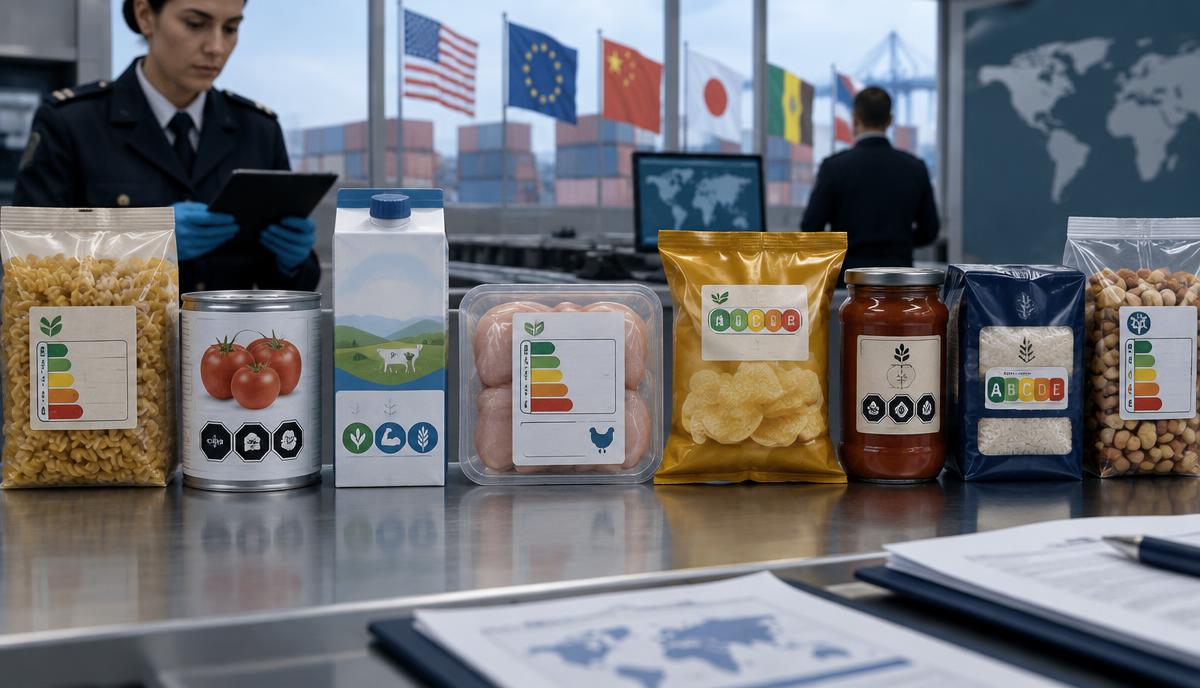
When the WTO's Technical Barriers to Trade committee met in May 2020, four members asked Mexico to wait. The United States and the European Union wanted a two-year delay to its new warning labels, Canada asked for twelve months, and Switzerland asked for more time without naming a figure. The American delegation argued that the labels might be "more trade restrictive than necessary to meet Mexico's legitimate health objectives" and pointed to the pandemic. Mexico's reply, relayed by a government official, was short: "We told them there would be no additional time." The labels took effect on 1 October as scheduled.
That exchange contains most of what is now at stake. A black octagon on a packet of biscuits is a health message to a shopper and a technical regulation to an exporter, and the two audiences want different things from the same square centimetre of packaging. The label has become the most visible edge of a larger dispute over whose evidence decides what a population eats.
A warning is a verdict, and exporters know it
Front-of-pack schemes fall into two families. Interpretive labels, such as Britain's traffic lights, Nutri-Score in Europe and the "Nutrition Info" box the US Food and Drug Administration proposed in January 2025, grade a product on a scale. Warning labels, used in Chile, Mexico and Colombia, say that a product is high in sugar, sodium, saturated fat or calories and say nothing about the rest. The difference matters commercially, because a warning attaches a verdict to a product whatever its neighbours on the shelf look like, which is why dairy, cured meat and confectionery exporters resist it hardest.
The trade argument rests on a single legal test. Under the WTO's Technical Barriers to Trade agreement, a measure should not be more trade restrictive than necessary to meet a legitimate objective, and the party applying it should be able to show why. That turns a question that sounds like nutrition science into a question about the burden of proof. Exporters ask the labelling country to demonstrate that the scheme works, that its thresholds are justified and that a gentler alternative would not do. Health ministries answer that the objective is legitimate and the evidence plentiful. Both sides are arguing about which evidence counts.
Chile and Mexico supply the evidence that exporters want to contest
The strongest data come from the countries that went furthest. Chile's labelling law, in force since 2016, was evaluated by researchers at the University of North Carolina using household purchase panels. Their early analysis found that purchases of sugary drinks fell by about 24 percent. A later study in PLOS Medicine, tracking 2,844 households from 2013 to 2019, found that after the second phase of the law, households were buying 20 percent less sugar, 14 percent less sodium, 10 percent less saturated fat and 8 percent fewer calories than the pre-policy trend predicted. A companion study of nearly 10,000 supermarket products found 94 percent compliance among those required to carry a warning.
In Mexico, a study published in 2026 in Social Science & Medicine, reported by the Global Food Research Program, found that purchases of total calories fell 15 percent, added sugars 25 percent, saturated fat 12 percent and sodium 7 percent across seven categories covering more than 90 percent of labelled products. The authors attribute the change to two mechanisms: shoppers buying fewer labelled products and manufacturers rewriting recipes to stay under the thresholds.
Reformulation is the quieter result and the more important one for trade. A label that changes what manufacturers put in the product alters what can be sold, and a threshold written in Santiago or Mexico City becomes a design specification for every firm that wants the market.
Europe's label war and the proposal that never arrived
The European Union shows what happens when the contest is fought over design rather than whether to label. France introduced Nutri-Score in 2017. Belgium, Germany, Luxembourg, the Netherlands and Spain have since adopted it, still on a voluntary basis. The Commission's 2020 Farm to Fork Strategy promised a harmonised, mandatory front-of-pack label, with a legislative proposal due by the end of 2022. It was never published. In March 2025, leaked documents reported by Radio France suggested the Commission would not copy any existing system, and an official at the daily briefing declined to say whether it backed Nutri-Score.
Italy has led the opposition, arguing that the algorithm penalises Italian products such as cured meats and cheeses, and backing NutrInform Battery, a scheme that shows nutrient content as a percentage of daily intake and awards no grade. The authors of a ten-year review in Nature Food, led by Chantal Julia and Serge Hercberg with colleagues in Essex and Liverpool, call the failure to legislate a policy failure and say that stakeholders with conflicts of interest "instrumentalized evidence" against the label.
Who pays for the studies
The most striking number in this debate concerns the research itself. One analysis of the literature on Nutri-Score found that a study was 21 times more likely to report unfavourable results if its authors declared a conflict of interest or it was funded by the food industry. The European Ombudsman has also documented transparency failures in how the Commission recorded its contacts with lobbyists, according to the FoodTimes analysis. Foodwatch, the campaign group, estimates that by 2010 industry had spent more than a billion euros promoting guideline daily amounts, a weaker alternative, after the European Parliament voted against mandatory traffic lights in 2010. The figure is the group's own estimate, but it fits the finding on funded studies.
None of this proves that every study sceptical of a label is compromised. It does show that the side with more money to commission research can keep a question open for years, and that a trade rule demanding proof before action rewards whoever can manufacture doubt.
The same argument at Codex and the WTO
This is an old fight conducted in new venues. A 2018 analysis in Health Promotion International by Anne Marie Thow and colleagues found five specific trade concerns about interpretive nutrition labelling raised at the TBT committee between 2007 and 2014, beginning with Thailand in 2007 and followed by Chile, Peru, Indonesia and Ecuador. Their conclusion was that nutrition labelling is a trade policy issue as much as a health one.
At Codex Alimentarius, the body that sets food standards for the WTO's purposes, front-of-pack guidance stalled in 2019, when the labelling committee met in Ottawa and could not agree. The United States, working with the International Dairy Federation, argued for revisions that tracked its own dietary guidelines. The dairy sector objected to criteria for "high in" claims, and Chile's black stop sign on cheese and butter was the example everyone had in mind. The committee deferred the work. Without a global reference, the TBT committee becomes the place where exporters test each country's label.
India's court is writing a label in public
India has now become the most instructive case, because its label is being shaped by a court. The Food Safety and Standards Authority of India proposed an Indian Nutrition Rating in 2022, a star scheme running from half a star to five. FSSAI's own expert committee later reported no stakeholder consensus on the star algorithm. In April 2025 the Supreme Court, hearing a petition brought by 3S and Our Health Society, gave the authority three months to produce a workable scheme. FSSAI later returned with a warning model: red hexagons marked "High Fat", "High Sugar" or "High Salt", first for products exceeding two nutrient thresholds and later for single exceedances, with exemptions proposed for single-ingredient foods such as ghee and honey.
At a hearing on 10 September, the bench of Justices J.B. Pardiwala and K. Vinod Chandran asked why a product high in only one nutrient should escape, since sugar, salt and saturated fat each cause harm independently. It asked whether red could be mistaken for India's non-vegetarian food mark, and whether manufacturers would swap one nutrient for additives to dodge a warning. It put thirteen questions to the authority and set the next hearing for 28 September. FSSAI's reported response drops the two-phase design in favour of a single rollout, with about four months to finalise the rules and a year for companies to adapt, on the grounds that packaging has been printed in bulk.
The court is asking the questions a trade tribunal would ask, about thresholds, design and unintended substitution. It is asking them on behalf of citizens rather than exporters, which is the point. India is a very large market for packaged snacks, noodles and beverages, and its thresholds will bind domestic and foreign firms alike. A label reached through public litigation, with the reasoning on the record, is easier to defend before the TBT committee than one issued by ministerial notice.
The American box and the British lights
The United States and the United Kingdom are the quieter participants. The FDA's proposed rule would require a box showing whether saturated fat, sodium and added sugars are low, medium or high, with large manufacturers complying three years after a final rule. The comment period was extended to July 2025, and as of mid-2026 no final rule had appeared. The country that argued in Geneva in 2020 that Mexico's thresholds were too stringent has so far not finished its own. Britain's traffic lights have been voluntary since 2013, and the consumer group Which? has called for them to be made mandatory.
The pattern across all of these is that the evidence on effectiveness has run ahead of the political decision. What is left is a contest over procedure: who sets thresholds, who funds the studies, and who must prove what. A label whose criteria are published, whose evaluation is run by researchers with no commercial stake and whose thresholds are revised on a fixed schedule is hard for an exporter to call arbitrary. Chile's published data gave Mexico something to point to when it refused to wait in 2020. India's court is demanding the same discipline in public, and the hearing on 28 September will show whether a major importing country can finish a label before the objections arrive.
**Sources:** PLOS Medicine, "Decreases in purchases of energy, sodium, sugar, and saturated fat 3 years after implementation of the Chilean food labeling and marketing law: An interrupted time series analysis"; PLOS Medicine, "An evaluation of Chile's Law of Food Labeling and Advertising on sugar-sweetened beverage purchases from 2015 to 2017: A before-and-after study"; Global Food Research Program (UNC), "Chileans bought less sugar, salt, saturated fat, and calories at the grocery store after trailblazing warning label law, with high compliance from the food industry"; Global Food Research Program (UNC), "Mexico's front-of-package warning labels are improving nutrition of food supply and purchases"; Yahoo News, "Mexico's new warning labels on junk food meet supersized opposition from U.S., EU"; Health Promotion International, "Nutrition labelling is a trade policy issue: lessons from an analysis of specific trade concerns at the World Trade Organization"; Nature Food, "Ten years of Nutri-Score front-of-pack nutrition labelling in Europe"; Foodwatch, "Nutri-Score in the EU: 18 years of food lobbying"; Food Manufacture, "EU Nutri-Score plans on the brink of collapse"; FoodTimes, "Nutri-Score's decade: evidence, blockades, and policy failure"; IDFA, "Codex Delays Problematic Work on Front-of-Package Labeling"; Bar and Bench, "Supreme Court flags gaps in FSSAI plan for red-hexagon warning labels on foods high in fat, sugar, salt"
The Food Observatory Brief
Weekly briefing on food systems, climate, agriculture and policy — straight to your inbox.
More on Policy
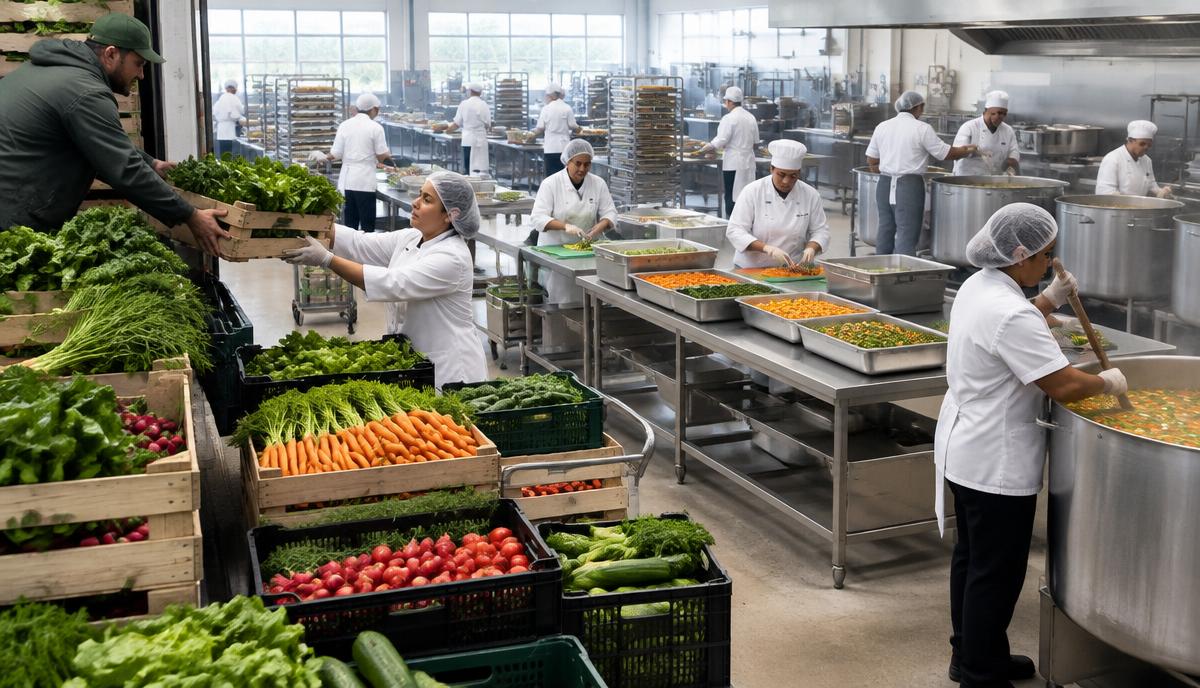
Governments Buy Billions of Meals a Year. Is That Food Policy?
Public procurement is a food policy lever most governments already hold and rarely use deliberately for health, local farmers or climate. This piece looks at Brazil, Copenhagen, US city programmes and India's public distribution system, and at the tender rules that decide what actually gets bought.
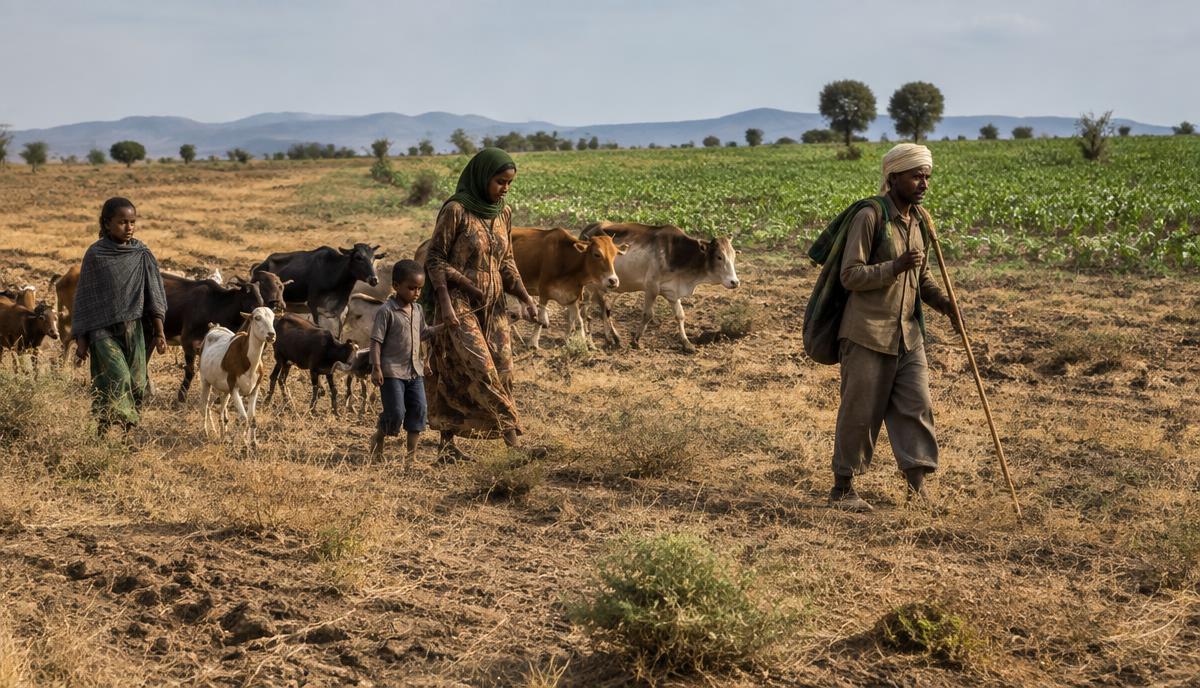
Desertification Is a Food Security Story
Land degradation affects up to 40 percent of the planet's land and drives yield loss, migration and conflict. This piece reads the outcomes of UNCCD COP17 in Ulaanbaatar as food policy, looks at where restoration pledges outrun finance, and argues that restoring land is the cheapest food security investment available.

What the Next Decade of Food Systems Will Look Like
Closing the series, this piece synthesizes where climate pressure, market concentration, shifting diets, and new technology are jointly pushing global food systems over the next ten years. Drawing on institutional forecasts rather than speculation, it argues the defining feature of the next decade will be regional divergence, not a single global trajectory.