What the Next Decade of Food Systems Will Look Like
Grounded in FAO, OECD, and World Bank forecasts, the coming decade looks less like collapse or abundance than managed divergence
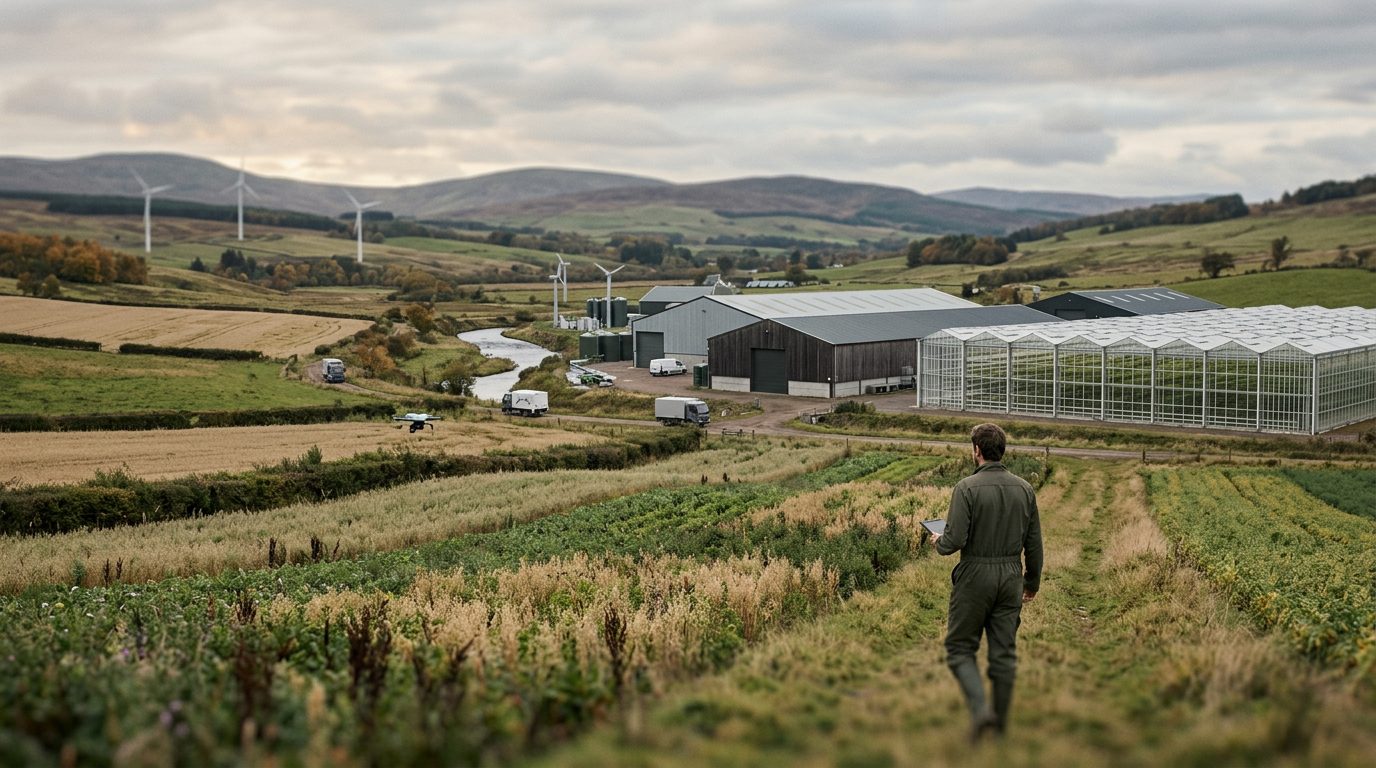
In April 2026, the price of cotton jumped 12 percent in a single month, not because of some sudden shock but because Australian, Turkish, and Brazilian production had quietly slipped enough that traders started pricing in scarcity. A few months earlier, the US wheat harvest had come in 21 percent below its recent run, even as Brazil brought in a record soybean crop of more than 432 million tonnes. Nobody planned this divergence. It is simply what happens when a warming, increasingly erratic climate rearranges which parts of the planet are good at growing what, while the rest of the food system, subsidies, corporate ownership, trade rules, diets, tries to catch up. That rearrangement, not any single crisis, is the defining story of food systems for the next ten years, and it is now well enough documented in institutional forecasts that it no longer needs speculation to describe.
The Production Map Is Being Redrawn, Not Just Stressed
The instinct is to talk about climate change and agriculture as a story of decline everywhere. The more accurate story, and the one embedded in the OECD-FAO Agricultural Outlook and FAO's own Food Outlook reporting, is regional reshuffling layered on top of continued aggregate growth. Global agricultural and fish production is still projected to expand by roughly 14 percent through the mid-2030s, driven overwhelmingly by productivity gains in middle-income countries rather than by expanding the traditional breadbaskets of North America and Europe. At the same time, the traditional breadbaskets are visibly losing ground in specific crops: US wheat production fell more than a fifth in the most recent season FAO tracked, North American coarse grains dropped as well, and cotton-growing regions in Australia, Turkey, and Brazil are seeing output declines tied directly to water stress and heat. Meanwhile Brazil keeps setting soybean records, and India and Southeast Asia are becoming the centers of demand growth that China occupied for the past generation, projected to account for 39 percent of global consumption growth by 2034, up from 32 percent historically, while China's share falls to just 13 percent. This is not a uniform crisis. It is a redistribution of agricultural viability, and the next decade will be spent figuring out who absorbs the losses and who captures the gains.
Prices Will Stay Higher and More Volatile Even as Headline Numbers Calm Down
FAO's Food Outlook found the global food import bill surged 7.9 percent to a record 2.22 trillion dollars in 2025, driven by coffee, cocoa, and animal products, the very foods most exposed to climate-sensitive growing regions. The World Bank's Commodity Markets Outlook for 2026 shows agricultural raw material prices holding broadly stable this year before easing about 3 percent in 2027 as supply normalizes, but that aggregate calm masks a widening gap between staple grains, where stockpiles are cushioning shocks, and specialty crops, where they are not. Research cited by the development group ODI found that climate-affected foods are rising in price roughly four times faster than unaffected ones, even while headline commodity indices look tame. The practical upshot for the next decade is a food system that looks statistically stable on average while specific categories, cocoa, coffee, olive oil, citrus, cotton, lurch through repeated regional supply shocks. Price stability at the index level should not be mistaken for resilience at the shelf level, and three billion people already cannot afford a healthy diet even in a period of comparatively moderate average prices.
Consolidation Keeps Winning, But Its Failure Points Are Becoming Visible
Every input a farmer touches is now controlled by a handful of firms. Four companies, Bayer, Corteva, Syngenta, and BASF, control half the global commercial seed market; the same four control 56 percent of pesticides; four equipment makers, led by Deere at 19 percent alone, control 44 percent of farm machinery sales. GRAIN's 2026 concentration update found that five of six major agricultural input sectors now meet textbook definitions of oligopoly. This concentration has not reversed and shows no sign of reversing over the next decade, because scale advantages in seed genetics, data platforms, and distribution networks compound rather than erode over time. What is changing is that this concentration is increasingly treated as a food security vulnerability rather than merely a competition issue: a genetics failure, cyberattack, or trade dispute affecting one of these firms now has systemic reach across dozens of countries at once. Alternative supply chains, regional seed cooperatives, direct-to-retail grain contracts, blockchain-traced smallholder networks, are growing in absolute terms but remain a rounding error against this concentration, and nothing in current investment flows suggests that changes by the mid-2030s. The realistic expectation is not that consolidation reverses, but that governments start treating a handful of agribusiness giants the way they treat systemically important banks.
The Subsidy and Trade Fight Is Shifting From Tariffs to Carbon Rules
For decades the agricultural trade fight ran through the WTO's stalled agriculture negotiations and old-fashioned tariff and subsidy disputes. That fight is being overtaken by a new one: carbon border policy. The European Union's Carbon Border Adjustment Mechanism became fully operational on January 1, 2026, and it is already functioning as a de facto agricultural trade barrier, because only one of seventy low- and lower-middle-income countries surveyed by ODI has any domestic carbon pricing system in place. Producers in poorer exporting nations, who did the least to cause the emissions the mechanism is designed to price, now face compliance costs their competitors in wealthier, carbon-priced markets do not. Layer onto this a domestic political shift in wealthy countries: in the United States, a defense budget exceeding a trillion dollars in 2026 is coming alongside roughly 23 percent cuts to non-defense spending, squeezing the nutrition and climate-adaptation programs that used to cushion farmers and consumers from volatility. The next decade of agricultural policy fights will be less about who gets to sell wheat where, and more about who gets punished for how that wheat was grown.
Diets in India, Southeast Asia, and Sub-Saharan Africa Will Set the Global Trajectory, Not the West
The nutrition transition long associated with China, rising incomes translating into rising meat and dairy consumption, is now shifting to a new set of countries, and the numbers are specific. The OECD-FAO Outlook projects that lower-middle-income countries will see per-capita animal-source calorie intake rise 24 percent by the mid-2030s, nearly four times the global average, pushing daily intake to 364 kilocalories. Low-income countries, concentrated in Sub-Saharan Africa, remain stuck at just 143 kilocalories, far below the 300-kilocalorie benchmark nutrition researchers associate with adequate micronutrient access. High-income countries are moving in the opposite direction, with FAO projecting declining consumption of fats and sweeteners as public health policy and shifting preferences take hold. The result is a global diet map bifurcating in real time: a widening nutritional gap between countries entering the meat-and-dairy phase of development and those still locked below basic adequacy, with almost no convergence between them projected over the coming decade.
Technology Will Help the Farms That Are Already Winning, and Do Little for the Rest
The most overstated claim in food systems commentary right now is that artificial intelligence and precision agriculture are about to transform smallholder farming broadly. The evidence points the opposite direction. Precision tools, satellite-guided variable-rate fertilizer application, AI-driven pest detection, automated irrigation, deliver real, measurable yield and input-efficiency gains, but overwhelmingly on the large, capitalized farms that can afford the sensors, connectivity, and machinery to use them. Smallholder farmers, who still produce a large share of the calories consumed in Africa and South Asia, lack the capital, land tenure security, and often the mobile data infrastructure to adopt the same tools at meaningful scale, and researchers tracking this gap describe a real risk that AI-enabled agriculture widens rather than narrows the productivity gap between commercial and subsistence farming. The realistic decade-ahead picture is not "AI transforms farming" but "AI further advantages farms that were already ahead," while the genuinely transformative technologies for smallholders, drought-tolerant seed varieties, basic soil-testing services, mobile-based market price information, remain unglamorous and comparatively underfunded.
A Food System Learning to Manage Divergence, Not Solve It
Put these forces together and the next decade of food systems does not resolve into either the collapse scenario or the abundance scenario that dominate public debate. It resolves into managed divergence: aggregate global food production keeps rising, aggregate calorie availability keeps improving, and institutions like FAO can keep pointing to historically large stockpiles as evidence the system is not breaking. But underneath that aggregate stability, production capacity keeps relocating away from historically dominant regions, price volatility concentrates in specific climate-exposed commodities rather than disappearing, ownership of the inputs that make farming possible keeps consolidating into fewer hands, and the benefits of new technology keep flowing disproportionately to farms that already had capital. None of this is speculative; it is the shape already visible in the projections institutions like the OECD, FAO, and World Bank have published for the years immediately ahead. The task for policymakers, investors, and consumers over the next decade is not to wait for these trends to average out into stability. It is to build the specific mechanisms, carbon-adjusted trade rules that do not punish poor exporters, antitrust scrutiny of agricultural input markets, financing that reaches smallholders rather than only commercial farms, that determine whether managed divergence ends in a food system that works for three billion more people or one that simply works better for the people it already serves.
Sources: OECD, "OECD-FAO Agricultural Outlook 2025-2034"; FAO Newsroom, "OECD-FAO Agricultural Outlook 2025-2034: Emerging economies will drive animal-source food consumption and production"; OECD, "OECD-FAO Agricultural Outlook 2026-2035"; FAO Newsroom, "FAO Food Outlook: Global food commodity market trends face rising geopolitical and weather risks"; World Bank, "Commodity Markets Outlook" (April 2026) and "Steady gains in agricultural raw material prices"; ODI, "Five forces reshaping food systems in 2026"; GRAIN, "Top 10 Agribusiness Giants: Corporate concentration in food & farming, 2026 Update"; Phys.org, "AI offers promise for agriculture, but smallholder farmers risk being left behind"; World Trade Organization, "Agriculture: Food Security" and WTO agricultural negotiations gateway
The Food Observatory Brief
Weekly briefing on food systems, climate, agriculture and policy — straight to your inbox.
More on Policy
Governments Buy Billions of Meals a Year. Is That Food Policy?
Public procurement is a food policy lever most governments already hold and rarely use deliberately for health, local farmers or climate. This piece looks at Brazil, Copenhagen, US city programmes and India's public distribution system, and at the tender rules that decide what actually gets bought.
Desertification Is a Food Security Story
Land degradation affects up to 40 percent of the planet's land and drives yield loss, migration and conflict. This piece reads the outcomes of UNCCD COP17 in Ulaanbaatar as food policy, looks at where restoration pledges outrun finance, and argues that restoring land is the cheapest food security investment available.
Front-of-Pack Labels Are Becoming a Trade Fight
Warning labels, traffic lights and Nutri-Score are spreading, and food exporters now challenge them in trade bodies. This piece argues that the label is the visible edge of a larger fight over whose evidence and whose interests decide diets, with a look at India's court-driven debate.