Food Inflation Is Becoming a Climate Indicator
Central banks now treat droughts, floods, and heatwaves as a direct driver of the price of groceries, not just background noise
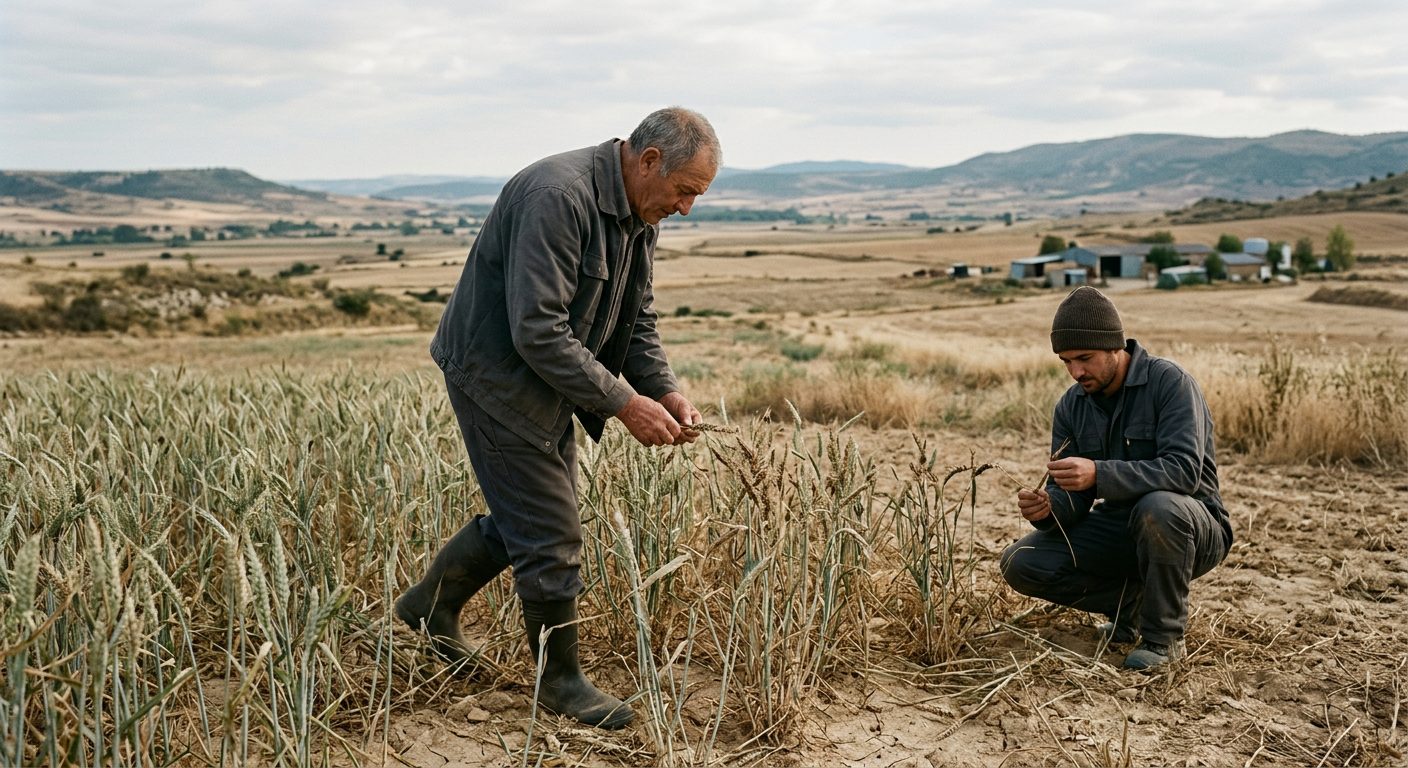
When Isabel Schnabel, a member of the European Central Bank's executive board, stood up in March 2022 and told an audience that the eurozone was entering an era of "climateflation," she was not being poetic. She was naming a mechanism her own institution's economists had started to see in the data: droughts, heatwaves and floods were no longer background noise in inflation models. They were becoming a direct, traceable input, on par with oil shocks and wage growth. Four years later, that mechanism has moved from a speculative line in a speech to a load-bearing part of how central banks explain the price of groceries.
This matters because food inflation used to be read as a monetary story, a story about interest rates, currency moves and fuel costs rippling through supply chains. Increasingly it is a climate story instead, one that can be dated to a specific heatwave in a specific growing region months before the receipts show up at the till. Economists have started treating the food component of the consumer price index the way seismologists treat aftershocks: a signal that something happened elsewhere in the system, measurable in basis points.
The ECB Put a Number on the 2022 Heatwave
The clearest evidence comes from the ECB itself. In research led by climate scientist Maximilian Kotz of the Potsdam Institute for Climate Impact Research, working jointly with ECB economists, researchers examined monthly price data across 121 countries back to 1996 and matched it against temperature and precipitation records. Their conclusion was blunt: the 2022 European heatwave alone added an estimated 0.67 percentage points to European food inflation and 0.78 points to eurozone inflation more broadly. Projecting forward, the same team estimated that climate change could add 1.5 to 1.8 percentage points to global food inflation annually by 2035, rising to as much as 4 percent by 2060, with the burden falling hardest on Africa and South America. Kotz has been careful to frame this as a floor rather than a ceiling, noting that the model captures only temperature and precipitation effects, not the compounding damage from flooding, pests or supply-chain disruption that typically rides alongside a heatwave.
The ECB has kept updating this arithmetic in real time rather than treating it as a one-off study. In an Economic Bulletin box published in 2026, the bank's staff estimated that the 2025 summer heatwave alone could add 0.4 to 0.7 percentage points to unprocessed food prices within a year, and flagged that "coffee, tea and cocoa" and "sugar, jam, honey, chocolate and confectionery" were responsible for more than half of the euro area's annual food inflation despite making up under a quarter of the food basket by weight. That is the tell: when a handful of climate-exposed categories consistently punch above their basket weight, the aggregate number stops behaving like ordinary inflation and starts behaving like a weather instrument.
Threadneedle Street Reaches the Same Conclusion
The Bank of England has arrived at a parallel finding through a different route. Researchers writing on the Bank's Bank Underground platform built a global weather-shock proxy from European Commission crop condition warnings, weighted by each country's share of global agricultural exports, and ran it through a Bayesian vector autoregression alongside oil and gas supply shocks covering two decades of data. Their result: a weather shock lifts UK food inflation by roughly 0.15 percentage points at its peak, arriving with a lag of about twelve months and persisting for two and a half years. In May 2025, they calculate, weather shocks alone were contributing 0.8 percentage points to a UK food inflation rate of 4.4 percent. The paper is explicit about the pathway, tracing Brazilian drought into coffee prices, West African rainfall and plant disease into cocoa, and dry weather in the UK and abroad into livestock feed costs that show up later as pricier beef and dairy.
Swati Dhingra, an external member of the Bank's Monetary Policy Committee, has made the same point in public remarks on the fragility of global food and energy supply chains under climate stress, arguing that weather has become a structural input to the inflation outlook rather than a transitory footnote. The Energy and Climate Intelligence Unit, a London-based research group, put a sharper edge on the same UK data: in August 2025, five climate-sensitive foods, butter, milk, beef and veal, chocolate and coffee, made up just 11 percent of the food basket by weight but rose in price four times faster than everything else, at 15.6 percent year on year versus 2.8 percent for the rest of the basket. Those five items alone contributed 0.21 percentage points of that month's 3.8 percent headline inflation rate. When a bank's own internal economics blog and an independent climate think tank converge on the same categories driving the same distortion, the case for treating food inflation as a climate readout gets hard to dismiss.
Olive Oil Became the Continent's Warning Light
If any single commodity has made climateflation visible to ordinary shoppers, it is olive oil. Spain produces roughly half the world's supply, and successive years of drought and extreme heat cut its harvest by half. The result was a wholesale price at origin that rose 112 percent year on year at the peak of the crisis, with Spanish retail prices climbing 52.5 percent annually, well above the EU average increase of 38.3 percent. Jesús Anchuelo of Spain's small farmers union described costs that were, in his words, historic, like nothing growers had faced before, with the oil eventually sold at prices that barely covered what it cost to produce. Jaime Lillo, deputy director of the International Olive Council, noted that Spanish prices, traditionally the cheapest in Europe because of the country's scale, had converged upward toward Italian, Greek and French levels as the drought erased Spain's usual production cushion. Because Spain exports around 70 percent of what it grows, domestic consumers found themselves bidding against international buyers for their own national staple, and olive oil became, briefly, the single most expensive ingredient in a tin of Spanish sardines.
The episode functioned as a case study for economists watching the broader pattern: a regional climate shock, concentrated in one growing area, propagating through a globally traded commodity into a measurable jump in a national inflation print. Prices have since eased from their 2024 peaks as rainfall returned to Andalusia, but the volatility itself, the whiplash between record scarcity and partial recovery, is now treated by analysts as the expected behavior of a climate-exposed crop rather than an anomaly.
Rice, Cocoa and Coffee Show the Pattern Is Global
Olive oil is a European story, but the underlying mechanism recurs wherever a food staple depends on a narrow band of predictable weather. Global rice markets absorbed a severe shock in 2023 when India, the world's largest exporter, banned shipments of non-basmati white rice after erratic monsoon patterns and an emerging El Niño threatened domestic output, a decision the International Food Policy Research Institute and other trackers linked directly to weather-driven yield anxiety rather than pure trade policy. Prices spiked to their highest levels in over a decade before easing only when India began relaxing restrictions roughly two years later, and the episode illustrated how a single exporting country's climate response can move a global benchmark price within weeks.
Cocoa and coffee have followed a similar arc and are now the textbook examples cited by both the ECB and the Bank of England: cocoa prices more than doubled between January 2024 and early 2025 as West African rainfall and disease battered Ivorian and Ghanaian harvests, while Brazilian drought did comparable damage to coffee supply. Those two commodities alone are now credited with driving more than half of the euro area's food inflation reading, despite representing a small slice of the average household's shopping basket. The commonality across olive oil, rice, cocoa and coffee is not the crop but the geography of vulnerability, production concentrated in a handful of climate-exposed regions, which turns a local heatwave or monsoon failure into a global price event with a predictable, and increasingly modeled, lag.
Central Banks Are Building Weather Into Their Forecasting Models
What separates this moment from earlier bouts of food-driven inflation is institutional intent. Central banks are not merely observing that weather correlates with prices; they are building weather variables directly into their forecasting infrastructure. The Bank of England's crop-condition proxy and the ECB's temperature-and-precipitation panel are early versions of what may become standard inputs alongside oil futures and wage settlements. Oxford Economics, in commentary on the eurozone's 2026 heatwave, projected food inflation could climb toward 3 percent in 2027, with weather effects alone contributing up to a full percentage point, a forecast built explicitly around this summer's temperature anomalies rather than any monetary variable. That a mainstream economics consultancy is now issuing food inflation forecasts keyed to a heatwave, months before the harvest is even in, is itself evidence of how thoroughly the climate lens has been absorbed into forecasting practice.
The practical upshot is that food inflation figures are becoming dual-purpose data. They still tell a household what a shopping basket costs. But read alongside crop-condition warnings and temperature anomalies, they also tell economists, and increasingly the public, where the climate system is currently under the most stress. A spike in olive oil is Andalusian drought made legible in euros per liter; a jump in cocoa is West African rainfall failure made legible in the price of a chocolate bar. As these episodes recur with shorter intervals between them, the distinction between a food price chart and a climate stress indicator is likely to keep narrowing, until checking the grocery bill and checking the weather map become, for economists, close to the same exercise.
Sources: European Central Bank, "Inside the food basket: what is behind recent food inflation?" Economic Bulletin, 2026; European Central Bank, Isabel Schnabel speech, "A new age of energy inflation: climateflation, fossilflation and greenflation," March 2022; Bank of England, Bank Underground, "Has UK food inflation been under the weather?" August 2026; Bank of England, Swati Dhingra speech, "Running on empty: Climate risks and the fragility of global energy and food supply chains," June 2026; Green Central Banking, "Climate change could increase food inflation globally, study finds," April 2024; Potsdam Institute for Climate Impact Research / ECB, Maximilian Kotz et al., climate-inflation study, 2024; Energy and Climate Intelligence Unit, "Foods hit by extreme weather rising in price four times faster than others," 2025; Euronews, "Why this summer's heatwaves could raise food prices next year," July 2026; Euronews, "Spain hit hard by rising price of olive oil as climate change takes its toll on production," October 2023; International Food Policy Research Institute, "India's export restrictions on rice continue to disrupt global markets, supplies, and prices"; Business Standard / Bloomberg, "India seen keeping rice export bans into 2024, holding up global prices," November 2023
The Food Observatory Brief
Weekly briefing on food systems, climate, agriculture and policy — straight to your inbox.
More on Climate
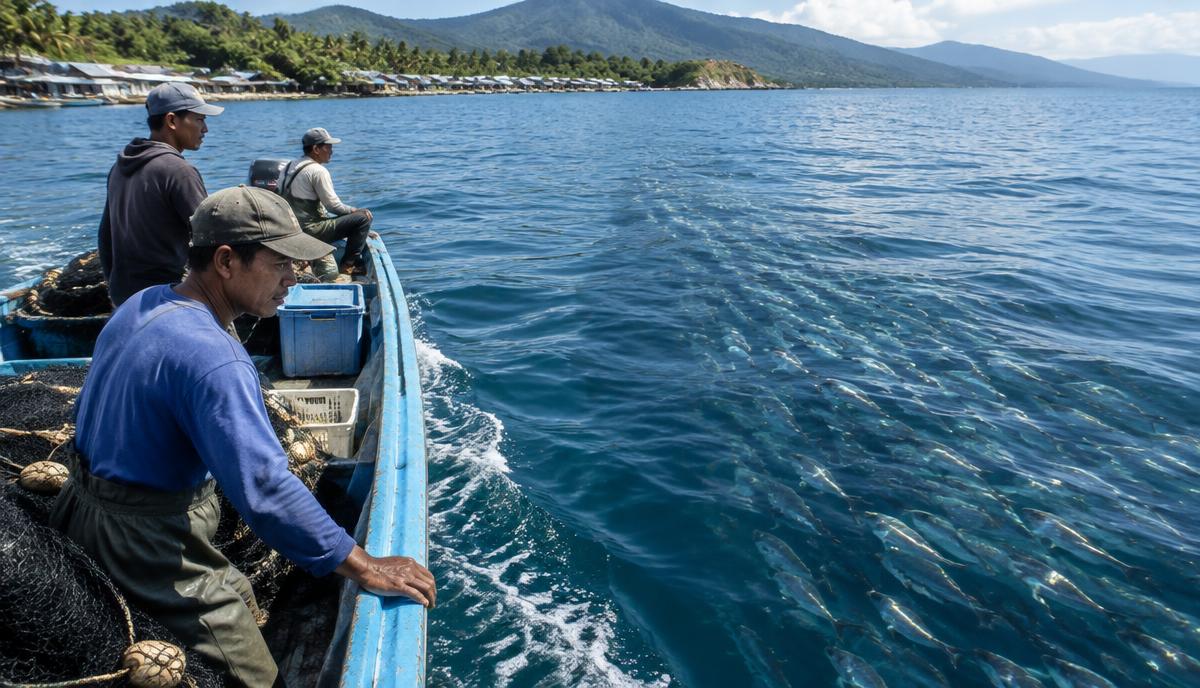
Warming Oceans Are Moving the World's Protein
Fish stocks are moving poleward and into deeper water as the oceans warm, while the countries that depend most on fish protein are often the least able to follow them. This piece argues that maritime boundaries, fisheries agreements and aquaculture investment have not caught up with moving fish.
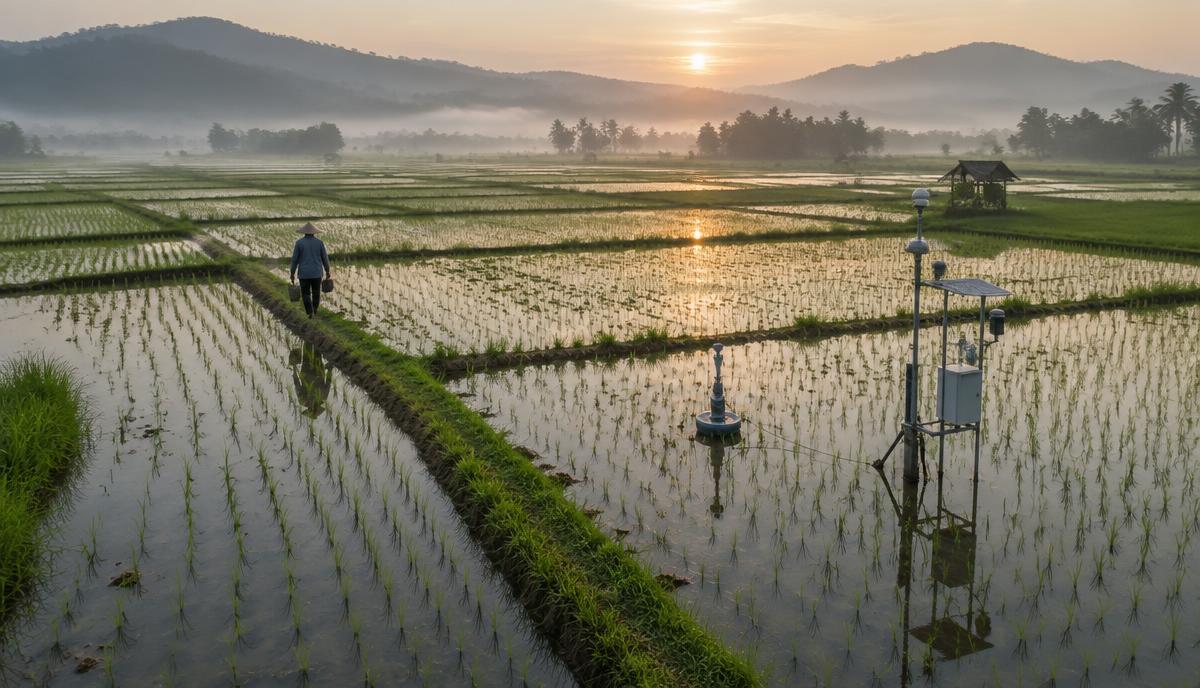
Rice Paddies and the Other Greenhouse Gas Problem
Flooded rice is a major source of human methane, and alternate wetting and drying or direct seeding can cut it while saving water. This piece uses the first payouts at Punjab Agricultural University to show why a known fix still struggles to scale, and what verification, contracts and policy would move adoption across South and Southeast Asia.