Why Food Systems Are Becoming a National Security Issue
In February 2026, America's agriculture and defense secretaries signed a joint memorandum treating farmland as critical infrastructure
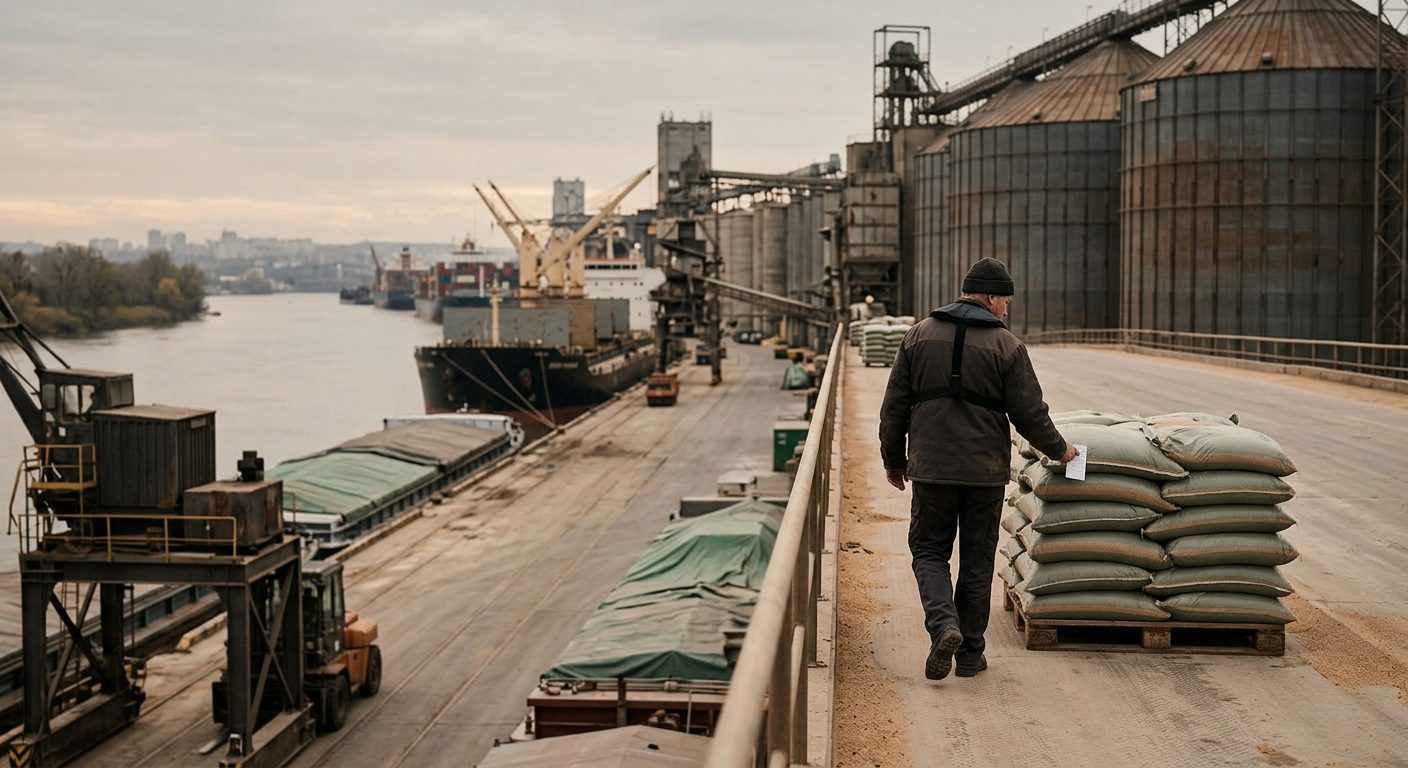
On February 11, 2026, the U.S. Secretary of Agriculture and the Secretary of War sat down together and signed a joint memorandum treating American farmland the way the Pentagon treats a shipping lane or a satellite constellation: as critical infrastructure that adversaries could target and that the state must defend. It was a small ceremony with an outsized implication. Feeding a country had quietly moved from the agriculture ministry's portfolio into the defense establishment's.
When the War Department Started Talking About Wheat
The February memorandum built on the National Farm Security Action Plan that USDA Secretary Brooke Rollins released in July 2025, a document built around the line that "agriculture is foundational to our nation" and structured, tellingly, in the language of a security strategy rather than a farm bill. One of its seven pillars calls explicitly for identifying "non-adversarial" trading partners for food inputs, a practice officials now describe as friend-shoring applied to fertilizer and grain rather than semiconductors. The plan also directs USDA researchers to work with the Defense Advanced Research Projects Agency on vulnerabilities in the food supply chain, the same agency that spent decades worrying about missile defense and cyberweapons. This is not agriculture policy dressed up in security language for funding purposes. It is the literal fusion of two bureaucracies that used to operate in separate universes, and it mirrors a broader shift captured in the 2026 National Defense Strategy, which puts homeland resilience, including food and agricultural systems, at the center of American defense planning for the first time in a generation.
Egypt's Nine-Month Countdown
The clearest illustration of why militaries now think this way sits in Cairo. When Russia invaded Ukraine in February 2022, Egypt imported roughly 85 percent of its wheat from the two combatants, and government spokesmen began publicly counting down how long the country's silos would last: five months of strategic storage plus about four months of expected domestic harvest, nine months in total before the world's largest wheat importer would run short. That is not an economic statistic. It is the kind of number a general tracks for munitions, and Egyptian officials scrambled to line up fourteen alternative suppliers, from Australia to Paraguay, fully aware that a bread shortage in a country of over 100 million people is the fastest route to the kind of unrest that toppled governments in 2011. Cairo's finance ministry was doing arithmetic that looked less like commodity trading and more like wartime logistics.
The Black Sea Corridor and the Weaponization of Wheat
The mechanism that made Egypt's countdown necessary was Russia's deliberate use of grain access as a lever of coercion. Moscow and Kyiv signed the UN-backed Black Sea Grain Initiative in July 2022 to reopen Ukrainian ports after a blockade that had stranded tens of millions of tons of grain destined for import-dependent nations across Africa and the Middle East. Russia withdrew from the arrangement a year later, in July 2023, and followed the withdrawal with strikes on Ukrainian port infrastructure and grain storage, effectively converting food logistics into a target set. Caitlin Welsh of the Center for Strategic and International Studies has documented how the Kremlin used the disruption to its advantage rather than merely as a byproduct of war, expanding Russian wheat exports to sub-Saharan Africa by 39 percent between 2022 and 2023 even as Ukraine's share of that same market collapsed from 11 percent to under 1 percent. Officials in Moscow have described food as a "silent weapon," and NATO's own parliamentary assembly took the unusual step in 2023 of publishing a report, "Food Security and Conflict," that catalogued the legal prohibitions on weaponizing food access and warned that the crisis Russia helped engineer was testing the resilience of the alliance's partners well beyond Ukraine's borders.
India's Ban and the Logic of Food Nationalism
Russia was not the only major exporter to treat grain as a strategic asset rather than a simple commodity during the shock. India, normally a marginal wheat exporter but the world's largest rice exporter, banned wheat shipments in May 2022 and then, in July 2023, banned exports of non-basmati white rice, a category that accounted for roughly a fifth of global rice trade. New Delhi framed both moves as domestic food security measures aimed at controlling inflation ahead of elections, but the effect on the international system was the same regardless of the stated motive: two of the world's largest food producers withdrew supply from the market simultaneously, and researchers tracking the response, including IFPRI's export restriction monitor, counted dozens of countries imposing similar curbs on grains, sugar, and fertilizer within months of the invasion. Each individual ban was a domestic political decision. Collectively, they demonstrated to every import-dependent government and every defense planner watching that food supply chains can seize up not from scarcity alone but from the accumulated caution of exporters protecting their own populations first.
Beijing's Silos and the Stockpiling Race
No country has drawn a starker connection between grain and state power than China, which the CSIS China Power Project estimates now holds roughly 69 percent of the world's corn reserves, 60 percent of its rice reserves, and 51 percent of its wheat reserves, figures that dwarf what any other nation keeps in storage. Beijing's State Council has designated food security a "ballast stone" of national security, and Xi Jinping has personally described it as a matter of both economic and political importance, language that in Chinese policy circles signals top-tier strategic priority rather than routine agricultural management. China accelerated its stockpiling further after pandemic-era disruptions, posting record soybean purchases in 2023 and locking in a deal with Russia for 70 million tons of grain over twelve years, a hedge against exactly the kind of maritime chokepoint disruption that a conflict over Taiwan could trigger. A pending Chinese Food Security Law is expected to formalize reserves, circulation, and emergency preparedness under an explicitly national-security framework, treating grain stores the way other states treat strategic petroleum reserves.
From Barrels to Bushels
That petroleum comparison is not incidental. For decades, energy security occupied its own category in defense planning, with dedicated reserves, chokepoint monitoring in places like the Strait of Hormuz, and NATO offices devoted to the topic. Food is now being folded into that same architecture. The Council on Strategic Risks, in its Feeding Resilience Plan and its follow-on "Stability Multipliers" report prepared for NATO audiences in January 2026, argues explicitly that food and climate stress function as threat multipliers in the same category the Pentagon has long used for energy shocks and cyberattacks, and it recommends commissioning a National Intelligence Estimate projecting food security trajectories a decade or more out, alongside a formal assessment of how food insecurity abroad affects U.S. military operations and basing. The Council notes that nearly 258 million people faced crisis-level food insecurity in 2022, a 250 percent increase since 2016, and that ten of the twelve countries with more than a million people in emergency-level hunger were also experiencing high or extreme conflict, a correlation strategic planners read as causal in both directions.
What the Intelligence Community Is Actually Watching For
The throughline across the U.S. National Intelligence Estimate process, NATO's parliamentary reporting, and China's own stockpiling doctrine is a shared judgment that food shocks translate into political shocks with a fairly short fuse. Analysts point back to the global food price spike of late 2010 and early 2011, which coincided almost exactly with the onset of the Arab Spring, and to the more than 12,500 protests recorded worldwide after the 2022 grain disruption, including unrest that helped topple Sri Lanka's government that same year. Security researchers studying Central America have also linked unusually dry growing seasons to measurable surges in migration toward the United States, a data point that has made its way into Homeland Security and State Department risk assessments precisely because it connects agronomy to border policy in a way officials can no longer treat as coincidental.
The Strategic Logic That Remains
What distinguishes this moment from earlier decades of concern about hunger is not that food insecurity is worse than before, though in absolute numbers it often is, but that the institutions built to fight wars and gather intelligence have concluded independently that grain silos, port infrastructure, and export policy belong on their own maps. Defense secretaries do not sign memoranda with agriculture secretaries, and intelligence agencies do not commission decade-long food forecasts, over problems they consider peripheral. Egypt's nine-month countdown, Russia's silent weapon, India's export bans, and China's mountain of reserves are four versions of the same discovery: whoever controls the wheat controls a lever that works faster, and sometimes more effectively, than a naval blockade.
Sources: CSIS, "Is Food Security National Security?"; CSIS, "China's Food Security: Key Challenges and Emerging Policy Responses"; Homeland Security Newswire, "A Turning Point: U.S. Recognizes Agriculture as a Domain of Defense"; USDA, "USDA and DoW Advance Key Parts of the National Farm Security Action Plan"; USDA, "Farm Security is National Security: The Trump Administration Takes Bold Action to Elevate American Agriculture in National Security"; The Council on Strategic Risks, "The Feeding Resilience Plan"; The Council on Strategic Risks, "Stability Multipliers: Food Security, Climate Change, and the Future of NATO Resilience"; NATO Parliamentary Assembly, "Food Security and Conflict" (2023 Committee Report, Dzerowicz); IFPRI, "From Bad to Worse: How Russia-Ukraine War-Related Export Restrictions Exacerbate Global Food Insecurity"; Middle East Eye, "Russia-Ukraine War: Egypt Has 'Nine Months Before Wheat Reserve Dries Up'"; CNN, "Concerns Mount Over Potential for Food Crisis Amid Russian Moves to Cripple Ukrainian Grain Exports"; World Grain, "India Pulls Wheat, Rice Off the Global Market"
The Food Observatory Brief
Weekly briefing on food systems, climate, agriculture and policy — straight to your inbox.
More on Policy
Governments Buy Billions of Meals a Year. Is That Food Policy?
Public procurement is a food policy lever most governments already hold and rarely use deliberately for health, local farmers or climate. This piece looks at Brazil, Copenhagen, US city programmes and India's public distribution system, and at the tender rules that decide what actually gets bought.
Desertification Is a Food Security Story
Land degradation affects up to 40 percent of the planet's land and drives yield loss, migration and conflict. This piece reads the outcomes of UNCCD COP17 in Ulaanbaatar as food policy, looks at where restoration pledges outrun finance, and argues that restoring land is the cheapest food security investment available.
Front-of-Pack Labels Are Becoming a Trade Fight
Warning labels, traffic lights and Nutri-Score are spreading, and food exporters now challenge them in trade bodies. This piece argues that the label is the visible edge of a larger fight over whose evidence and whose interests decide diets, with a look at India's court-driven debate.