Why Nutrition Is Becoming a Climate Issue
Climate change is no longer just a story about whether there will be enough calories, but whether diets stay nutritious
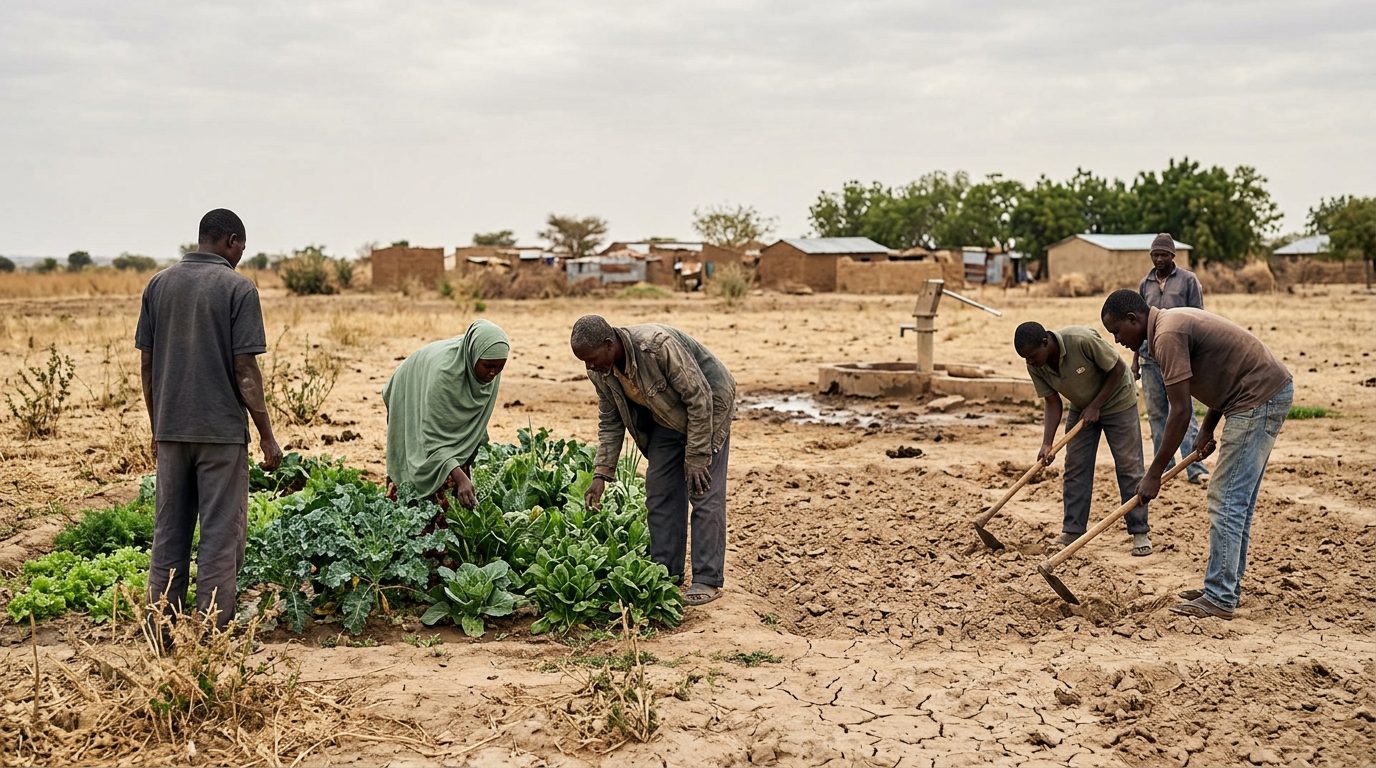
For most of the last two decades, the dominant story connecting climate change to hunger was a story about calories: would there be enough wheat, rice, and maize to go around as the planet warmed. That story is no longer the whole story, and arguably not even the most urgent one. A parallel crisis is unfolding in the food that fills the rest of the plate, the beans, greens, fish, milk, and eggs that keep bodies running on more than starch. The 2025 State of Food Security and Nutrition in the World report, produced jointly by FAO, WHO, UNICEF, WFP, and IFAD, found that roughly one-third of the global population, more than 2.5 billion people, cannot afford a healthy diet, and it named floods, droughts, cyclones, and erratic rainfall among the forces pushing nutrient-dense food further out of reach even where staple grain supplies look stable on paper.
That is the shift worth paying attention to. Climate change is not simply a threat to how much food the world grows. It is becoming a determinant of what kind of food people can get, and that distinction is where the real public health damage is concentrated.
The Calorie Trap: Why "Enough Food" Can Still Mean Bad Nutrition
Rice, wheat, and maize are relatively climate-resilient in the sense that they are traded globally, stored for months, and buffered by strategic reserves. Fruits, vegetables, and legumes are not. They are perishable, water-intensive, and often grown by smallholders on rain-fed plots with little insurance against a bad season. When a heat wave, flood, or drought hits a vegetable-growing region, the effect shows up almost immediately in local markets as a price spike, and price spikes hit these foods hardest because demand for them is elastic in a way demand for staple starches is not. Jessica Fanzo, a food systems researcher at Columbia University's Climate School, and her coauthors laid this out in a 2025 Annual Review of Nutrition paper, arguing that climate change works through "complex, multidirectional pathways through food, health, water, and social protection systems," and that its clearest nutritional signature is a decline in dietary diversity rather than a collapse in total caloric supply. Households facing a vegetable or legume price shock do not usually go hungry outright, they substitute down, eating more refined starch and less of everything that supplies iron, folate, vitamin A, and zinc. The SOFI 2025 report documented food price inflation exceeding 10 percent in 65 percent of low-income countries during the study period, volatility that falls disproportionately on the nutrient-dense, perishable end of the food basket. The result is a form of malnutrition that can coexist with technically adequate calorie intake, sometimes called hidden hunger, and it is exactly the outcome climate volatility is best suited to produce.
The Ocean's Pantry Is Shrinking Where It Is Needed Most
Fish is not a luxury food for roughly 3 billion people who rely on seafood for a meaningful share of their animal protein, and for many coastal and island communities it is the single largest local source of omega-3 fatty acids, vitamin B12, iodine, zinc, and calcium. That supply is now under direct assault from warming oceans, and the damage is landing unevenly by geography rather than by policy failure. A 2023 study in Nature Climate Change led by William Cheung and Muhammed Oyinlola at the University of British Columbia's Institute for the Oceans and Fisheries, with Christina Hicks of Lancaster University, modeled how warming and acidification are reshaping the nutrient content and abundance of wild-capture seafood. The findings were stark: under a high-emissions trajectory, low-income countries could lose roughly 30 percent of the nutrients, including calcium, omega-3s, and other micronutrients, currently available to them from seafood by 2100, compared with a projected 10 percent loss if the world holds warming within the Paris Agreement range. The researchers calculated that tropical, lower-income nations face nutrient declines of 10 to 12 percent per degree of warming, two to three times the global average rate, with countries including Indonesia, Sierra Leone, Nigeria, and the Solomon Islands among the most exposed. Calcium availability from seafood could fall by 15 to 40 percent and omega-3 availability by 5 to 25 percent under the most severe scenarios. "For many, seafood is an irreplaceable and affordable source of nutrients," the researchers noted, particularly where dairy and meat remain too expensive or culturally unavailable to substitute. A follow-up analysis focused on Southeast Asia and Pacific Island nations, published in Science of the Total Environment in 2024, reached a similar conclusion using regional fisheries data: the places most dependent on the ocean for micronutrients are also the places projected to lose the most nutritional value from it.
When the Cows Cannot Cope With the Heat
Livestock and dairy systems are running into their own thermal ceiling. Cattle, like humans, regulate body temperature through mechanisms that stop working efficiently past certain heat and humidity thresholds, and the physiological consequence is measurable: cows under heat stress eat less, produce less milk, and struggle to reproduce. A modeling study published in The Lancet Planetary Health projected that under a high-emissions scenario, heat stress could cost the global cattle sector nearly $40 billion annually by the end of the century, equivalent to almost 10 percent of 2005 production value, with milk losses reaching 4.7 percent of that value and beef losses exceeding 14 percent. The paper found the damage was not evenly distributed. Sub-Saharan Africa faces the steepest projected losses across every emissions scenario modeled, India's beef production could decline more than 45 percent, and Brazil's dairy sector could shrink by over 13 percent, even as demand for milk and meat in low- and middle-income countries continues climbing alongside population and income growth. That collision, rising demand meeting falling supply, is precisely the setup that turns a production problem into a nutrition problem, since milk and meat remain among the most concentrated dietary sources of bioavailable iron, zinc, vitamin B12, and high-quality protein for young children, whose growing bodies are least able to compensate for their absence during critical developmental windows.
The Hidden Hunger Inside Adequate Harvests
What ties the vegetable, fish, and dairy stories together is a phenomenon nutrition scientists increasingly describe as hidden hunger, malnutrition defined not by insufficient calories but by insufficient micronutrients. A scoping review on safeguarding diet quality under climate change, together with the broader body of work Fanzo and colleagues have assembled, converges on the same structural point: staple grain systems are buffered by global trade and storage in ways fruit, vegetable, legume, and fish systems are not, so climate shocks translate into diet quality damage well before they show up as headline food shortages. Research on child malnutrition across sub-Saharan Africa has linked drought exposure and abnormally high temperatures during pregnancy and early childhood to elevated rates of stunting and wasting, independent of whether food availability in the affected region technically met caloric requirements. This is the pattern epidemiologists worry about most, because hidden hunger does damage that does not announce itself in famine imagery. Iron deficiency impairs cognitive development, vitamin A deficiency weakens immune function and vision, zinc deficiency raises susceptibility to diarrheal disease, and these outcomes accumulate quietly in populations that, by conventional metrics tracking calorie sufficiency, appear to be doing fine.
Building Diets That Can Take a Hit
The policy response taking shape, unevenly but with real institutional weight behind it, goes by the term nutrition-sensitive climate adaptation, an approach that treats dietary quality as a design goal for agricultural resilience rather than an afterthought addressed once yields are secured. Biofortification is the most mature example. HarvestPlus and FAO have supported the development of more than 290 varieties of a dozen staple crops, biofortified with vitamin A, iron, or zinc and often bred simultaneously for drought tolerance, now released or under testing in 60 countries. More than 50 million people worldwide have adopted these crops, according to FAO, including roughly 30 percent of bean farmers in Rwanda who switched to high-iron varieties within four years of their introduction. Peer-reviewed trials have linked biofortified crop consumption to measurable reductions in anemia and childhood diarrhea and to improved cognitive performance, evidence that has helped biofortification move from a niche breeding program into a mainstream tool in national nutrition strategies. FAO officials involved in the work frame the ambition plainly: the goal is to move governments and donors "from feeding to nourishing" the populations most exposed to climate shocks.
Beyond biofortification, the same logic is showing up in diversified cropping systems that pair drought-tolerant staples like sorghum and millet, already a dietary staple for some 300 million people across Africa, with home garden programs designed to keep vegetable and legume production going even when field crops fail, and in efforts to build more resilient vegetable value chains through better cold storage, shorter supply routes, and irrigation investment aimed specifically at perishable, nutrient-dense crops rather than staple grains alone. None of these interventions are exotic. What is new is the recognition, formalized in FAO's guidance on designing nutrition-sensitive agriculture investments, that resilience planning has to be built around what people actually need to eat well, not just around what keeps aggregate calorie counts intact.
The Argument This Reframing Demands
Treating climate change purely as a threat to grain yields has allowed a subtler and arguably more consequential crisis to develop mostly out of view: the steady erosion of dietary diversity and micronutrient access across the populations least equipped to absorb the loss. Vegetable and legume price shocks, collapsing seafood nutrient yields, and heat-stressed dairy and cattle systems are not three unrelated stories, they are three expressions of the same underlying dynamic, in which the most nutritionally valuable parts of the food system tend to be the most climate-fragile parts of it. The institutions tracking this, FAO, WHO, and the Lancet among them, have made the data increasingly hard to ignore. What remains is the harder work of redirecting adaptation investment toward the foods that actually determine whether a diet nourishes a child's brain or merely fills a stomach, and doing it at the speed the warming itself is setting.
Sources: FAO, WHO, UNICEF, WFP, IFAD, "The State of Food Security and Nutrition in the World 2025"; Nature Climate Change, "Climate change exacerbates nutrient disparities from seafood" (Cheung, Oyinlola, Hicks et al., 2023); University of British Columbia Institute for the Oceans and Fisheries, "Low-income countries could lose 30% of nutrients like protein and omega-3 from seafood due to climate change"; Science of the Total Environment, "Climate change undermines seafood micronutrient supply from wild-capture fisheries in Southeast Asia and Pacific Island countries" (2024); The Lancet Planetary Health, "Impacts of heat stress on global cattle production during the 21st century: a modelling study"; Annual Review of Nutrition, "Climate Change, Extreme Weather Events, Food Security, and Nutrition: Evolving Relationships and Critical Challenges" (Fanzo et al., 2025); FAO, "Biofortification: Better crops, better nutrition"; HarvestPlus, "FAO Highlights Biofortification Among Nutrition-Sensitive Options for Agricultural Intervention"; FAO, "Designing nutrition-sensitive agriculture investments"; Council on Strategic Risks, "Review: Climate Security in the 2025 State of Food Security and Nutrition in the World Report"
The Food Observatory Brief
Weekly briefing on food systems, climate, agriculture and policy — straight to your inbox.
More on Health

School Meals Are the Most Underrated Food Policy
School meals reach hundreds of millions of children and work at once as nutrition policy, education policy, social protection and a guaranteed market for local farmers. This piece explains why they are the rare food policy where health, farmer income and equity point the same way, and which contract terms decide whether the benefits materialise.
Antimicrobial Resistance Starts on the Farm
A large share of the world's antibiotics goes to livestock and aquaculture, and resistance genes travel from farms to people through food, water and soil. This piece argues that drug resistance cannot be solved inside hospitals alone, and examines Europe's experience cutting farm use, the role of vaccines and husbandry, and the reality in places with almost no vets.
Ultra-Processed Foods and the Fight Over a Definition
Regulators, researchers and food companies are contesting what counts as ultra-processed food, because whatever the definition captures decides what gets labelled, taxed, restricted in school meals or marketed. This piece traces how the NOVA research category became a legal one, what the evidence on health outcomes does and does not show, and what a workable definition could look like.